




The Shifting Sands of AI Expansion: How Midterms Repriced Data Center Growth
The recent midterm elections delivered an unexpected message to the booming artificial intelligence industry: expand, but at a new price. In a striking turn of events, voters across numerous localities didn’t outright reject data centers but instead demanded a more equitable arrangement. Sensing this shift, AI powerhouse OpenAI swiftly moved to secure what it cannot simply build or buy: community consent, or what industry insiders call a “social license.”
OpenAI’s Proactive Pledge: A New Era of Community Compacts
Just days after election results signaled widespread voter skepticism towards unchecked data center proliferation, OpenAI unveiled its National Community Compact. This landmark document outlines a commitment to fully cover the electricity and grid infrastructure costs for its data center campuses. Crucially, it also pledges financial guarantees before significant spending commences, ensuring local utility customers are shielded from the financial fallout of delayed or canceled projects. While OpenAI states these commitments have been evolving for months, formalizing them in a public compact marks a significant pivot towards transparent, community-centric development.
A “social license” is the ongoing acceptance and approval of a company’s operations by the local community. It’s not granted by zoning boards or purchased with tax abatements; it’s earned by demonstrating that a project genuinely benefits the community, or at the very least, causes no harm. Without it, projects face permit delays, legal challenges, and local opposition. The midterms revealed just how thin this social license had become for the AI industry, prompting a fundamental re-evaluation of its growth strategy.
Voters Speak: Limits, Not Bans, on Data Centers
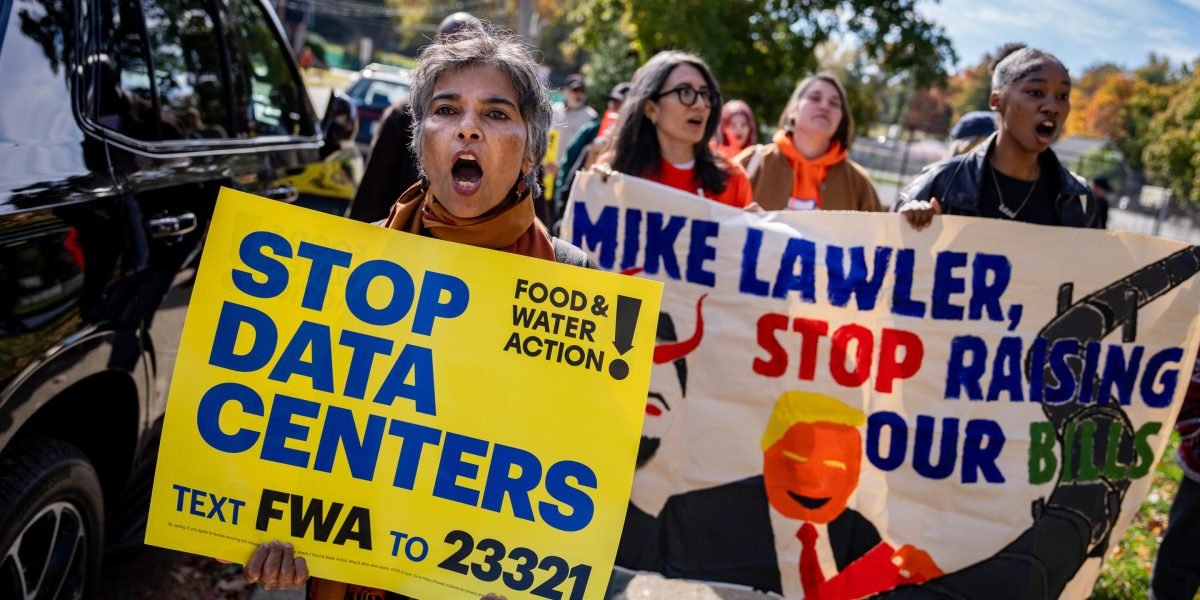
The ballot box proved to be a powerful arbiter in approximately 40 localities nationwide, with around 28 measures passing in 25 areas, all signaling opposition to the status quo of data center development. Ohio, already grappling with 125 data center moratoriums, was a focal point. Communities like Sunbury and Trenton overwhelmingly voted to ban large-scale data centers after proposals from tech giants like Amazon. In Hubbard, a similar ban passed, effectively halting a proposed 300-megawatt project.
However, the narrative wasn’t one of outright rejection. Instead, voters sought to impose limits. In Perry, Ohio, a staggering 87% of voters demanded financial guarantees and noise limits from hyperscale developers seeking tax breaks—precisely the safeguards OpenAI would offer days later. Grove City, while not enacting a ban, mandated a public vote for any project exceeding 50 acres, 20 megawatts, or 500,000 gallons of water daily. The message was clear: modest server farms might be welcome, but gigawatt-scale campuses require greater scrutiny and accountability. This sentiment transcended partisan lines, with figures like former Ohio gubernatorial candidate Vivek Ramaswamy and Texas Gov. Greg Abbott also advocating for pauses or stricter controls on data center expansion. The underlying grievance was consistent: rising electricity bills, with over 70% of polled Americans opposing nearby data centers primarily due to power price concerns.
From Tax Breaks to Training Programs: A New Deal for Communities
For decades, corporations have leveraged tax incentives to secure locations, often with questionable returns for local taxpayers. The infamous $33 billion spent on sports stadiums or Amazon’s HQ2 saga, where jurisdictions like Newark, NJ, offered a staggering $7 billion in tax breaks, exemplify this often-unbalanced exchange. Amazon, in that instance, skillfully played multiple cities against each other, ultimately choosing Queens despite a ‘lower’ $3 billion offer, highlighting the often-futile nature of such incentive wars.
The AI industry’s data center buildout initially followed this familiar playbook: tax revenue and construction jobs in exchange for generous tax breaks. But the recent elections unequivocally declared this offer insufficient. Hyperscalers are now being compelled to forge a new social contract. Microsoft, for example, launched its “Community-First AI Infrastructure” plan in January, committing to cover its own electricity costs, pay full local property taxes without seeking abatements, replenish more water than it consumes, and provide free AI training in local educational institutions. OpenAI quickly followed suit, promising tailored community plans for each of its Stargate campuses. This fall, a collective of tech giants—Google, Microsoft, Meta, Oracle, xAI, OpenAI, and Amazon—further solidified this shift by signing a non-binding White House pledge to build and operate AI infrastructure with a heightened focus on community benefits and environmental responsibility.
The era of unbridled, incentivized AI expansion is evolving. Communities are asserting their power, demanding that the benefits of technological advancement are shared, and the burdens are fairly managed. The AI industry is learning that true growth requires not just technological prowess, but also a robust social license.
For more details, visit our website.
Source: Link





Leave a comment