



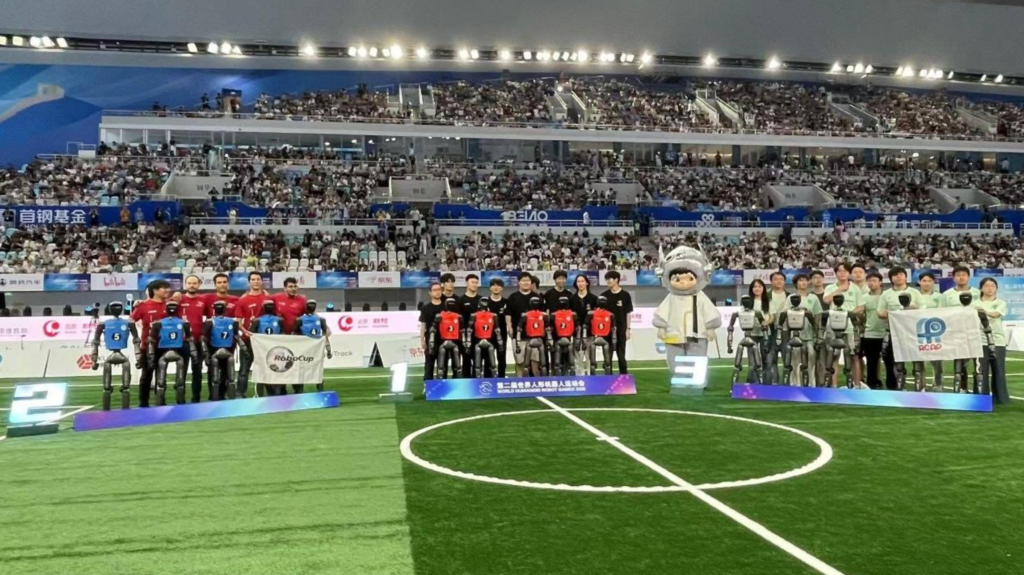

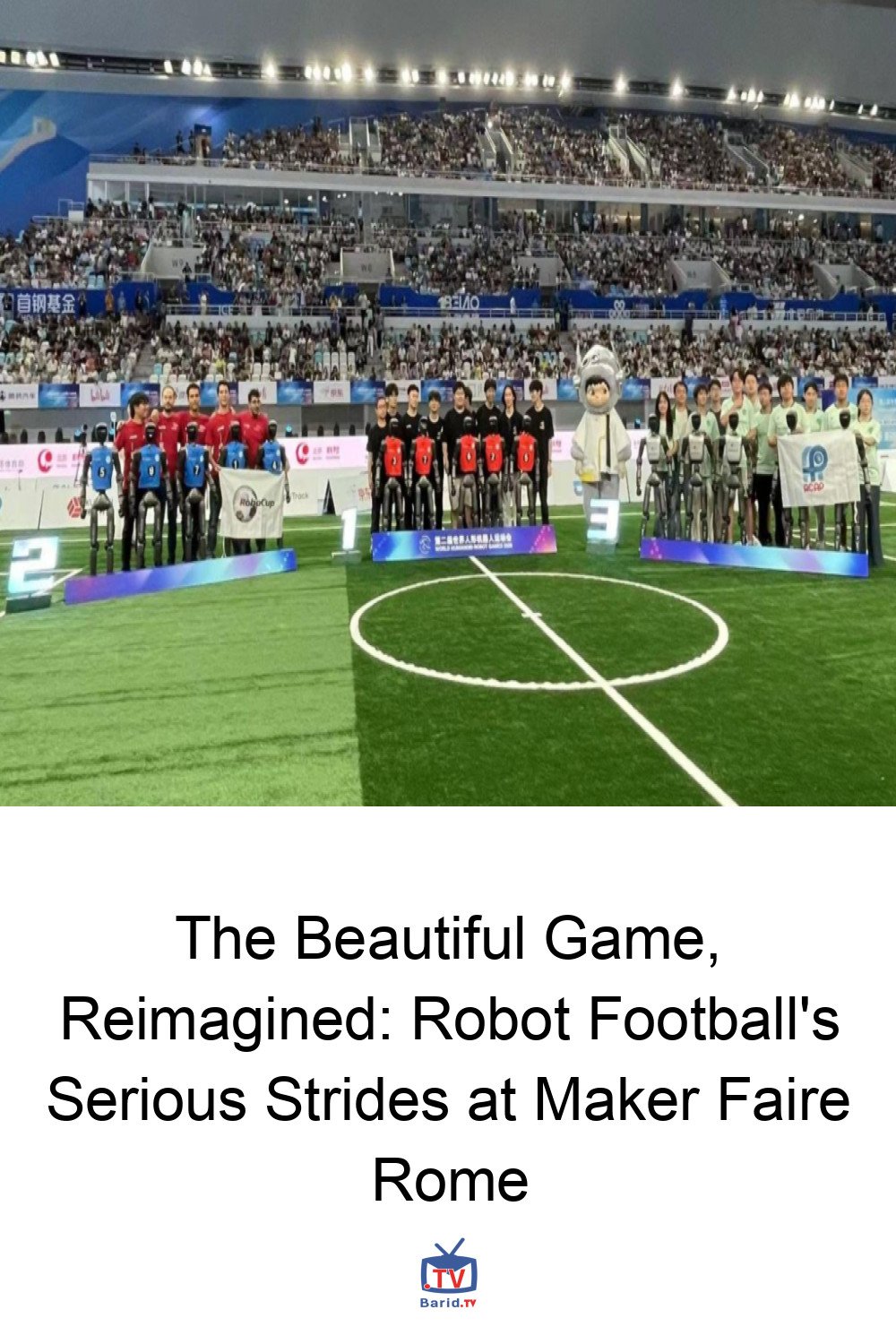
The roar of the crowd, the tension of a penalty kick, the intricate dance of strategy and skill – these are hallmarks of the beautiful game. But what if the players were not human, but highly advanced robots? This October, Maker Faire Rome is set to showcase the cutting edge of this fascinating field, bringing the complex challenges of robot football to a wider audience, hot on the heels of a historic milestone in humanoid robotics.
A Historic Match: The 11-a-Side Robot Debut
This past summer, the world witnessed a significant moment in the evolution of artificial intelligence and robotics. In Incheon, South Korea, twenty-two humanoid robots, operating entirely autonomously, stepped onto a football pitch for the first-ever 11-a-side match in RoboCup history. Teams B-Human from Bremen and HTWK Robots from Leipzig faced off in an exhibition game, a testament to decades of relentless engineering. While B-Human clinched a 4-0 victory, the real triumph was simply the ability to play such a complex game at all.
This achievement marks a monumental leap from RoboCup’s inaugural humanoid competition in 2002, where robots grappled with far simpler tasks. Twenty-four years later, the vision of fully autonomous robot footballers is steadily becoming a reality, showcasing an incredible journey of innovation and problem-solving.
Why Football? The Ultimate Robotics Challenge
RoboCup, established in 1997, set an audacious long-term goal: by mid-century, a team of autonomous humanoid robots should be capable of defeating the reigning human World Cup champions under FIFA rules. While this may sound like science fiction, football serves as an unparalleled proving ground for robotics. Unlike static environments, a football match is a dynamic chaos of constant motion:
- The ball is always moving.
- Opposing players are constantly repositioning.
- The robot itself must maintain balance on two legs while simultaneously processing its environment and strategizing its next move.
There are no pre-programmed sequences for success. A robot must dynamically locate the ball, understand its position relative to the pitch and other players, choose an action, execute movement without falling, and react instantaneously to unforeseen events. All these intricate systems—vision, locomotion, decision-making, and coordination—must work in perfect harmony.
The Interconnected Challenges
Improving one system often impacts another. Enhanced vision is useless if the robot lacks the agility to react. A perfectly trained kick is futile if the ball’s position is misjudged. Optimizing a walking system might inadvertently create new localization problems. Every component change necessitates rigorous testing and tuning, highlighting the delicate balance required in complex robotic systems.
The Maker’s Perspective: Beyond the Hardware
The 2026 RoboCup season introduced a pivotal change: the unification of the Standard Platform League and Humanoid League into the new Humanoid Soccer League. Teams like B-Human and HTWK Robots competed using the Booster Robotics’ K1 humanoid platform. This shift signifies that while the basic hardware might be standardized, the true innovation now lies in the software and intelligence that drives these machines.
Acquiring an off-the-shelf humanoid platform eliminates the monumental task of designing every joint, gearbox, and structural part. However, it doesn’t deliver a ready-made footballer. That transformation requires intensive software development, training, control algorithms, and countless hours of testing and tuning. It involves the painstaking process of discovering how behaviors that appear flawless in simulation behave drastically differently when confronted with the realities of motors, batteries, friction, and gravity.
B-Human’s victory in the RoboCup 2026 Middle Division, followed by their participation in the experimental 11-a-side match, underscores this point. The hardware provides the canvas; the software paints the masterpiece.
Beyond the Goal: What to Watch For
For those attending Maker Faire Rome, the real spectacle of robot football extends far beyond the scoreline. Pay close attention to the moments leading up to a kick:
- How does the robot locate the ball?
- How does it perceive its own body and feet in relation to the ball?
- What strategic angle does it choose for approach?
- How rapidly can it adapt its direction?
- What happens when another robot unexpectedly obstructs its path?
- And when, inevitably, a robot falls – how does it autonomously decide to recover and re-enter the game?
A single robot football match encapsulates a myriad of advanced problems: computer vision, localization, motion planning, bipedal locomotion, machine learning, and multi-agent coordination. It vividly demonstrates a fundamental truth for every hardware maker: the physical world has its own stubborn opinions. Unlike a perfect simulation, real robots contend with loose connectors, fading batteries, and unpredictable surface variations. This October, witness these challenges and triumphs firsthand at Maker Faire Rome, where the future of robotics plays out on the pitch.
For more details, visit our website.
Source: Link








Leave a comment