




Navigating the AI Frontier: Choosing Your Pentesting Champion Wisely
In the relentless world of cybersecurity, the adage “attackers move first” has never been more true. With exploitation often preceding the availability of a patch, and a significant percentage of vulnerabilities being targeted on or before their disclosure, the speed of defense must match the velocity of threat. Enter AI-powered penetration testing – a revolutionary approach poised to bridge this critical gap.
However, not all AI pentesting vendors are created equal. While a demo might paint a compelling picture, the true capabilities of an AI agent are revealed in the complex, real-world environment of your own web applications. This article provides a crucial checklist and scorecard to help you cut through the marketing hype and select a vendor that truly delivers on its promises.
The AI Arms Race: Why Speed and Intelligence Matter
The threat landscape is evolving at an unprecedented pace. Google‘s Threat Intelligence Group recently uncovered a zero-day exploit, a 2FA bypass rooted in a subtle logic flaw, believed to have been developed with AI. Such sophisticated attacks often elude traditional fuzzing and static analysis, highlighting the urgent need for more advanced defensive measures.
Agentic pentesting, leveraging AI to simulate attacker behavior, is emerging as a vital solution. A staggering 87% of US security leaders are already exploring, piloting, or actively using this technology. But with innovation comes complexity: selecting the right AI agent is paramount to realizing its full potential.
Beyond the Demo: Your Application is the Ultimate Test
Every AI pentesting demo can be impressive on a vendor’s carefully curated target. Yet, the real challenge lies in how these agents perform on your unique web applications. Consider these common pitfalls:
- An agent that identifies real flaws but stalls at your login page, failing to assess critical authenticated workflows.
- An agent that navigates your application but provides no clear metrics on its coverage, leaving you blind to potential gaps.
- An agent that exploits genuine issues but lacks robust guardrails, posing a risk to your production environment.
These crucial differences only surface when you put vendors to the test on your own infrastructure. A structured “bake-off” is not just recommended; it’s essential before committing to any solution.
The Power of Context: More Than Just a Smart Scanner
Before launching an attack, any effective tester – human or AI – must first understand the target. This reconnaissance phase is critical, often consuming a significant portion of a manual pentest’s time. AI agents vary dramatically in how they handle this:
- Some agents start from a blank URL with every run, rebuilding the application map from scratch.
- Others leverage an existing, continuously updated model of your site, providing a crucial head start and deeper understanding.
An AI agent without context is merely a sophisticated scanner. With context, it can reason about your application’s logic and interdependencies, uncovering vulnerabilities that might otherwise be missed. For instance, a security researcher’s AI assistant initially deemed an Apache Airflow search a dead end, but by analyzing how deployment parts trusted each other, an unauthenticated RCE (CVE-2026-68982) was discovered – a testament to contextual reasoning.
Proof, Not Suspicion: Demanding Validated Findings
A list of potential issues is not a validated pentest. You need concrete proof. Insist that your chosen AI agent:
- Actively exploits what it suspects (within safe, authorized parameters).
- Reproduces its findings reliably.
- Provides verifiable evidence for your team to confirm.
Consider the case of a major insurer whose production website was assessed by an AI pentesting agent. The agent discovered a logic flaw allowing one-time passcodes to be sent to any email address. It then proved the vulnerability by logging in with a code sent to its own inbox, with guardrails preventing further exploitation. This critical flaw had been missed by a previous manual pentest just six months prior, underscoring the value of AI-driven validation.
Your Essential AI Pentesting Vendor Checklist
To truly evaluate an AI pentesting vendor, move beyond superficial demos. Focus on these critical areas:
1. Deep Reach into Logged-In Workflows
Can the agent effectively navigate and test complex authenticated sections of your application? Many vulnerabilities reside behind login screens.
2. Validated Findings and Reproducible Evidence
Does the agent provide concrete proof of exploitation, not just suspicious patterns? Can your team easily verify its findings?
3. Robust Production Safety Guardrails
What hard limits and safety mechanisms are in place to prevent unintended consequences in your production environment?
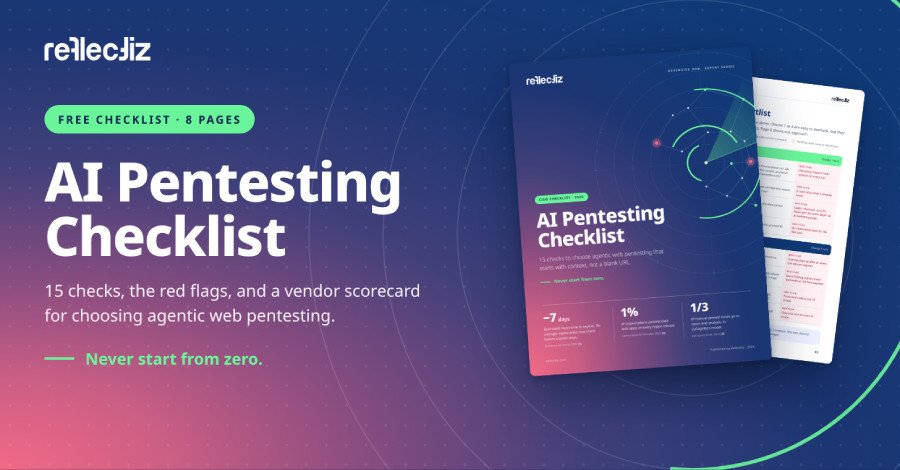
These are just three of the 15 crucial questions covered in our comprehensive checklist. The full guide delves into starting context, coverage proof, sophisticated attack chaining, access across various roles, secure data handling, and retesting capabilities.
The “Bake-Off” Advantage: A Real-World Evaluation
The most effective way to compare vendors is through a structured bake-off. Provide every vendor with the same:
- Target application.
- Test accounts.
- Defined scope.
- Evaluation week.
Track key timestamps: access granted, discovery complete, and first test initiated. Utilize a detailed scoring sheet that weights critical factors and prioritizes safety. The best AI pentesting agent isn’t the one with the flashiest demo; it’s the one that transparently shows what it tested, unequivocally proves what it found, and operates safely within your application environment.
Empower your security decisions. Download our free AI Pentesting Checklist and vendor scorecard today to make an informed choice that truly safeguards your web applications.
For more details, visit our website.
Source: Link







Leave a comment