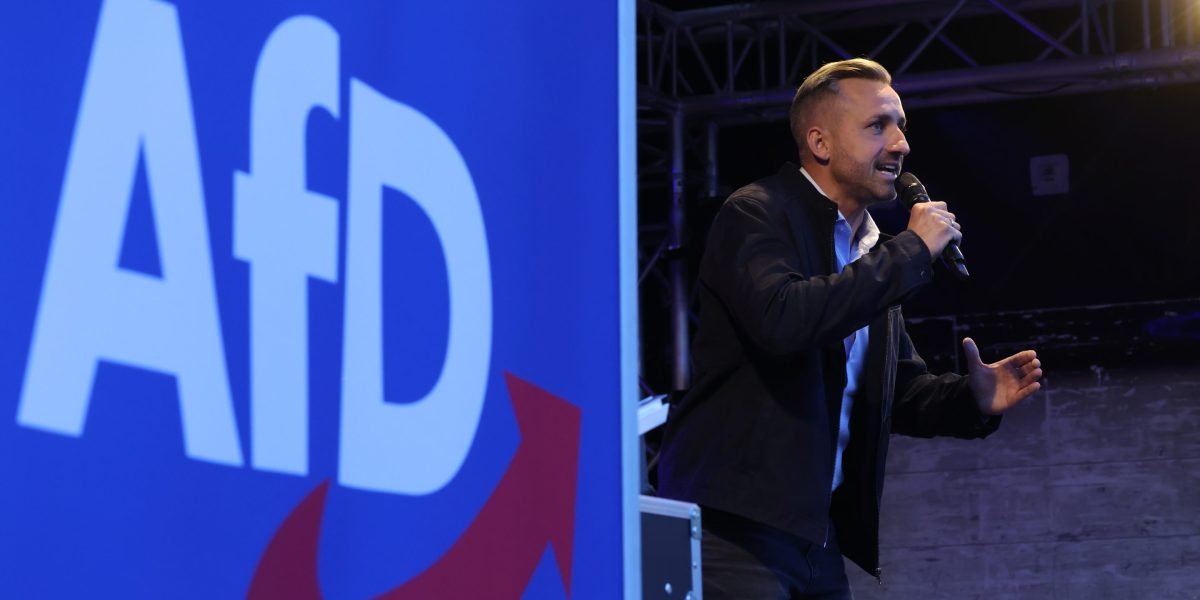

The political landscape of Germany is bracing for a seismic shift as the far-right Alternative for Germany (AfD) party secured a commanding victory in a recent regional election in Saxony-Anhalt. While the triumph marks a significant milestone, the path to forming the country’s first far-right state government since World War II remains fraught with challenges and political maneuvering.
AfD’s Resounding Victory in Saxony-Anhalt
Projections from public broadcasters ARD and ZDF, based on exit polls and initial counts, indicate the AfD garnered over 44% of the vote in the eastern state, more than doubling its performance from five years prior. This overwhelming support from the region’s 2.1 million residents west of Berlin positions the anti-migration and Russia-friendly party as the strongest political force in Saxony-Anhalt.
Ulrich Siegmund, 35, the AfD’s candidate for governor, declared that the party had “written history,” interpreting the voters’ decision as a clear signal that “things cannot carry on like this” and a direct message “toward Berlin.” Siegmund did not shy away from criticizing Chancellor Friedrich Merz, stating, “A very good campaigner for us in this election campaign was Friedrich Merz. Every day this man is in the chancellery is one too many.”
A Blow to the Mainstream and the “Firewall” Challenge
The AfD’s success comes as a severe setback for Chancellor Friedrich Merz and his center-right Christian Democratic Union (CDU), which has governed Saxony-Anhalt for an uninterrupted 24 years. The CDU saw its support plummet to an estimated 18%, losing approximately half its previous backing. Other mainstream parties, including The Left Party, the center-left Social Democrats, and the Greens, each hovered around 9%.
The AfD’s ambition was to secure an absolute majority to govern independently, thereby circumventing the “firewall”—a collective refusal by mainstream parties to cooperate with the AfD. While the party fell marginally short of an outright majority, its national co-leader, Alice Weidel, hailed the result as “sensational,” asserting a “very clear mandate to govern here” and extending an “outstretched hand to all who want to make Saxony-Anhalt better and move Germany forward.”
However, the CDU’s national general-secretary, Franziska Hoppermann, firmly reiterated the party’s stance against any collaboration. “AfD is a right-wing extremist party. It wants to leave the euro; that would be economic downfall… it works closely together with Russia, it wants a completely different social model,” she stated. “We will not work with them.”
The AfD’s Controversial Platform and Ideology
The AfD, the largest opposition party in Germany’s national parliament, finds its strongest support in the less prosperous, formerly communist eastern states like Saxony-Anhalt. Its regional branch in Saxony-Anhalt is notably classified as a “proven right-wing extremist group” by the domestic intelligence agency, citing concerns such as members’ denigration of migrants from Muslim countries. The party openly advocates for “remigration,” a politically charged term for the deportation of immigrants, and has faced legal challenges, with one leader appealing convictions for using a Nazi slogan. The AfD, however, dismisses accusations of extremism as politically motivated.
Governing Challenges and Future Prospects
Despite their electoral triumph, forming a government for the AfD in Saxony-Anhalt presents a complex puzzle. Incumbent governor Sven Schulze (CDU) acknowledged the AfD’s strength but offered no immediate path forward for his party. A previous instance in Thuringia saw the AfD win a state election but fail to form a government, with a minority CDU government eventually taking power.
Should the CDU attempt to forge an alliance with smaller parties to block the AfD, it would necessitate delicate negotiations, potentially requiring tacit support from the hard-left Left Party—a party with which the CDU traditionally refuses to form coalitions. Germany’s 16 states wield significant powers, particularly in security and education, making the control of Saxony-Anhalt a highly coveted prize.
Ulrich Siegmund has outlined his key priorities, which include a “deportation offensive,” eliminating incentives for immigrants to “exploit our social system,” and initiating a process to withdraw Saxony-Anhalt from the regional public broadcaster due to “disinformation” concerns. Additionally, the AfD in Saxony-Anhalt seeks to allow homeschooling, which is currently heavily restricted or not permitted in Germany.
Germany at a Crossroads
The Saxony-Anhalt election underscores a growing discontent with the national government’s performance, particularly regarding the country’s sluggish economy. The AfD’s surge reflects a broader trend of populist sentiment in Europe, yet Germany has historically resisted far-right leadership at national, state, or major-city levels. This election could be a harbinger of significant political realignments, testing the resilience of Germany’s democratic “firewall” and setting a precedent for future elections across the nation.
For more details, visit our website.
Source: Link