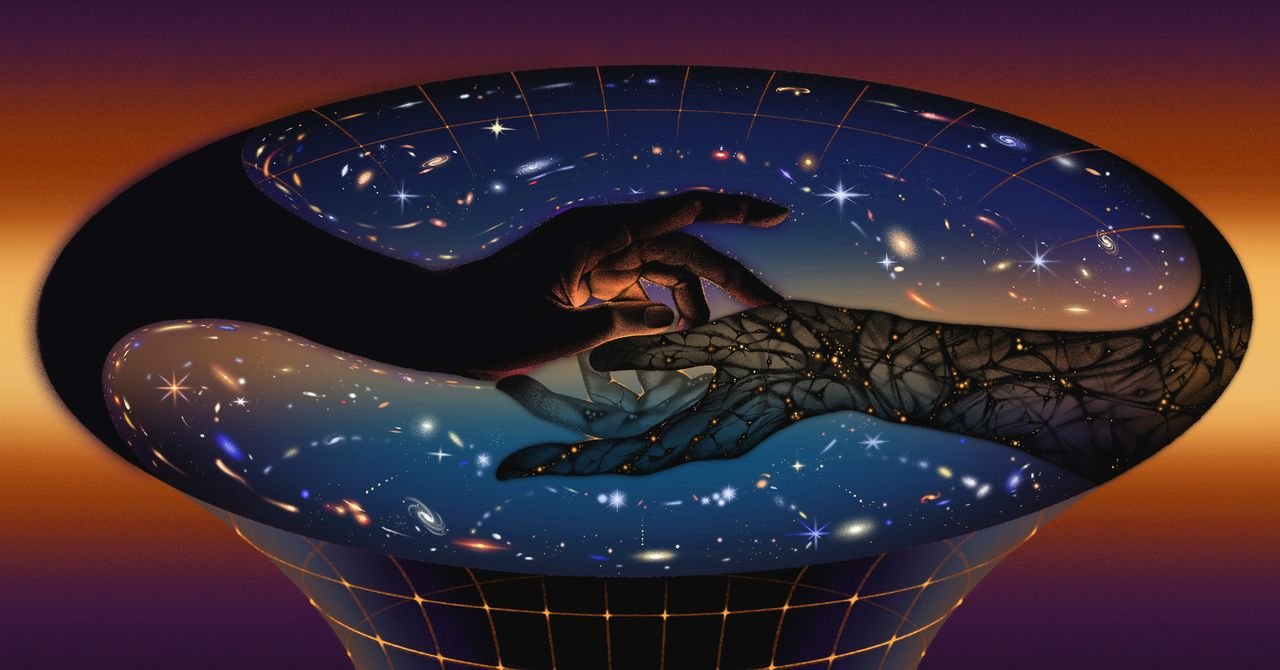

For eons, humanity has gazed at the cosmos, seeking understanding. Yet, the vast majority of our universe remains shrouded in mystery, dominated by two elusive entities: dark energy and dark matter. These invisible forces, making up an astonishing 95% of the cosmos, have long been treated as separate, distinct puzzles. Dark energy, an enigmatic force, accelerates the expansion of space, while dark matter provides the gravitational glue holding galaxies together. Neither emits, reflects, nor absorbs light, rendering them directly unobservable.
The Shifting Sands of Dark Energy
For decades, cosmologists largely assumed dark energy, often dubbed the ‘cosmological constant,’ remained unwavering. However, recent groundbreaking observations are challenging this fundamental assumption, hinting at a dynamic, evolving force.
The DESI Revelation
In 2024, the Dark Energy Spectroscopic Instrument (DESI) research team delivered a seismic shift in our understanding. Their findings suggested that the strength of dark energy might not be constant after all. This was further corroborated by a 2025 study, utilizing an even larger dataset, which definitively concluded that dark energy is changing over cosmic time.
These studies indicate a fascinating trajectory: dark energy appears to have reached a peak value approximately 2 billion years ago, subsequently beginning a period of weakening. Intriguingly, earlier cosmic eras suggest it may have grown stronger, a phenomenon that seemingly defies the conventional law of energy conservation.
Entering the ‘Phantom Regime’
Researchers describe this perplexing behavior as dark energy entering the ‘phantom regime.’ Imagine a ball effortlessly rolling uphill without any apparent external push – a scenario that seems impossible under normal gravitational laws. Similarly, dark energy’s fluctuating strength suggests it’s under the influence of something beyond our current understanding, prompting scientists to explore radical new theories.
A stunning 3D map of the universe, meticulously crafted by the DESI team, reveals intricate, connected strands of galaxies forming the cosmic web. This visual testament to the universe’s structure underscores the profound implications of these new dark energy findings.
A Unified Dark Universe?
A growing chorus of theoretical physicists is now exploring a provocative idea: what if dark energy’s mysterious fluctuations are intrinsically linked to dark matter? This challenges the long-held assumption that these two cosmic titans operate independently.
Early Seeds of Interaction
The concept of dark energy and dark matter interacting isn’t entirely new. As far back as 2005, physicist Justin Khoury and his collaborators at the University of Pennsylvania explored a hypothetical scenario where dark energy’s density could increase over time. Their research revealed that if dark energy and dark matter could influence each other, they could produce what *appeared* to be phantom behavior, even if it wasn’t truly phantom in the conventional sense. Khoury noted, “It is the most natural, simplest way of achieving this.”
New Models for a Coupled Cosmos
Two decades later, the DESI findings breathed new life into Khoury’s earlier work. This spurred him and his Pennsylvania colleagues, Meng-Xiang Lin and Mark Trodden, to develop a sophisticated model of ‘dark interactions.’ This model, drawing parallels from quantum chromodynamics, posits that both the energy density of dark energy and the mass of dark matter change in a synchronized dance.
Another compelling study, published in January in Physical Review D, proposes a similar interaction. Cosmologist Elsa Teixeira from the University of Montpellier in France, an author of the study, suggests that dark matter might have transferred a small portion of its energy to dark energy during an earlier cosmic epoch. Given that “Dark matter is the main brake on [the universe’s] expansion,” a reduction in this braking effect would naturally lead to an accelerated expansion of the universe.
Beyond Phantom Behavior: Addressing the Hubble Tension
The implications of a coupled dark sector extend beyond merely explaining the ‘phantom regime.’ Physicists like David Andriot of the French National Center for Scientific Research (CNRS) argue that what we perceive as phantom behavior might simply be a consequence of our current cosmological ‘bookkeeping.’ “Any change or evolution of the mass of dark matter has been put into the box of dark energy,” Andriot explained, highlighting the need for a unified approach.
Cumrun Vafa, a Harvard University physicist, echoes this sentiment, stating, “The notion that you can compute dark energy independently of dark matter is wrong.” He suggests that this very assumption, prevalent among many cosmologists and even the DESI team, may have inadvertently led to the interpretation of ‘physically unacceptable phantom behavior.’
Crucially, the idea of interacting dark forces offers a potential solution to another monumental challenge in cosmology: the Hubble tension. Teixeira and her colleagues’ research demonstrates that allowing dark energy and dark matter to interact can, in certain scenarios, help reconcile the discrepancies in the universe’s expansion rate as measured by different methods.
The Path Forward: Redefining Our Universe
The universe’s dark components are far from static, isolated mysteries. As new data emerges and theoretical models evolve, the scientific community is increasingly leaning towards a unified ‘dark universe’ where dark energy and dark matter are intricately linked. This paradigm shift promises not only to unravel the deepest cosmic enigmas but also to refine our fundamental understanding of the universe’s past, present, and future.
For more details, visit our website.
Source: Link