

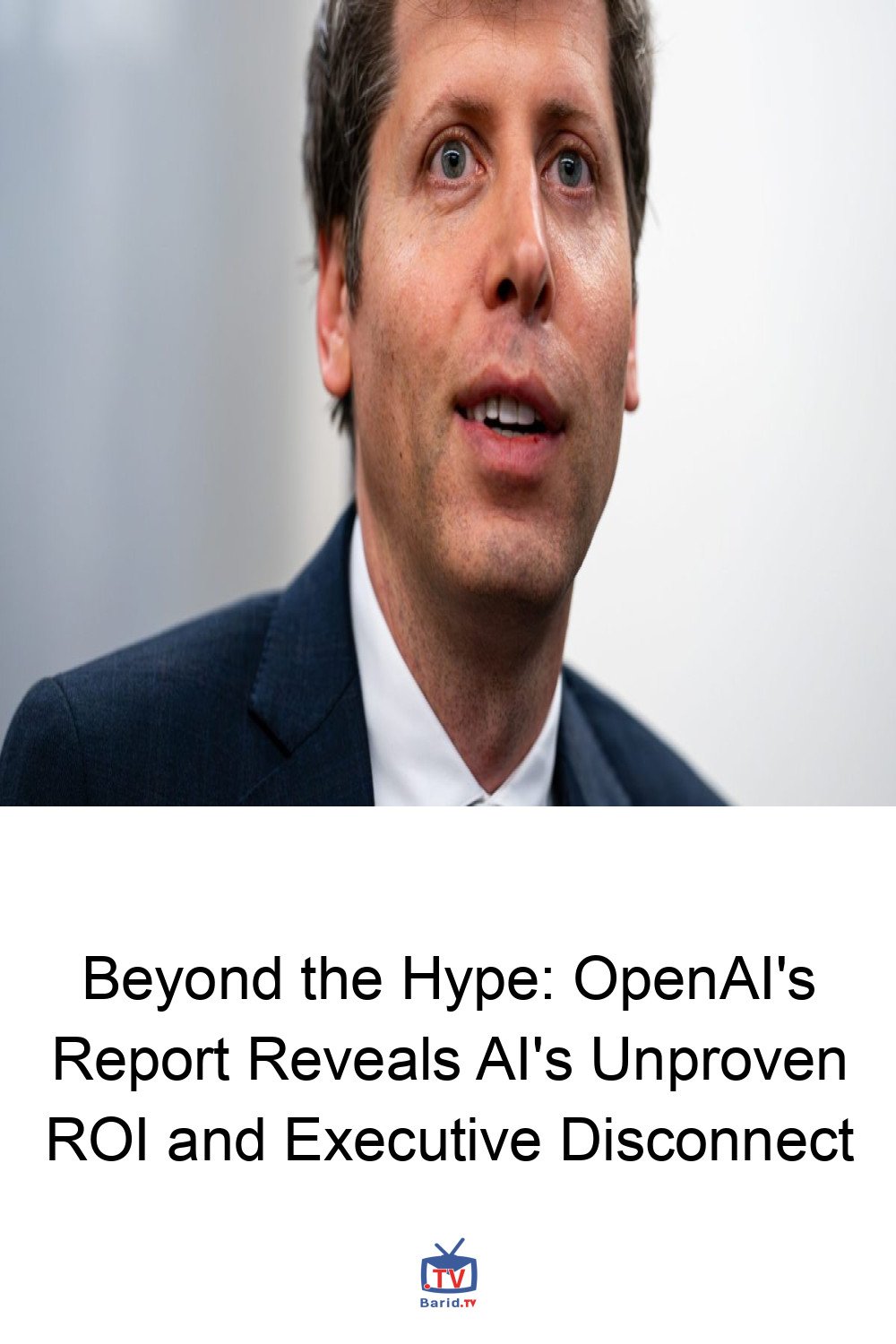
The artificial intelligence industry is awash with staggering sums of money, from former OpenAI employees cashing in $10 million in a single day to a three-year-old firm like Lovable doubling its valuation to $13.3 billion. Anthropic is even reportedly eyeing a monumental $2 trillion IPO. Yet, amidst this financial frenzy, a critical question looms large: What is the actual return on investment (ROI) for companies adopting AI?
OpenAI, the very vanguard of the AI revolution, attempts to tackle this existential query in its recent 69-page report on enterprise ChatGPT adoption. While the report initially paints a picture of explosive AI usage growth across all organizational levels and functions, touting a “frontier gap” where AI adopters supposedly pull ahead, a closer look at the fine print reveals a more nuanced, and perhaps inconvenient, truth.
The ROI Enigma: More AI, More Revenue? Not So Fast.
Deep within the report, on page 35, a small but significant table presents a finding that challenges the prevailing narrative: there is no statistically significant correlation between an employee’s AI usage (measured by messages sent and tokens used) and the company’s revenue per employee. The report explicitly states, “Revenue per employee is not meaningfully associated with output tokens per employee or messages per active user once other controls are included.”
Unpacking OpenAI’s Own Data
While the study notes that companies with higher existing revenue per employee tend to be early ChatGPT adopters, and that high-usage companies generally boast higher revenue per employee, it crucially fails to establish a causal link. In essence, the report suggests that already successful, lucrative companies are more likely to embrace AI, rather than AI being the direct driver of their increased profitability. The direct impact of increased AI usage on a company’s bottom line remains unproven by OpenAI’s own findings.
Leadership Lag: Executives on the Sidelines
Another striking revelation buried within the report is the surprising lack of AI engagement among senior leadership. Executives, arguably the very individuals responsible for strategic AI adoption and ROI measurement, are using the technology the least. It’s not merely a matter of fewer executives compared to general employees; a graph on page 29 highlights that most senior employees exhibit less intense usage, sending the fewest weekly messages per user.
A Disconnect from the Front Lines
In contrast, early career employees demonstrate the highest usage by a significant margin. OpenAI CFO Sarah Friar herself acknowledged this disparity in a LinkedIn post, emphasizing, “For leaders, that’s a reminder that competitive advantage comes from the people closest to the work. Listen to them, learn from them, and help the rest of the organization catch up.” This suggests a potential disconnect between leadership and the operational realities of AI integration.
OpenAI’s Enterprise Hurdles and Strategic Shifts
The report also inadvertently sheds light on a challenging period for OpenAI’s enterprise sales. From October to December 2025, the company’s overall usage within enterprises experienced a complete flatline, as depicted by a perfectly flat “total” growth line in a graph on page 26. This period coincided with Anthropic’s Claude Code gaining significant traction, reportedly becoming the preferred platform for many corporate entities.
A Q4 2025 Stumble
However, OpenAI managed a significant rebound, with usage thrusting upward into an exponential curve in January 2026. This growth is attributed to both acquiring new clients and deepening engagement with existing ones. CEO Sam Altman’s strategic reorganization, prioritizing enterprise sales and streamlining operations by discontinuing “side quests” like the Sora video app, likely played a pivotal role.
The CRO Shake-Up
In an aggressive move to sustain this momentum and accelerate customer adoption ahead of a potential IPO, OpenAI recently appointed Dali Rajic as its new Chief Revenue Officer, replacing Denise Dresser after less than a year in the role. Rajic’s mandate is clear: drive adoption and help businesses quantify AI’s impact, a direct response to the very ROI questions raised by the report.
Questioning Credibility: Paid Academics
Finally, a detail that warrants scrutiny is the involvement of paid academics in the report’s authorship. Two of the five authors, David Holtz (Columbia Business School) and Prasanna Tambe (Wharton at the University of Pennsylvania), are academics compensated by OpenAI. While including external academics typically lends credibility and implies impartiality, the financial arrangement with OpenAI introduces a potential conflict of interest, making the waters a little muddier regarding the report’s objectivity.
As the AI industry continues its meteoric rise, OpenAI’s own research offers a crucial reality check. While the potential of AI is undeniable, companies must look beyond the hype and critically assess the tangible returns. The journey to clear AI ROI is evidently more complex than simply adopting the technology; it requires strategic integration, engaged leadership, and a clear understanding of its true impact on productivity and profitability.
For more details, visit our website.
Source: Link