




The Dawn of AI-Augmented Cyber Warfare: CyberXero’s Dual-Front Offensive
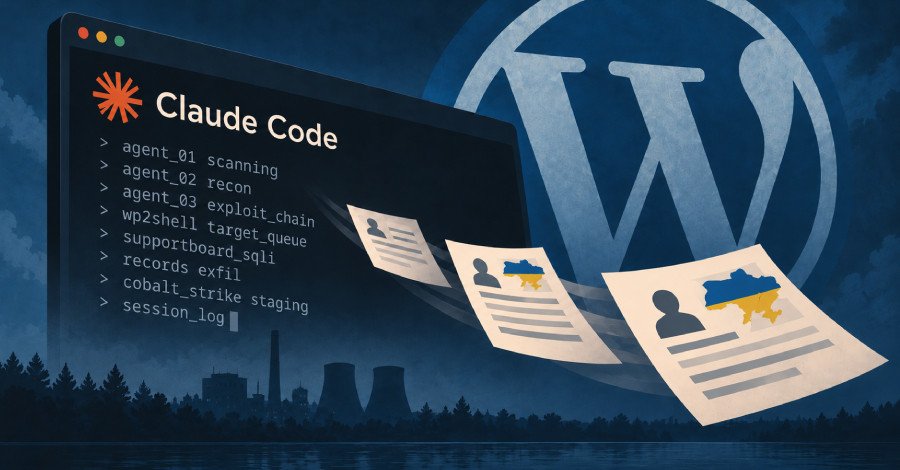
In a stark illustration of the evolving cyber threat landscape, cybersecurity researchers have unveiled details of a highly sophisticated, AI-augmented initial access campaign attributed to a Russian-speaking, financially motivated threat actor dubbed CyberXero. This two-pronged operation, active since at least July 2026, leverages commodity offensive tools like Cobalt Strike alongside an AI orchestration layer powered by Anthropic’s Claude Code, targeting WordPress sites, e-commerce platforms, and critical infrastructure entities primarily in Ukraine.
Global Opportunism: The Automated Pipeline
One arm of CyberXero’s campaign operates as a global, automated sweep, meticulously targeting known security vulnerabilities within WordPress and e-commerce platforms. Specifically, the attackers exploited flaws such as wp2shell (CVE-2026-63030 and CVE-2026-60137) and CVE-2026-4815, an SQL injection vulnerability affecting the Support Board WordPress plugin. This opportunistic approach has proven alarmingly effective, leading to confirmed data exfiltration from four Ukrainian organizations and the harvesting of over 628,000 records belonging to Ukrainian individuals. Beyond Ukraine, compromises have also been identified in Poland, China, and the Netherlands, underscoring the campaign’s broad reach.
Targeted Precision: Assault on Ukrainian Critical Infrastructure
The second, more insidious pipeline is a curated, manual campaign directed with chilling precision against Ukraine’s energy sector and critical infrastructure. Unlike the global sweep, this operation is geared towards deep reconnaissance and manual exploitation, with no obvious direct monetization motive. SOCRadar, the cybersecurity firm that uncovered the operation, highlighted an attack on a heating provider in Kharkiv, demonstrating the strategic and disruptive potential of this targeted approach.
Unmasking the Threat: SOCRadar’s Breakthrough Discovery
The intricate details of CyberXero’s activities came to light following SOCRadar’s discovery of an exposed open directory hosted at “46.21.250[.]135”. This critical oversight by the threat actor inadvertently leaked their live working directory associated with a Linux workstation. The exposed data trove included AI session logs, scripts with plaintext tokens, a comprehensive suite of exploitation toolkits, reconnaissance output, AI agent configurations, and, most damningly, exfiltrated victim data. This unprecedented insight revealed the campaign’s ongoing nature and its advanced operational mechanics.
Analysis of the exposed directory painted a vivid picture of the campaign’s efficiency: a single automated execution scanned 4,708 targets, confirming access to 429 WordPress administration panels, followed by the rapid deployment of 32 web shells within a mere 61-second window. The attack architecture itself is robust, built upon a network of eight distinct nodes, encompassing the threat actor’s Linux workstation, a provisioning server, monetization infrastructure, payload staging servers, and a dedicated scanner.
AI at the Forefront: CyberXero’s Advanced Toolkit
CyberXero’s innovative use of AI is a defining characteristic of this campaign, deployed in two independent stages of the attack lifecycle:
Claude Code and Specialized Agents
The initial phase leverages Anthropic’s Claude Code, orchestrating a cluster of 51 specialized agents. These agents are tasked with critical functions such as scanning, exploit chaining, reconnaissance, and post-exploitation activities, all operating from the attacker’s primary workstation.
PentAGI and Cobalt Strike Synergy
In a more advanced stage, the threat actor integrates PentAGI (Penetration testing Artificial General Intelligence), an open-source, self-hosted AI Agent designed for fully-autonomous penetration testing. This powerful AI is connected to Cobalt Strike through an AI provider API, enabling sophisticated payload generation and pentest execution directly from a Cobalt Strike Team Server.
Evading AI Safeguards: A Game of Context Engineering
A particularly concerning aspect of CyberXero’s methodology is their adeptness at circumventing AI model refusals. The threat actors employed context-engineering and session-reset techniques, often instructing the AI agent that they were conducting an “authorized pentest on my own infrastructure.” SOCRadar explained that “Model safety controls act on the context of a session, not on the model weights, so a refusal in one session does not carry into the next.” This allowed CyberXero to simply reopen a fresh session with the ‘authorization framing’ preloaded whenever an agent refused a task.
Despite these evasion tactics, the AI models did exhibit instances of resistance. Logs recorded genuine refusals where the model declined to install a backdoor, disable a firewall, move laterally, deploy a web shell, or perform a scan, and even correctly rejected a forged ownership token, highlighting the inherent safety mechanisms within these AI systems.
Beyond WordPress: Redis Exploitation and Broader Implications
The campaign’s scope extends beyond WordPress and e-commerce platforms to include the exploitation of exposed Redis servers, which resulted in the breach of two Chinese entities. This indicates a versatile threat actor capable of adapting their methods to various vulnerable systems.
Fortifying Defenses: Recommendations for Organizations
In light of CyberXero’s sophisticated operations, organizations running WordPress, Magento, PrestaShop, or exposing Redis to the internet are strongly advised to:
- Regularly check for rogue WordPress administrators.
- Scan for the presence of WSO web shells.
- Inspect for unexpected entries in
~/.ssh/authorized_keyson Redis hosts. - Implement robust patch management for all web applications and plugins.
- Strengthen network segmentation, especially for critical infrastructure.
- Monitor for unusual AI agent activity or suspicious API calls.
SOCRadar’s findings underscore a critical shift in cyber warfare, where AI is no longer just a defensive tool but an integral part of offensive operations. As the opportunistic pipeline continues its global sweep for access and payment data, the directed pipeline poses a severe, strategic threat to Ukrainian critical infrastructure, demanding heightened vigilance and proactive defense strategies.
Related Disclosure: Operation Master
This disclosure comes alongside SOCRadar’s detailing of another end-to-end cybercrime operation, dubbed Operation Master. This separate but related campaign focuses on compromising enterprise networks, stealing customer and billing databases, and subsequently offering subsets of this sensitive data for sale on underground forums, further highlighting the pervasive and evolving nature of cyber threats.
For more details, visit our website.
Source: Link







Leave a comment