



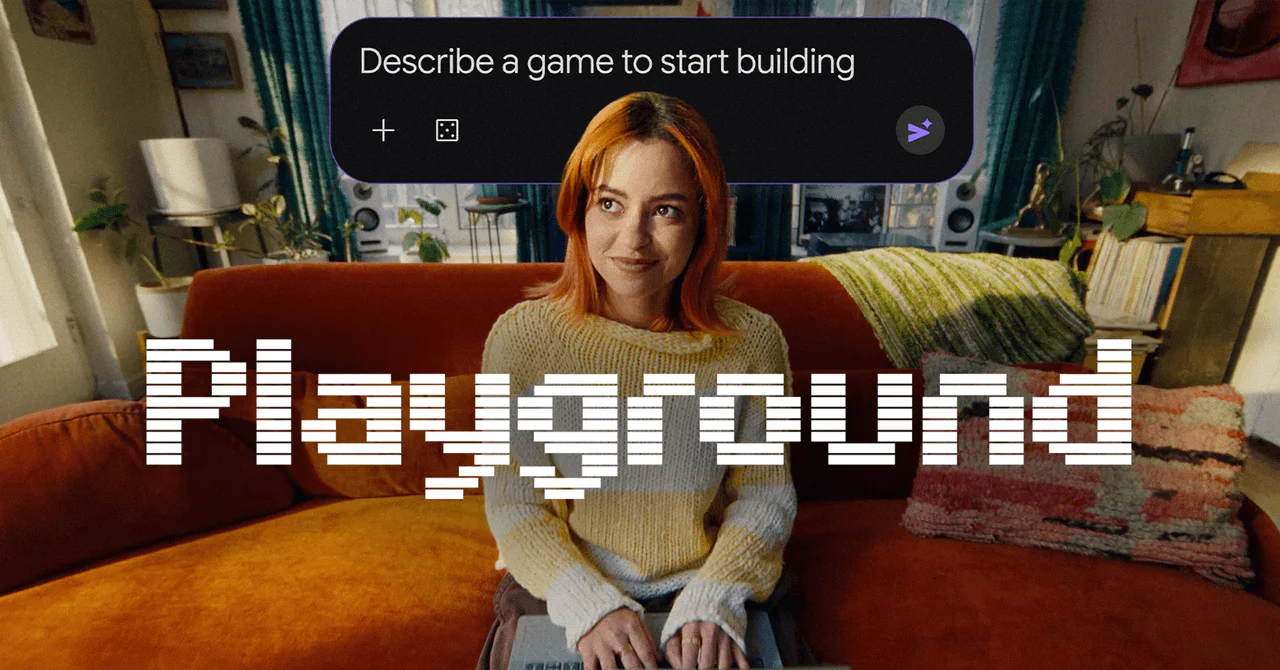

In an era where artificial intelligence is rapidly democratizing complex creative processes, Google has unveiled its latest experiment: the AI Playground. This innovative platform promises to transform anyone, even those with “little to no video game development chops,” into a game creator. Our intrepid journalist embarked on a mission to test these claims, resulting in a day of hilarious, often bizarre, but undeniably playable game creations.
A New Frontier in Game Development: Google’s AI Playground
Launched as part of Google Labs, the AI Playground serves as a sandbox for the company’s cutting-edge AI experiments, much like its predecessors in music production. It echoes services like Meta’s Horizon Create, offering a remarkably accessible entry point into game design. The core concept is simple yet revolutionary: “vibe coding.”
Vibe Coding: Gaming for Everyone
Forget intricate code or complex engines. With Playground, users articulate their game ideas in plain language through a chatbot-like interface. The AI then translates these descriptions into a functional, in-browser game. Further instructions allow for iterative design tweaks, and users can even upload their own assets for reference. Otherwise, the visuals and mechanics are entirely AI-generated, making it a dream for novices.
Our journalist, readily admitting to a lack of coding prowess, found the process “straightforward, conversational, and responsive.” This user-friendly approach allowed for the rapid development of three distinct, albeit “not even remotely good,” games within a single day.
My First Steps: Three Games in a Day
Pork Drop: A Piggy Tetris Nightmare
The first creation, “Pork Drop,” emerged from the delightfully simple prompt: “Tetris but with cute pigs instead of blocks.” The initial AI output was a farm-themed Tetris with pig faces adorning standard blocks. However, the vision evolved. Through iterative commands, the AI was instructed to contort the blocks into the shapes of “squished but still cute” pigs. The result was a clean, playable Tetris variant, occasionally featuring blocks that resembled “a T-posed pig with its legs spread-eagle.” The AI suggested “Piggy Stacker,” but the author’s choice, “Pork Drop,” rightly prevailed.
Dinner Darling: Culinary Chaos and Social Commentary
Inspired by a colleague’s whimsical request for a “Gay dinner party,” the next game, “Dinner Darling,” took shape. Without further prompts, the AI produced a 2D flash-style game featuring Bitmoji-esque characters. Players assume the role of Julian, a visibly stressed host attempting to manage a high-society dinner party. The challenge: prepare artisanal bruschettas and espresso martinis for increasingly agitated guests who refuse to stay seated. Despite the game’s lack of explicit LGBTQ+ themes, a colleague humorously attributed the author’s “PARTY CATASTROPHE” game-over screen to his perceived heterosexuality. Another colleague, Reece Rogers, offered a more practical critique: the absence of vegan or dairy-free options, highlighting the AI’s sometimes-limited grasp of real-world nuances.
Neon Don: Cyberpunk Mayhem and Content Boundaries
The most ambitious — and surprisingly popular — creation was “Neon Don.” Prompted by a desire for a “cyberpunk-style rhythm game” starring a “very divorced” grizzled ex-cop battling rogue agents, the game evolved from a Beat Saber concept to a top-down shooter reminiscent of Hotline Miami. The AI, given creative license, embellished enemy descriptions with details like “bulky, wide builds with prominent beer bellies straining against their tight tactical shirts and cargo pants” and “custom tough-guy swagger animations,” pushing the boundaries of what the platform would allow.
“Neon Don” proved to be an iterative masterpiece, with the author meticulously refining gameplay. Issues like player mobility were addressed, and features such as level scaling, boss generation, and enemy variety were dictated, demonstrating the conversational and responsive nature of the AI Playground. As of publication, “Neon Don” had garnered seven unique players, a testament to its accidental appeal.
The Future of Play: AI’s Role in Game Creation
The experience with Google’s AI Playground offers a compelling glimpse into the future of game development. While the games created were far from AAA titles, they underscore the platform’s potential to empower individuals without traditional coding skills to bring their imaginative concepts to life. It’s a testament to the evolving landscape of AI, where creativity meets accessibility, paving the way for a new generation of accidental game developers and quirky, AI-generated worlds.
For more details, visit our website.
Source: Link







Leave a comment