
Amazon’s Secret Weapon: A ‘Quasi-Random’ Network Revolutionizing Data Centers
Amazon has quietly unveiled a monumental leap in networking design, a breakthrough it claims has been deployed across its data centers since late last year. This innovative technology promises a significant boost in data speeds coupled with a notable reduction in energy consumption, potentially granting the tech behemoth a crucial advantage in the relentless race to build ever-faster cloud infrastructure.
The ‘Quasi-Random’ Core
At the heart of this new architecture lies a “quasi-random” design, a sophisticated hybrid that marries the structured reliability of traditional data networks with the performance benefits of more random configurations. While the concept of random networks has intrigued researchers for decades, the challenge of scaling such a system has remained an elusive puzzle—until now, according to Amazon.
Brighten Godfrey, a distinguished computer science professor at the University of Illinois Urbana-Champaign and a leading expert in networking, expressed his astonishment at Amazon’s real-world implementation. Godfrey, who co-authored a pivotal 2012 paper on random network graphs, described the problem as “mind-bending to solve, in general.”
Introducing the ShuffleBox
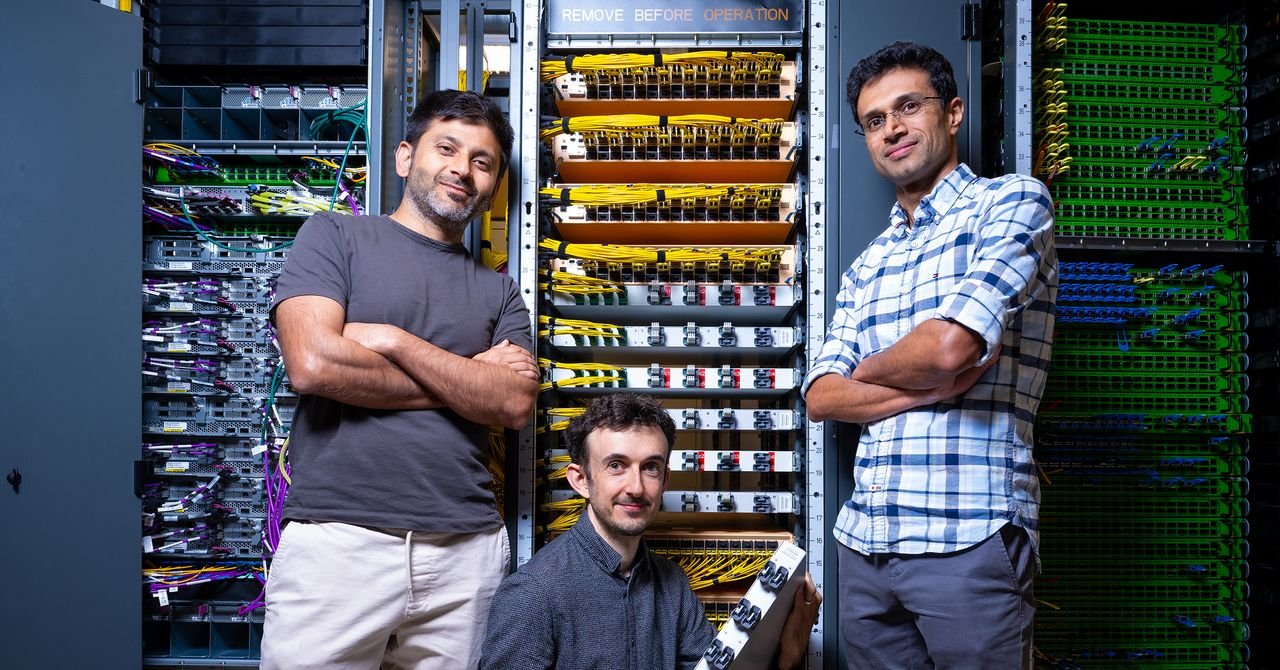
A dedicated team of engineers and researchers at Amazon Web Services (AWS), bolstered by talent recruited from academia, has been diligently tackling the random networking conundrum since 2023. Their efforts culminated in the creation of a novel piece of data center equipment: the “ShuffleBox.” This ingenious device automates the intricate cable shuffling essential for this new class of networking.
“By essentially flattening the network, we eliminated the bottlenecks that come with traditional networking designs,” explained Matt Rehder, Vice President of AWS Network Engineering, in an exclusive interview with WIRED. “We think we’re the only ones who have done this at scale.”
Efficiency Beyond AI: A Broader Impact
Amazon formally detailed its groundbreaking design in a recent paper titled “RNG: Flat Datacenter Networks at Scale.” RNG, standing for “resilient network graphs,” aptly describes the system’s nature—neither entirely structured nor purely random.
Intriguingly, the AWS team behind RNG isn’t primarily pitching this innovation for generative AI applications. Instead, the focus is on enhancing the efficiency of Amazon’s everyday data center architecture. Rehder clarified, “RNG is a great fit for our core demands, but AI training data patterns are far more coordinated and centrally orchestrated, so they don’t approximate a random graph.” This underscores the technology’s potential to optimize core cloud services, benefiting a vast array of users.
The Limitations of Legacy ‘Fat-Tree’ Networks
For nearly four decades, since the mid-1980s, communication networks—from telecommunications to data centers—have predominantly relied on a “fat-tree” topology. This design typically features two or three vertical layers of switches and routers, interconnected by “fat” nodes at the top, where multiple routers of the same type reside, branching into thinner connections below. In essence, data navigates up and down this hierarchical stack, with increased bandwidth at the top to mitigate bottlenecks.
While the tech industry has refined variations of the fat-tree architecture over the years, its inherent rigidity, inefficiency, and reliance on complex physical cabling have presented persistent challenges. Anyone who has glimpsed the dense “nests” of colorful cables in a server room understands the logistical and financial burden. Rehder highlighted that cabling represents one of the most significant costs in networking, with Amazon’s global data centers alone utilizing an astonishing 20 million kilometers of fiber-optic cables—a distance equivalent to 25 round trips to the moon.
Past Innovations: Jellyfish and OCS
The quest for more efficient network designs is not new. In 2012, amidst the burgeoning demand for cloud computing, a team from the University of Illinois Urbana-Champaign, including Godfrey, introduced “Jellyfish.” This concept proposed a “high-capacity network interconnect” leveraging a random graph topology, aiming for greater efficiency and incremental scalability compared to fat-tree networks.
“We gave it the name Jellyfish because it’s fluid,” Godfrey recalled. “You can connect the routers and switches randomly and it becomes this flexible pool of network capacity, which is very efficient.”
However, Jellyfish brought its own set of complexities, particularly in layout, data routing (due to diversified paths), and the inherent difficulty of randomly chosen cable endpoints.
A few years later, Google explored another avenue: integrating optical circuit switching (OCS) into its network designs. OCS employs tiny mirrors to dynamically reconfigure optical cabling in real-time, reflecting light between ports. While innovative, this solution introduced its own engineering complexities and costs.
Amazon’s New Paradigm
While others grappled with the trade-offs of existing and experimental designs, Amazon was meticulously working towards its own solution, culminating in the RNG system and the ShuffleBox. This development marks a pivotal moment, potentially redefining the foundational architecture of cloud computing and setting a new standard for speed, efficiency, and scalability in the digital age.
For more details, visit our website.
Source: Link