

As the digital frontier expands at an unprecedented pace, the race for sustainable and scalable data infrastructure intensifies. While tech giants like Alphabet cast their gaze skyward for the next generation of data centers, visionary investor Peter Thiel is charting a course to the depths of the ocean, backing a groundbreaking startup poised to revolutionize how we power and cool our digital world.
Peter Thiel Dives Deep: A Billion-Dollar Bet on Ocean Data Centers
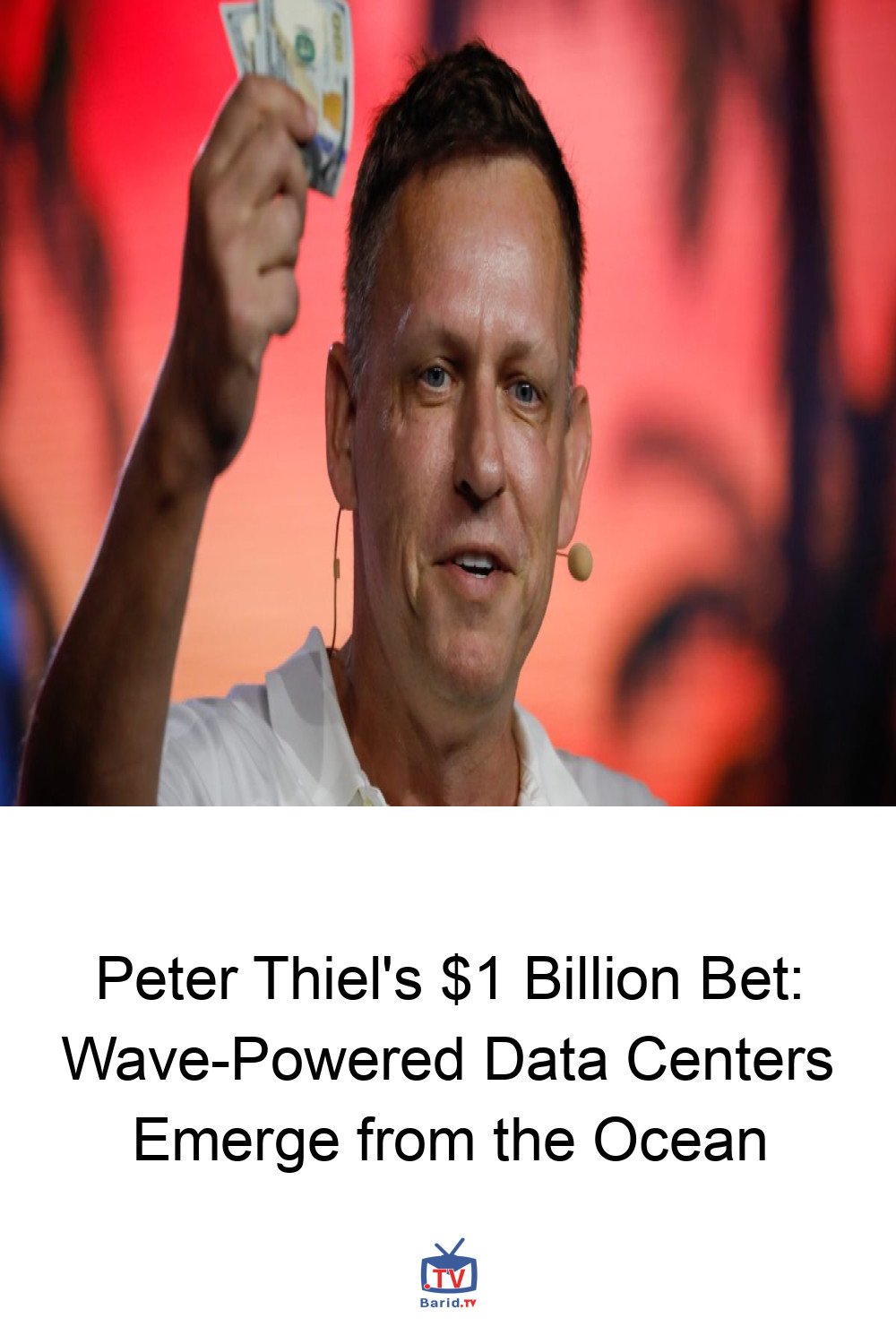
Panthalassa, a U.S.-based startup, has captured the attention—and significant investment—of Peter Thiel, co-founder of PayPal and Palantir. Earlier this month, the company announced a staggering $140 million in funding, spearheaded by Thiel, propelling its valuation close to an impressive $1 billion, as reported by the Financial Times. This substantial backing underscores a bold new direction in tech infrastructure: harnessing the immense power of ocean waves to fuel a fleet of floating data centers.
Thiel, known for his unconventional and often prescient investments, articulated his vision: “The future demands more compute than we can imagine. Extra-terrestrial solutions are no longer science fiction. Panthalassa has opened the ocean frontier.” His statement highlights the growing urgency to find innovative solutions beyond traditional land-based infrastructure.
The Energy Crisis Driving Innovation
The burgeoning demand for AI in the U.S. is colliding with a critical bottleneck: an aging, overstretched power grid vulnerable to extreme weather events. Reports from energy analytics firm Wood Mackenzie reveal a slowdown in data center development, directly attributed to limited electricity capacity. With energy infrastructure dating back to World War II, tech companies are compelled to seek novel environments to expand their compute capabilities without further burdening existing resources.
Panthalassa’s Oceanic Solution: Nodes of Power
Named after the ancient superocean that once enveloped Pangaea, Panthalassa’s innovative design features “nodes” that float on the ocean’s surface. These nodes are equipped with nearly 280-foot-long steel structures that extend deep below the waterline. The spherical top bobs with the waves, causing an attached tube to oscillate water within it. This motion, in turn, spins internal turbines, generating clean electricity.
Crucially, each node also houses a hermetically sealed, airtight AI server, cooled efficiently by the surrounding seawater. This ingenious integration of power generation and cooling within a single, self-contained unit represents a significant leap forward in sustainable data center design.
From Prototypes to Pacific Deployment
Panthalassa has meticulously developed its technology over several years, beginning with Ocean-1 and Ocean-2 prototypes in 2021. The company is now poised to deploy its most advanced system, Ocean-3, in the northern Pacific Ocean this year, with commercial operations slated to commence in 2027.
Garth Sheldon-Coulson, Panthalassa co-founder and CEO, emphasized the vast potential: “There are three sources of energy on the planet with tens of terawatts of new capacity potential: solar, nuclear, and the open ocean. We’ve built a technology platform that operates in the planet’s most energy-dense wave regions, far from shore, and turns that resource into reliable clean power. We’re now ready to build factories, deploy fleets, and provide a sustainable new source of energy for humanity.”
Thiel’s Enduring Fascination with the Ocean Frontier
Peter Thiel’s investment in Panthalassa isn’t an isolated venture; it’s a continuation of a long-standing fascination with the ocean as a frontier for human development. For nearly two decades, Thiel has explored “seasteading”—the libertarian-inspired concept of creating autonomous, permanent islands on the high seas, independent of national jurisdictions. His 2008 donation of $500,000 to The Seasteading Institute underscored this utopian vision.
While his belief in the immediate viability of seasteading may have tempered, Thiel’s interest in ocean-based innovation remains robust. His venture capital fund, Founders Fund, initially backed Panthalassa in 2018, but his latest investment comes from his personal fund, signaling a deeper, more personal commitment to the project.
Navigating the Deep: Challenges and Resilience
Despite the promise, deploying and scaling AI infrastructure in the vast, unpredictable ocean presents unique challenges. Previous subsea data center experiments, suchs as Microsoft’s Project Natick (which concluded in 2024 after successfully submerging 900 servers in the Scottish Sea with fewer failures than land-based counterparts), demonstrated feasibility but also highlighted potential risks.
Md Jahidul Islam, a University of Florida professor specializing in electrical and computer engineering, raised concerns about subsea infrastructure. He noted that while underwater data centers benefit from “free cooling and isolation from variable environments on land,” these advantages can become liabilities. Dense water, for instance, transmits acoustic signals faster than air, potentially making systems vulnerable to acoustic attacks. Furthermore, isolated underwater data centers can be harder to monitor and troubleshoot.
Panthalassa, however, dismisses these concerns as “a non-issue” for its architecture. A company spokesperson stated, “We designed our nodes with acoustic and mechanical resilience in mind. Our architecture is built around solid-state components, pressure-vessel isolation, and rigorous environmental testing.” This robust design philosophy aims to mitigate the inherent risks of the deep-sea environment, paving the way for a truly oceanic future for data.
For more details, visit our website.
Source: Link