




AI’s New Frontier: Google’s Gemini 4 Carbon Revolutionizes Cybersecurity Defense
In a significant leap forward for artificial intelligence in digital defense, Google has unveiled Gemini 4 Carbon, its latest frontier model engineered with cutting-edge cybersecurity and long-horizon capabilities. This advanced AI is not just an incremental update; it’s setting new industry benchmarks across critical aspects of vulnerability management, from identification to remediation.
Unprecedented Performance Across Cybersecurity Benchmarks
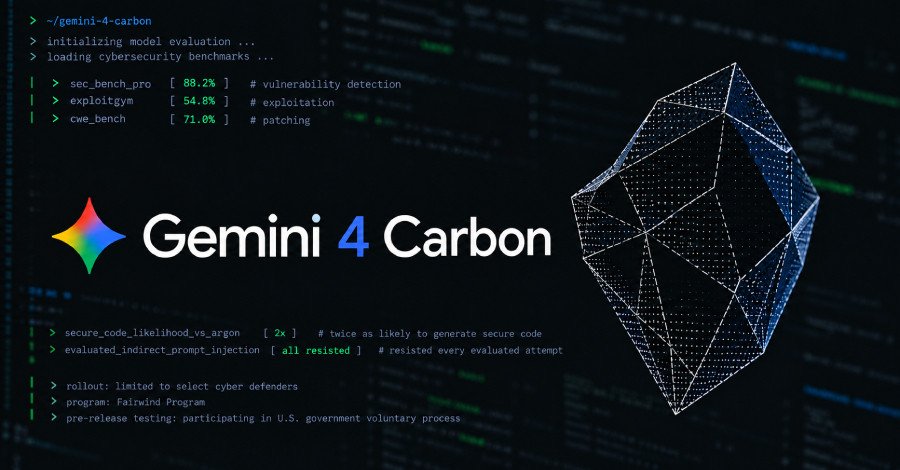
Gemini 4 Carbon has demonstrated a commanding lead in several key cybersecurity metrics. According to Koray Kavukcuoglu, senior vice president of Google DeepMind and chief AI architect at Google, the model shows “significant gains across coding and agentic tasks.” Specifically, Carbon achieved an impressive 88.2% in SEC-bench Pro for finding vulnerabilities, a 54.8% success rate in ExploitGym for exploitation, and a robust 71.0% in CWE-bench for patching.
Beyond these specialized cybersecurity benchmarks, Carbon also leads the Artificial Analysis Intelligence Index with a score of 59. This places it ahead of formidable competitors such as Anthropic’s Claude Opus 5.5 (58), OpenAI GPT-6 Astra (57), and GPT-6.1 Sol (55), underscoring its broad-spectrum intelligence.
Intelligent Design: Secure Code and Human-Centric Interaction
A core focus of Gemini 4 Carbon’s development has been enhancing cybersecurity performance across the board, including improved vulnerability detection, validation, and remediation. Notably, Carbon is twice as likely to generate secure code compared to its predecessor, Argon, marking a substantial improvement in proactive security measures.
Google also highlighted Carbon’s sophisticated approach to complex tasks. Rather than “guessing or forcing a path forward” in ambiguous or high-pressure situations, the model is designed to seek human input. This collaborative intelligence model aims to prevent errors and ensure more reliable outcomes. Furthermore, Carbon has demonstrated strong resistance to all evaluated indirect prompt injection attacks, a crucial feature for maintaining model integrity and preventing malicious manipulation.
Strategic Rollout and Industry Context
The introduction of Gemini 4 Carbon follows closely on the heels of Gemini 4 Argon’s debut. Its rollout strategy mirrors that of its predecessor, initially targeting a select group of cyber defenders before expanding access to trusted partners through Google’s Fairwind Program. Google is also actively participating in the U.S. government’s voluntary pre-release model testing process, emphasizing its commitment to responsible AI deployment.
The Competitive Landscape: OpenAI and Anthropic’s Contributions
The AI cybersecurity arena is rapidly evolving, with other tech giants also making significant strides. OpenAI recently launched GPT-6.1 Terra, positioning it as a fast, efficient model adept at communication and computer-based tasks. OpenAI states that Terra meets the “Critical threshold in cybersecurity” under its Preparedness Framework and maintains the protections of the GPT-6 Astra series. It also boasts improved alignment, greater transparency about limitations, and strong resistance to prompt injection attacks.
Adding to the competitive ferment, Anthropic recently revealed that an unreleased internal research model had uncovered critical vulnerabilities in widely used software. This included a one-click remote code execution in Google Chrome, an exploit chain in Apple Safari, an Android lock screen bypass, and a denial-of-service (DoS) flaw in the Windows HTTP.sys driver (CVE-2026-33096). These issues have since been patched by the respective companies.
Anthropic’s findings underscore a pivotal shift: “These attack chains demonstrate the model’s ability to create sophisticated, multi-step exploits in both open-source and proprietary software,” a spokesperson noted. “These skills have historically been the domain of few specialist teams… Now, it’s something models can do with little human involvement, and then prove by producing a working exploit that anyone can run and verify.” This statement highlights the transformative potential—and inherent risks—of advanced AI in cybersecurity, capable of both fortifying defenses and, in the wrong hands, creating potent new threats.
For more details, visit our website.
Source: Link







Leave a comment