





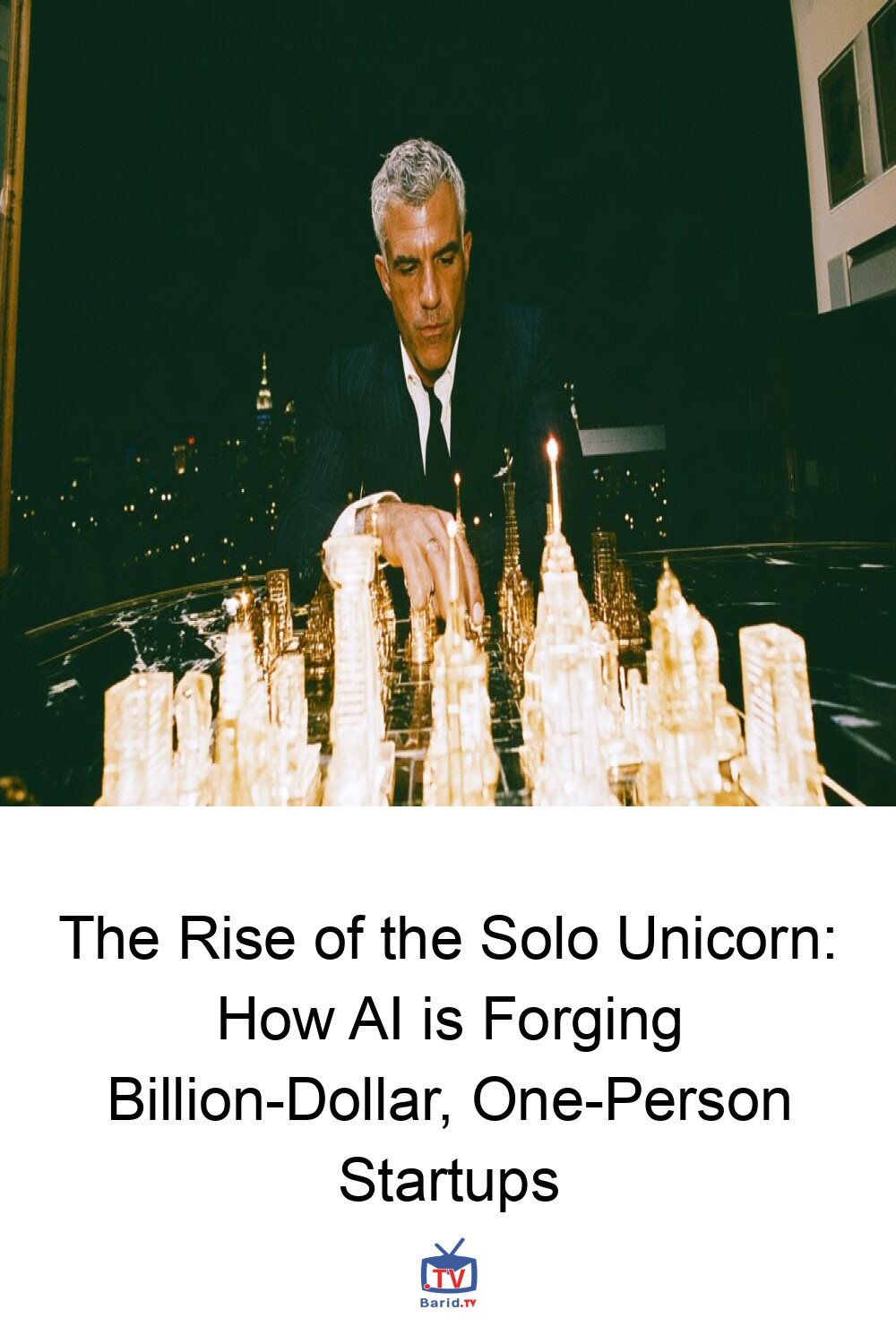
Every technological epoch ushers in a wave of groundbreaking enterprises. Yet, the advent of artificial intelligence is not merely creating new giants; it’s fundamentally reshaping the very blueprint of how these colossal companies are constructed. For decades, the bedrock of software scale was inextricably linked to human capital. A startup aiming for $10 million in Annual Recurring Revenue (ARR) typically necessitated a workforce of 30 to 60 individuals. To breach the billion-dollar valuation mark (around $100M ARR), an organization chart often swelled to 500-700 employees. This conventional wisdom, however, has been rendered obsolete.
When OpenAI CEO Sam Altman boldly declared that the era of the “one-person billion-dollar company” was upon us, it struck many as audacious hyperbole. Today, it’s proving to be prophetic. Astonishingly, one in three startups is now founded and operated by a single individual, a significant leap from just one in six a mere seven years ago. We are witnessing the dawn of an age where the next technological titan won’t emerge from a sprawling Silicon Valley campus teeming with engineers, but from the ingenuity of a solitary founder, amplified by an intelligent legion of highly specialized AI agents.
So, how exactly is this seemingly impossible feat being achieved? Let’s delve into the strategic framework enabling the rise of the solo unicorn.
Phase 1: The Zero-Friction Product Build
The barrier to entry for launching a software product has dramatically plummeted, approaching zero. Contrast this with 2015, where developing a Minimum Viable Product (MVP) demanded a dedicated engineering team, six to twelve months of operational runway, and a seed capital injection ranging from $50,000 to $150,000. Today, even non-technical entrepreneurs are crafting sophisticated, fully functional web applications in a matter of hours or a single afternoon.
Leveraging cutting-edge AI-first development platforms such as Cursor, Lovable, or Bolt, a solo founder can engage in prompt-based coding. Simply articulate the desired application, and the AI autonomously generates the front-end code, architects the database, and seamlessly integrates payment processors. Yet, product creation is merely the initial stride. A solo venture aspiring to a billion-dollar valuation must meticulously adhere to three stringent criteria:
Zero-Human Fulfillment
The product’s core value delivery must be entirely automated. Building a solo empire is incompatible with manual consulting, shipping physical goods, or providing high-touch, human-intensive services. The Software-as-a-Service (SaaS) model stands as the sole viable vehicle meeting this critical requirement.
Global Scalability
The target market must transcend geographical limitations and physical supply chain constraints. The product needs to be accessible and functional worldwide without significant logistical overhead.
Maximum Margin
The business must command an exceptional gross profit margin, ideally in the 80-90% range. This high profitability is crucial for attracting the elevated valuation multiples (10x to 20x revenue) necessary to achieve a billion-dollar valuation on a more modest actual revenue base, such as $50 million.
Phase 2: The Multiplier Stack – Why 1 = 10
The extraordinary productivity of a solo founder, often surpassing that of a traditional ten-person team, isn’t a result of working impossibly long hours. Instead, it stems from the meticulous construction of an interconnected, automated tool stack where every action generates a multiplicative, rather than additive, effect.
Consider a typical operational workflow within a conventional software company:
- A customer reports a bug via email.
- Customer support personnel read the report and escalate it to engineering.
- Engineers diagnose the code, develop a fix, and deploy it.
- The finance department updates billing records for server usage.
This seemingly straightforward sequence historically demanded the involvement of four distinct human beings and consumed an entire morning in back-and-forth communication. Now, observe the same sequence executed by a modern solo founder:
- A customer reports a bug via email.
- An intelligent AI agent (e.g., powered by Claude) processes the email, diagnoses the underlying issue, and drafts a personalized apology.
- The agent automatically feeds the diagnosis into an AI coding tool.
- The founder quickly reviews the proposed fix and approves its deployment.
- Automated financial software (like Stripe or Roe) seamlessly handles all backend billing adjustments without any human intervention.
What once required four salaries and several hours of collective effort is now completed by a single individual in approximately twenty minutes. The exponential scaling of the business is achieved entirely through this sophisticated software stack, not through an expanding headcount.
Phase 3: The AI Agent Workforce
Historically, achieving product-market fit often presented a critical juncture for solo operations. The sudden surge in customer demand typically forced founders to rapidly expand, hiring extensive customer support teams, sales development representatives, and marketing departments. The solo unicorn, however, ingeniously sidesteps this traditional bottleneck by deploying an autonomous workforce of highly capable AI agents.
Unlike rudimentary automations that follow rigid, predefined rules, AI agents are endowed with contextual intelligence. They can be assigned complex objectives and are empowered to execute them autonomously, learning and adapting as they go.
Autonomous Customer Support
Directly integrated with the company’s internal documentation and knowledge base, an AI agent can instantaneously resolve an impressive 95% of tier-1 and tier-2 customer inquiries. This includes processing refunds, troubleshooting common errors, and answering billing questions, all available 24/7 without human oversight.
Proactive Sales & Outreach
Instead of assembling a team of a dozen Sales Development Reps (SDRs), a solo founder can deploy specialized AI agents (utilizing platforms like Clay). These agents autonomously scour the internet for highly qualified leads, enrich their data profiles, and craft hyper-personalized cold emails at a volume and speed that human teams simply cannot match.
Intelligent Operations Management
Dedicated operations agents continuously monitor server health, proactively flag unusual user behavior patterns, and generate comprehensive weekly performance analytics. In this new paradigm, the founder transcends the role of a day-to-day operator, evolving into the strategic orchestrator of an artificial intelligence-driven enterprise.
For more details, visit our website.
Source: Link






Leave a comment