




The Dawn of AI Decision Models: A Game Changer for Cybersecurity?
In a blink, a new breed of artificial intelligence models has swept across the tech landscape, transitioning from nascent concepts to widespread adoption. Companies like TypeSafe AI, with its ‘System One’ model Jev, and OpenAI, with its new Decisions API, have spearheaded this rapid evolution. Even open-source initiatives like Cribl’s ‘cribl-decision’ and Laya are quickly gaining traction. These aren’t your typical generative AI tools; they’re designed for decisive action, taking in specific states and typed questions to yield choices, scores, or probabilistic yes/no answers.
For the realm of security operations (SOCs), this development is nothing short of monumental. While the buzz often focuses on the AI models themselves, the true impact lies in how they integrate into and elevate existing security platforms. This article delves into why SOCs should be embracing this technology, and critically, where the current discourse might be missing the mark.
Why Security Operations Centers Should Be Excited
AI decision models possess three inherent qualities that make them an ideal fit for the demanding task of alert triage:
1. Automated Triage with Unprecedented Precision
The core strength of these models lies in their ability to provide quantifiable, actionable outputs. A calibrated probability attached to a typed answer allows for sophisticated automation. Imagine asking a model if an alert is benign: a probability above 0.97 could trigger automatic closure, while anything below 0.6 might instantly escalate to an incident. The grey area in between? That’s where human analysts step in for a closer look. TypeSafe even advocates for stricter thresholds for irreversible actions, mirroring the gravity of “disabling an account” versus merely “adding a comment to a ticket.” This level of automated, risk-calibrated response is a significant leap forward.
2. Unprecedented Affordability for Every Alert
Cost has historically been a barrier to comprehensive AI adoption in security. However, these new decision models are remarkably economical. Jev, for instance, is priced at a mere $42 per billion input tokens, with response times ranging from 70 to 500 milliseconds. Consider an enterprise handling 450,000 alerts annually, each requiring a few thousand tokens for analysis. The annual model expenditure could be as low as a few hundred dollars. This economic shift obliterates the rationale for selectively triaging only high-severity alerts, paving the way for every single alert to receive an intelligent verdict.
3. Auditable Transparency and Reproducibility
Unlike the often opaque reasoning of generative AI, decision models offer a fixed answer space and an inherent probability score. Every decision becomes a clear, loggable record. This means every verdict can be logged, replayed, and directly compared against actual outcomes. Such transparency vastly simplifies auditing processes, offering a level of accountability far superior to deciphering a generated paragraph of reasoning.
However, a crucial caveat remains: while vendors claim these models “can’t hallucinate,” this merely means the output adheres to the defined schema. A perfectly structured answer can still be fundamentally incorrect.
The Peril of the “Calibrated Guess”: Garbage In, Garbage Out
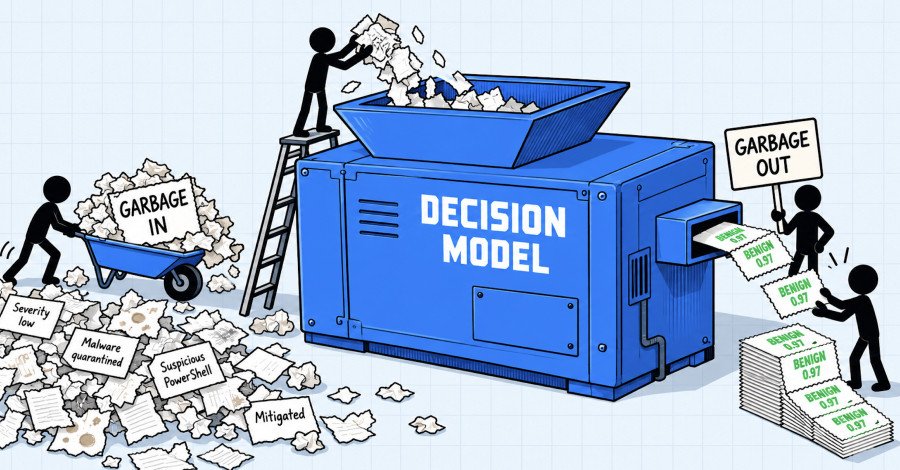
The age-old computing adage, “Garbage in, garbage out,” holds true. A calibrated guess, no matter how sophisticated, remains a guess. Calibration promises accuracy across a distribution; if a model states 90% confidence, it implies correctness 90% of the time for inputs resembling the current one. The critical question, then, is what constitutes “this one.” If the input is limited to an alert title and severity, the model’s calibration is confined to alerts with that specific title and severity. It lacks crucial contextual awareness, such as details about the affected host.
The Criticality of Context: Beyond Surface-Level Alerts
This lack of deep context has profound practical implications. Our AI SOC Report 2026, analyzing 25 million alerts from 2025, revealed striking insights. Of 82,000 alerts that triggered a live memory scan, approximately 2,600 machines were actively infected. Alarmingly, 51% of these infected machines had already been reported as “mitigated” by their EDR systems. Consider what a decision model would see for such an alert: “Malware detected, threat quarantined, low severity.” A perfectly calibrated model, based solely on this input, would likely close it with high confidence, as most alerts matching this description are indeed benign. The model performs its function, but the input itself is misleading.
Severity ratings present a similar, larger-scale challenge. Our data indicates that nearly 1% of genuine incidents originated from alerts initially flagged at the lowest severity levels. For an enterprise generating 450,000 alerts annually, this translates to roughly 54 real threats – about one per week – being potentially overlooked due to an overreliance on surface-level severity. As Cribl’s own model card honestly states, these models can be overconfident and are sensitive to prompt wording. This transparency is vital, as it applies across the entire category of decision models.
Security Context Engineering: The True Path to Intelligence
To truly harness the power of AI decision models, we must move beyond raw alerts and embrace what Filip Stojkovski aptly terms “Security Context Engineering.” This approach mirrors a meticulous crime scene investigation: you wouldn’t rely on a general description from a chatbot to find a suspect. Instead, you’d gather DNA, fingerprints, forensic evidence, and witness statements. Security investigations demand the same rigor.
The objective is to transform a raw alert into a comprehensive set of facts before any decision, human or automated, is made. Here’s a stark contrast:
What an Alert Gives You vs. What Forensic Evidence Reveals
- What ran?
- Alert: “Suspicious PowerShell”
- Forensic Evidence: The full process tree, parent process, complete command line, and the script found on disk.
- What did it do?
- Alert: A hash and a reputation score.
- Forensic Evidence: The file’s behavior upon detonation, network calls made, and files dropped.
- Is it still there?
- Alert: “Mitigated” from the EDR.
- Forensic Evidence: A live memory scan revealing injected code or a fileless payload.
- Who was it?
- Alert: A username.
- Forensic Evidence: Where they logged in from, the specific device used, and whether this activity deviates from their normal patterns.
The third point, “Is it still there?”, warrants particular attention. Last year, common memory-resident threats included tools like Mimikatz, Meterpreter, and Cobalt Strike. These are designed to operate entirely within memory, precisely where traditional file-based detection often falls short.
Conclusion: Augmenting, Not Replacing
AI decision models represent a significant leap forward in automating and streamlining security operations. Their speed, cost-effectiveness, and auditable nature offer immense potential for improving alert triage and response. However, their true power is unlocked not by simply feeding them raw, often incomplete, alert data, but by integrating them into a robust framework of Security Context Engineering. By meticulously enriching alerts with comprehensive forensic evidence, SOCs can transform these powerful models from calibrated guessers into highly effective, context-aware decision engines, augmenting human expertise and fortifying our digital defenses against an ever-evolving threat landscape.
For more details, visit our website.
Source: Link







Leave a comment