



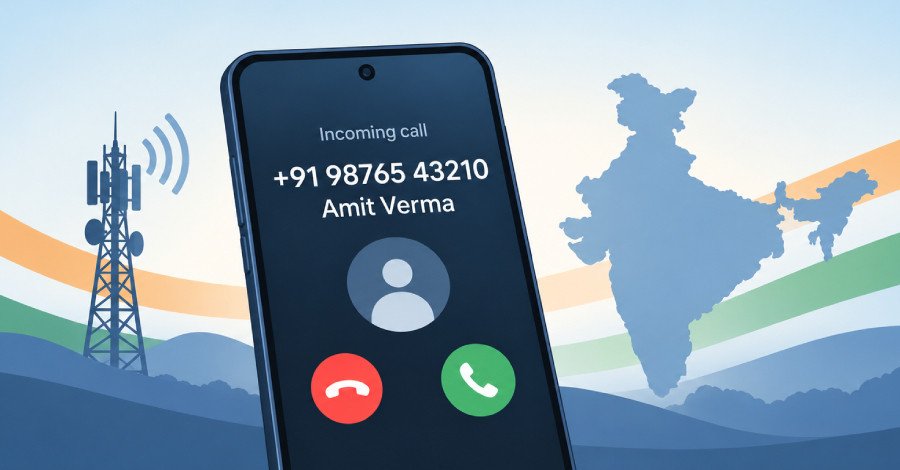

The Indian government is taking a significant step to empower its citizens against the growing menace of spam and fraudulent calls. Starting November 1, 2026, telecom service providers (TSPs) across the nation will be required to display the registered names of callers alongside their numbers for all incoming calls on 4G and newer generation networks. This landmark directive aims to enhance transparency and provide users with crucial information to identify unknown callers.
A New Era for Caller Identification
The Department of Telecommunications (DoT) has issued a circular, dated October 13, 2026, urging TSPs to implement the Calling Name Presentation (CNAP) service. This service is designed to present the “calling name identity” of the caller on the recipient’s device. This identity will be the name of the calling user as recorded in the subscriber data record of the originating telecom service provider, integrated into the existing calling line identification.
Targeting Modern Networks First
Initially, this robust caller ID system will primarily focus on wireless terrestrial networks leveraging 4G and higher generation technologies. The circular indicates that the rollout of CNAP for older 2G and 3G networks, as well as Public Switched Telephone Networks (PSTNs), will be considered and examined separately at a later stage.
How the New System Will Work
Upon receiving a call, users will observe two key pieces of information:
- The caller’s number, maintaining the current practice.
- The name of the calling user, determined by a specific hierarchy:
- If the number is already saved in the recipient’s contacts, the contact’s saved name will be displayed.
- If the number is not saved, the calling name identity, as stored in the telecom operator’s subscriber database, will be presented for domestic calls.
- For calls originating from outside India, the label “International Call” will be displayed.
Behind the Scenes: Database and Security
To facilitate this mandate, every originating TSP is now tasked with establishing and meticulously maintaining a comprehensive database that maps subscribers’ names to their respective numbers. When a call is received, the operator on the receiving end will query this database to retrieve and display the calling name identity to the user.
The Ministry of Communications is also emphasizing a “secure-by-design” approach for the implementation of this system. TSPs are urged to ensure communication security by:
- Guaranteeing that the calling name identity is not retained once the incoming call concludes.
- Upholding the quality of service in strict adherence to applicable laws.
- Provisioning all necessary database, network, and connectivity infrastructure to efficiently process calling name identity queries.
Special Provisions for Businesses
Recognizing the unique needs of business and bulk connection users, the new guidelines allow for a “preferred name” option. This preferred name will supersede the standard calling name identity and must be one of the following:
- A trademark officially registered in the user’s name with the Trade Marks Registry under the Controller General of Patents, Designs and Trade Marks.
- A trade name of the user as registered on the Goods and Services Tax (GST) portal.
For new connections, this preferred name must be meticulously recorded in both the customer application form and the subscriber data record. Furthermore, original documents proving the user’s registration under such a name must be presented to the originating TSP, with true copies attached to the application form.
This proactive measure by the Indian government is poised to significantly enhance user safety and privacy, making it harder for spammers and fraudsters to operate anonymously. It marks a crucial step towards a more transparent and secure telecommunications environment in India.
For more details, visit our website.
Source: Link







Leave a comment