





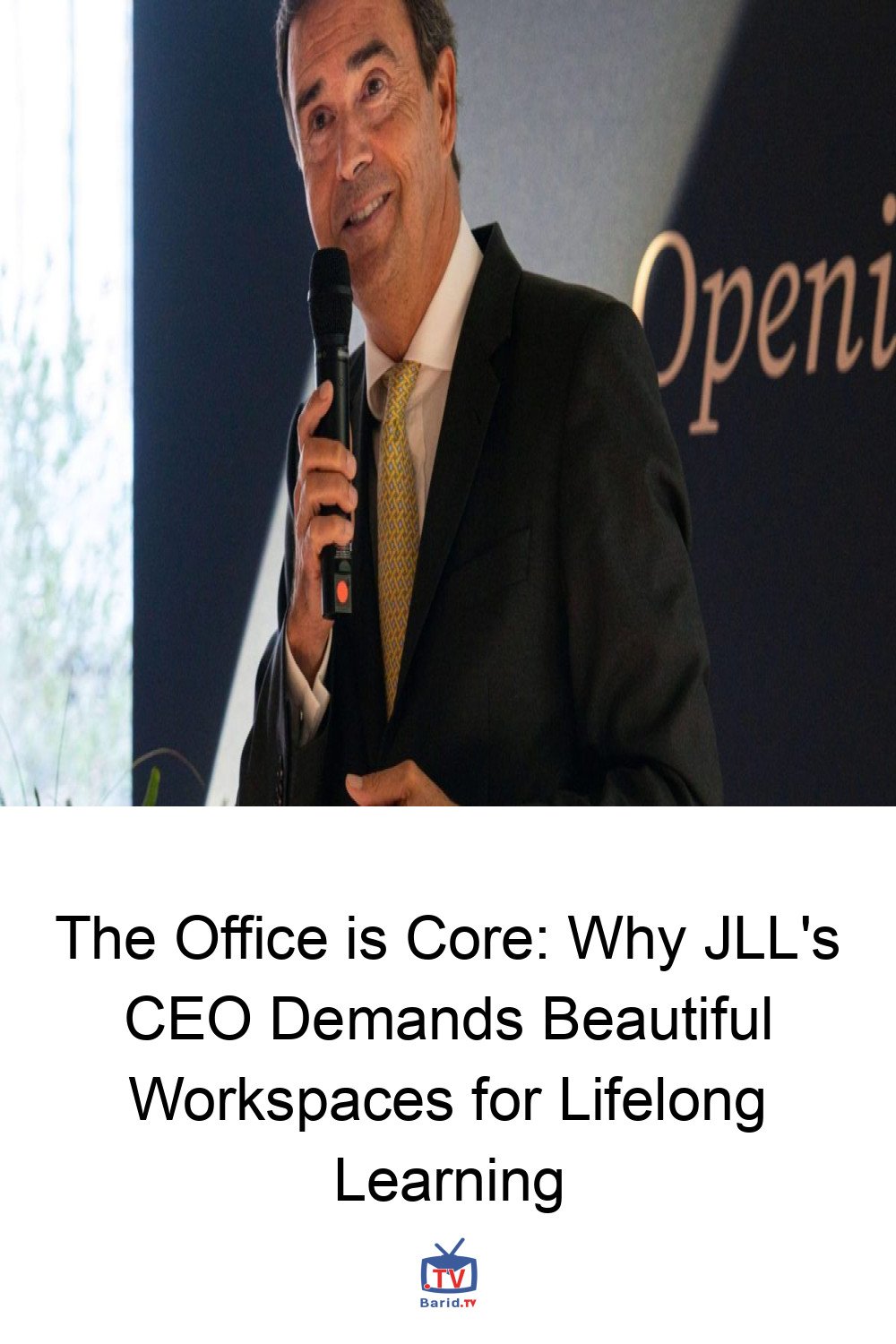
In an era increasingly defined by remote work, Christian Ulbrich, CEO of real estate giant JLL, offers a compelling counter-narrative: the office isn’t just back; it’s fundamental. His conviction stems from deeply personal experiences, contrasting his own formative career with that of his son during the pandemic.
The Foundational Power of Proximity
Ulbrich vividly recalls his first professional role, a formative experience spent in close quarters with his boss. “I could consistently learn by just observing him, overhearing his conversations, asking him quick questions, and so my learning experience was fantastic,” he recounts. “It would have never been possible if I had worked from home.” This direct, immersive learning environment, he argues, was invaluable.
His son’s entry into the professional world painted a starkly different picture. Starting his career amidst the COVID-19 pandemic, the younger Ulbrich spent his initial 15 months largely remote. “He was working from home, and he was devastated,” Ulbrich shared. “The ability to learn for him was minimized.” This generational contrast underscores Ulbrich’s belief in the irreplaceable value of in-person interaction for professional development.
Beyond Efficiency: The Lifelong Learning Imperative
As the head of JLL, a Fortune 500 powerhouse whose share price has seen significant recovery, Ulbrich’s perspective carries considerable weight. JLL’s recent Q2 earnings, boasting 11% revenue growth and a 21% increase in advisory property services, signal a robust return to the in-office market. For Ulbrich, the benefits extend far beyond mere operational efficiency.
Interaction Fuels Innovation and Growth
“From a plain efficiency point of view, and if we generalize, it’s clearly more efficient to have people in the office than if they work from home,” he states. “The benefit which you gain from people interacting, communicating, sharing best practice, sharing ideas is massive—outweighing the cost of the office space. Therefore, to have people coming to an office is, for almost all companies, beneficial.”
Ulbrich champions the office not just for executives eyeing productivity, but for every employee. In a world where university knowledge can quickly become outdated, continuous learning is paramount. “We’re in that [era] now of lifelong learning. You need your co-workers to continue learning, and how can you do that? You can do that in an office.”
Flexibility, But the Office Remains Core
While advocating for the office, Ulbrich is not rigid. JLL itself embraces a degree of flexibility. “Does that mean that you have to come to the office every day of the week? Probably not,” he concedes. “And I believe, and we practice that at JLL, that there is [a need for] flexibility. But the core place for work is the office. And if there is a reason that people have to stay a day at home, they can stay that day at home and work from there. But the basic principle is they have to come to the office.” This approach positions the office as the primary hub, with remote work as an occasional, justified exception.
The Mandate for Magnificent Workspaces
If the office is to be the core, it must be exceptional. Ulbrich emphasizes this point from JLL’s new London offices, a space designed with sustainability and employee well-being at its heart. Featuring recycled materials, minimal private offices, abundant natural light, and terraces, it’s a far cry from the drab cubicle farms of yesteryear.
“It has to be absolutely state of the art with regards to sustainability,” he insists. “It has to be in a very professional location, and it has to be really good architecture—which is a lot of light and terraces and all the elements which would make our colleagues feel comfortable.” The message is clear: attract people back to the office by making it a truly desirable destination.
London: The Unrivaled Global Business Nexus
Beyond the future of work, Ulbrich, a German native, also weighed in on global business hubs. Despite JLL’s Chicago headquarters, he firmly asserts London’s preeminence. “London is the global hub because it’s the city which is able to attract pretty much everybody, no matter what their racial background is, their country passport is,” he argues. “They all like to come to London, whereas some people would be hesitant to come to New York, and other people will be hesitant to come to China. Everybody is coming to London.” This universal appeal, he believes, solidifies London’s position as the world’s leading business destination, a sentiment that even iconic Chicago cannot fully replicate.
For more details, visit our website.
Source: Link







Leave a comment