



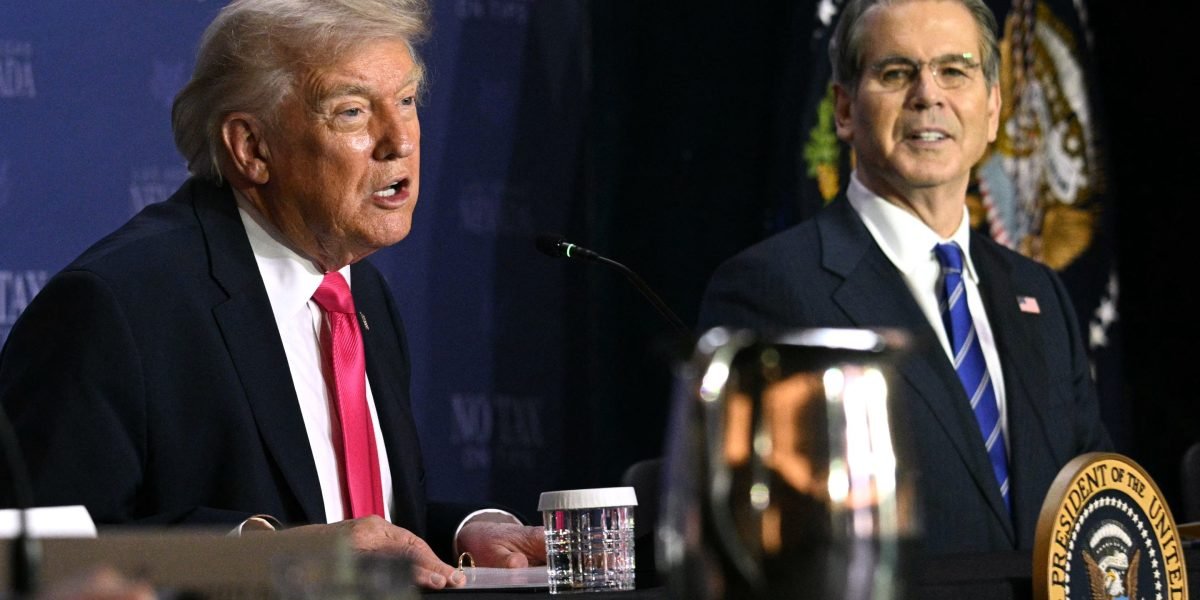

In a revelation that has sent ripples through Washington and Wall Street, former President Donald Trump’s financial accounts executed a staggering volume of trades in a single month, dwarfing the total annual transactions of his own Treasury Secretary, Scott Bessent, a seasoned financial veteran.
A Torrent of Transactions: Trump’s July Activity
According to a report filed with the Office of Government Ethics (OGE) and first brought to light by Business Insider, accounts associated with President Trump recorded an astonishing 1,156 transactions in July alone. This included 440 purchases and 716 sales, collectively representing an estimated value between $79 million and $270 million. The precise monetary value of each individual trade, however, remains undisclosed.
This immense activity stands in stark contrast to Treasury Secretary Scott Bessent’s disclosures. A Wall Street veteran who founded the hedge fund Key Square, Bessent reported a mere 29 transactions for the entirety of 2025. All of Bessent’s reported transactions were sales, primarily involving his interests in Key Square and individual stocks like Verizon and Archer Daniels Midland, as he moved to divest assets to prevent conflicts of interest upon joining the administration.
The White House’s Explanation and Ethical Scrutiny
Addressing the flurry of activity, a White House spokesperson previously informed Fortune that President Trump’s assets are managed within a trust overseen by his children. The high frequency of trades, they explained, is attributed to third-party “computer-based model portfolios that automatically replicate recognized indexes, such as the Schwab 1000.” The White House did not provide further comment on the latest findings.
While federal conflict of interest law (18 U.S. Code 208) typically prohibits officials from actions affecting personal financial interests, this statute notably excludes the President and Vice President. This exemption has historically been a point of contention, especially given the unprecedented scale of Trump’s trading. His second term saw a significant escalation in activity, with OGE disclosures revealing over 21,000 transactions in his first year back in office.
Breaking Precedent: A Departure from Modern Presidential Norms
Maintaining an actively traded portfolio of individual securities while in office is highly unusual for a U.S. President. Since the enactment of the Ethics in Government Act of 1978, modern presidents have typically opted for blind trusts or restricted their investments to non-conflicting assets like diversified mutual funds. Walter Shaub, former director of the Office of Government Ethics, highlighted this deviation in 2017, stating that Trump’s financial management plan “doesn’t meet the standards that the best of his nominees are meeting and that every president in the past four decades has met.”
The sheer volume and potential timing of these transactions have drawn sharp criticism from lawmakers. Senator Elizabeth Warren (D-Mass.) and Representative Robert Garcia (D-Calif.) voiced concerns in a letter to Trump, questioning “whether you are using your knowledge of government activities, your official authority, or the vast megaphone provided by the Presidency to make investments or move markets to your personal benefit.”
A Paradoxical Stance: Trading Restrictions for Congress
Adding another layer of complexity, the Trump administration, in July, expressed “strong support” for the Stop Insider Trading Act. This proposed legislation aims to prohibit members of Congress and their families from trading stocks while in office. However, the bill faced opposition from some Democratic lawmakers due to a provision introducing new ID requirements for federal elections. While the House passed the bill, it remains under Senate consideration. Crucially, the trading restrictions within this bill would not extend to the President or Vice President, highlighting a perceived double standard in ethical oversight.
The extensive trading activity by President Trump’s accounts continues to fuel debate over presidential financial ethics and the need for greater transparency and accountability at the highest levels of government.
For more details, visit our website.
Source: Link








Leave a comment