The volatile geopolitical landscape of the Middle East has once again flared, with the Strait of Hormuz becoming a flashpoint for renewed military exchanges between the United States and Iran. A series of incidents, including a tanker strike and an intercepted drone, have sent shockwaves through global markets, pushing oil prices past the $90 mark as both nations signal readiness for further confrontation.
Escalation in the Strait of Hormuz
Maritime Incidents and Military Responses
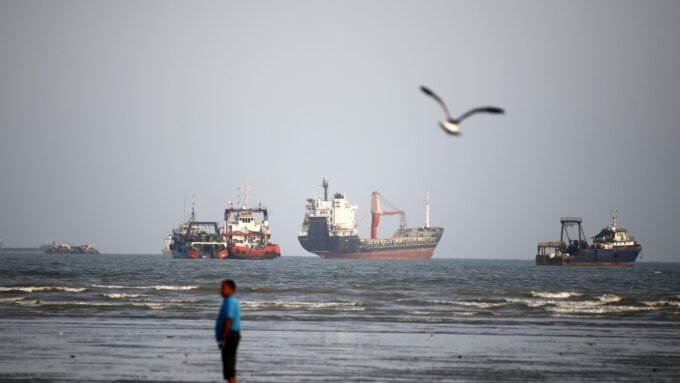
Monday witnessed a dangerous escalation in the critical Strait of Hormuz. A commercial tanker, navigating the southern shipping lane near the Omani coast, was reportedly struck by three unidentified projectiles. The UK Maritime Trade Operations agency confirmed the incident, noting thankfully no casualties. Concurrently, Iran’s Islamic Revolutionary Guard announced the interception of a U.S. MQ-9 drone over the eastern Strait, adding another layer of tension to an already fraught situation.
These maritime events followed a direct exchange of military strikes. Iran launched attacks on two American bases in Jordan, a retaliatory move after U.S. forces targeted two Iranian rocket launchers on Larak Island. The U.S. claimed these launchers were intended to deploy sea mines in the Strait of Hormuz, a vital artery for global oil shipments. Larak Island, strategically positioned within the Strait, has long served as a crucial control point for Iranian forces, underscoring its significance in regional power dynamics.
Tehran’s Diplomatic Overture Amidst Conflict
Amidst the escalating hostilities, Iranian President Masoud Pezeshkian, speaking at the Shanghai Cooperation Organisation Summit, extended a conditional olive branch. He stated that Tehran would “immediately reciprocate” if Washington honored its commitments under the interim deal signed in June. This offer, reported by the Iranian Student News Agency, suggests a potential, albeit narrow, path for de-escalation, contingent on U.S. adherence to prior agreements.
Washington’s Stance and Economic Pressure
Trump’s Warning and Strategic Calculus
The resumption of U.S.-Iran military strikes, the first in over a month, has intensified rhetoric from Washington. President Donald Trump, speaking to Fox News, declared, “We are going to hit them hard,” promising a “response” to Iran’s attacks. Analysts, however, view the U.S. strike on Larak Island not as a shift towards full-scale war, but rather an attempt to break a strategic deadlock.
Ali Vaez, deputy program director at the International Crisis Group, suggested the U.S. action was a targeted punishment for specific behavior, aiming to enforce a blockade rather than broaden war aims. Jason Brodsky, policy director of United Against Nuclear Iran, echoed this, stating the Trump administration’s objective is to degrade Tehran’s capabilities to mine the Strait of Hormuz, while maintaining focus on economic coercion ahead of midterm elections.
The Economic Squeeze on Iran
Washington’s strategy heavily relies on economic pressure. The U.S. has intensified “secondary sanctions,” penalizing nations and businesses that purchase Iranian crude, further squeezing Iran’s already struggling economy. U.S. Treasury Secretary Scott Bessent asserted that Iran’s “kinetic lashing out” was a direct consequence of these new sanctions. President Trump, from the Oval Office, claimed Iran’s financial systems, armed forces, and governing body have largely degraded, yet ominously added, “It doesn’t mean we won’t smack them to see what happens.”
Global Repercussions: Oil Markets in Turmoil
The seven-month-long conflict has profoundly disrupted global energy supplies and sent tremors through financial markets. International benchmark Brent crude soared past $90 a barrel amidst the renewed hostilities, trading at $91.35. U.S. West Texas Intermediate futures also saw significant gains, adding 1.07% to reach $86.68 per barrel. The volatility underscores the Strait of Hormuz’s pivotal role in global energy security.
An Endurance Contest
As the situation unfolds, analysts like Jason Brodsky characterize the conflict as “fundamentally an endurance contest.” He highlights President Trump’s “unpredictability” as a factor that should concern Tehran, suggesting that mounting economic pressure could provoke more aggressive military responses from Iran. The world watches anxiously as this high-stakes standoff continues to unfold.
For more details, visit our website.
Source: Link