

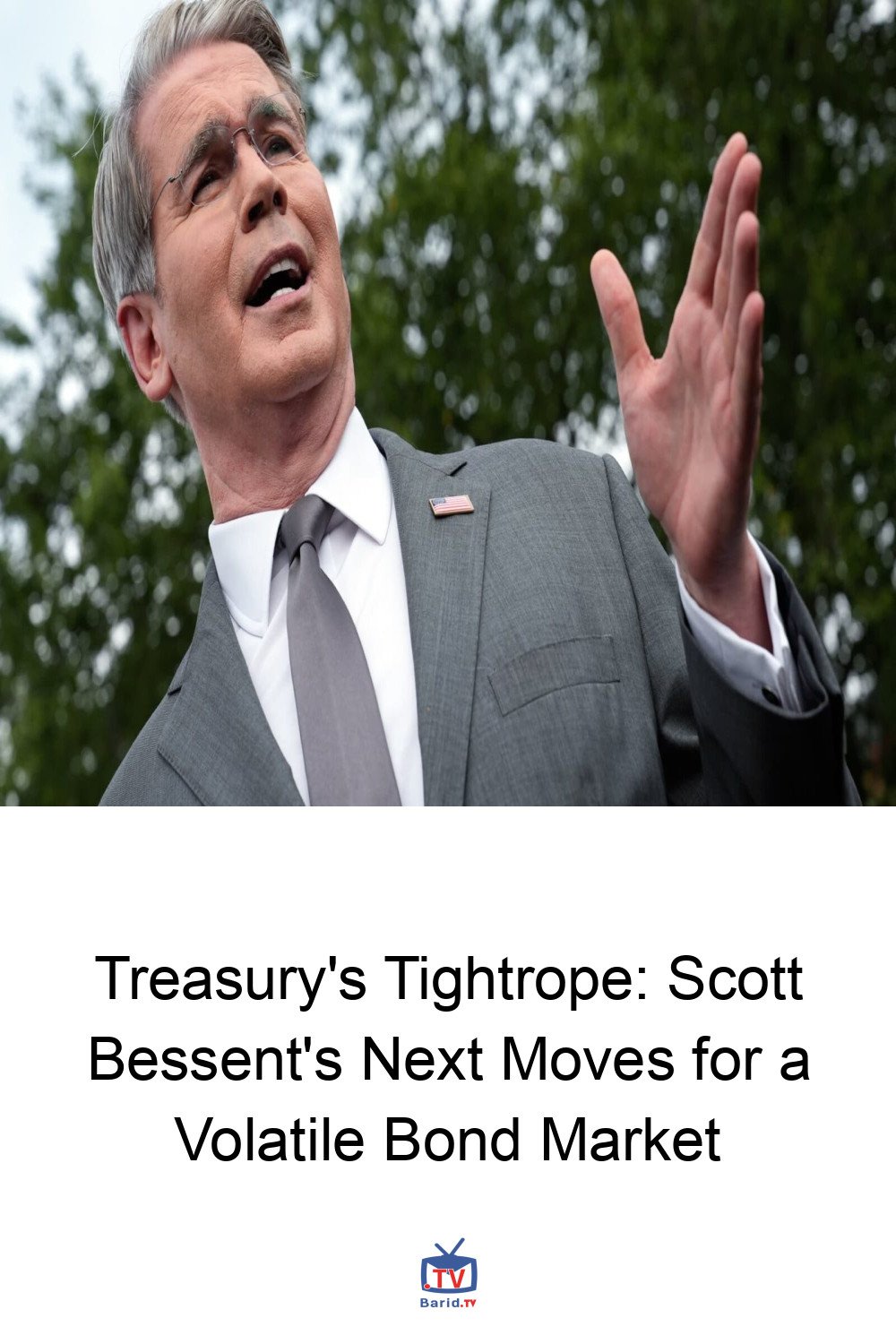
Treasury’s Tightrope: Scott Bessent’s Battle to Calm Volatile Bond Markets
In the high-stakes arena of government finance, Treasury Secretary Scott Bessent finds himself at a critical juncture. Despite his recent assurances of a “big toolkit” to address mounting pressures in the U.S. government bond market, initial interventions have largely failed to quell investor anxieties. As bond yields continue their upward trajectory, the market is scrutinizing Bessent’s next moves, with the credibility of the Treasury itself hanging in the balance.
The urgency of the situation was underscored by Bessent’s remarks on Thursday, following a week of heightened volatility. His declaration of a comprehensive arsenal of tools aims to restore calm to a market grappling with liquidity concerns. However, the two-pronged strategy deployed thus far – an accelerated bond buyback program and an attempt to verbally guide market sentiment – has yielded minimal success, leaving experts and investors alike questioning the efficacy of the Treasury’s current approach.
Initial Efforts Fall Flat: A Skeptical Market Responds
The Treasury’s announcement on Wednesday to significantly increase bond buybacks, starting in early September, initially sparked a positive reaction. Investors, anticipating a crucial backstop for longer-maturity government bonds, saw yields tumble. Yet, this optimism was short-lived. By Thursday, long-end yields had rebounded, reflecting deep-seated skepticism among market participants about the program’s ability to counteract a confluence of adverse factors.
Bessent’s subsequent appearance on CNBC aimed to clarify the Treasury’s intent, emphasizing that the intervention was purely for market liquidity, not yield curve control. While yields briefly dipped, they quickly recovered, overshadowed by criticism regarding the rollout of the prior day’s announcement. One analyst succinctly described the secretary’s televised reassurance as having “minimal impact” on the prevailing market pressures.
Unpacking Bessent’s “Big Toolkit”: Options and Risks
Despite the lukewarm reception to his initial gambits, Bessent maintains that his “big toolkit” offers a range of potent options. “Part of it is signaling here and to show that we believe that the yields don’t reflect the underlying fundamentals,” he stated. However, with markets remaining unconvinced, the pressure is on to deploy more decisive measures. Here are the paths Bessent might consider, each fraught with its own set of opportunities and perils:
Amplifying Buybacks: A Double-Edged Sword?
The most straightforward option would be to simply scale up the existing bond buyback program. If the initial $4 billion-plus round is deemed insufficient, the Treasury could announce even larger, more frequent repurchases. However, critics like Evercore ISI analyst Krishna Guha warn that such a move, if not substantial enough, could be perceived as a “weak form of Operation Twist” – a Federal Reserve initiative that swaps longer-term notes for short-term bills. Guha suggests that an inadequate expansion “will have little enduring impact and could backfire if it is seen as signaling concern about the ability to fund longer-term at acceptable cost.”
Shifting Gears: Smaller Auctions and Maturity Composition
Another avenue involves adjusting the supply side of the equation. The Treasury could reduce the volume of longer-dated debt issued, shifting towards shorter-term bills. This approach, notably criticized by Bessent when employed by his predecessor Janet Yellen, carries the risk of signaling distress. A more aggressive version would involve a broader change in the maturity composition of outstanding debt, requiring investors to absorb lower-yielding, shorter-duration instruments. As Guha notes, “Global investors know that struggling sovereigns often resort to shorter dated issuance. We think the US is different from all others, but it is not different without limit.” This strategy could erode confidence if perceived as a sign of fundamental weakness.
The ‘Bessent Put’: Tactical Maneuvers for Market Control
Markets are already coining the term “Bessent put” to describe the Treasury’s interventions. This concept suggests that the secretary could leverage his tools in an unpredictable, tactical manner to catch short-sellers off guard, impose losses, and create a perception of two-sided risk. This “guerilla operation” aims to slow down fundamentals-driven yield moves and prevent overshooting. While potentially effective for short-term “smoothing,” Guha cautions that “this may not have much lasting impact on where yields are a few months from now.” Its unpredictability, while a strength, could also introduce an element of uncertainty that some investors might find unsettling.
Credibility on the Line
Regardless of the path Bessent chooses – or even if he opts for inaction, allowing markets to self-correct – his decisions carry significant weight for the Treasury’s long-held credibility. Jefferies’ chief U.S. economist, Thomas Simons, has already voiced concerns, pointing out that the buyback announcement came weeks after the quarterly refunding plans, breaking with the Treasury’s established “regular and predictable” communication strategy. Any further deviations from this principle could deepen market skepticism, making future interventions even harder to execute effectively. As the bond market navigates turbulent waters, all eyes remain on Secretary Bessent, whose toolkit may be big, but whose margin for error is increasingly slim.
For more details, visit our website.
Source: Link