
Unveiling the Universe’s Earliest Mysteries
When astrophysicist Charlotte Mason delves into the profound enigmas of the cosmos, her thoughts often translate into intricate doodles. “I am quite a visual person,” she explains, “I usually draw a lot of pictures trying to understand what’s going on.” Mason, a researcher at Copenhagen’s Cosmic Dawn Center, has recently found her sketchbooks filled with ‘little red dots’ – hundreds of perplexing objects discovered in the groundbreaking images from the James Webb Space Telescope (JWST).
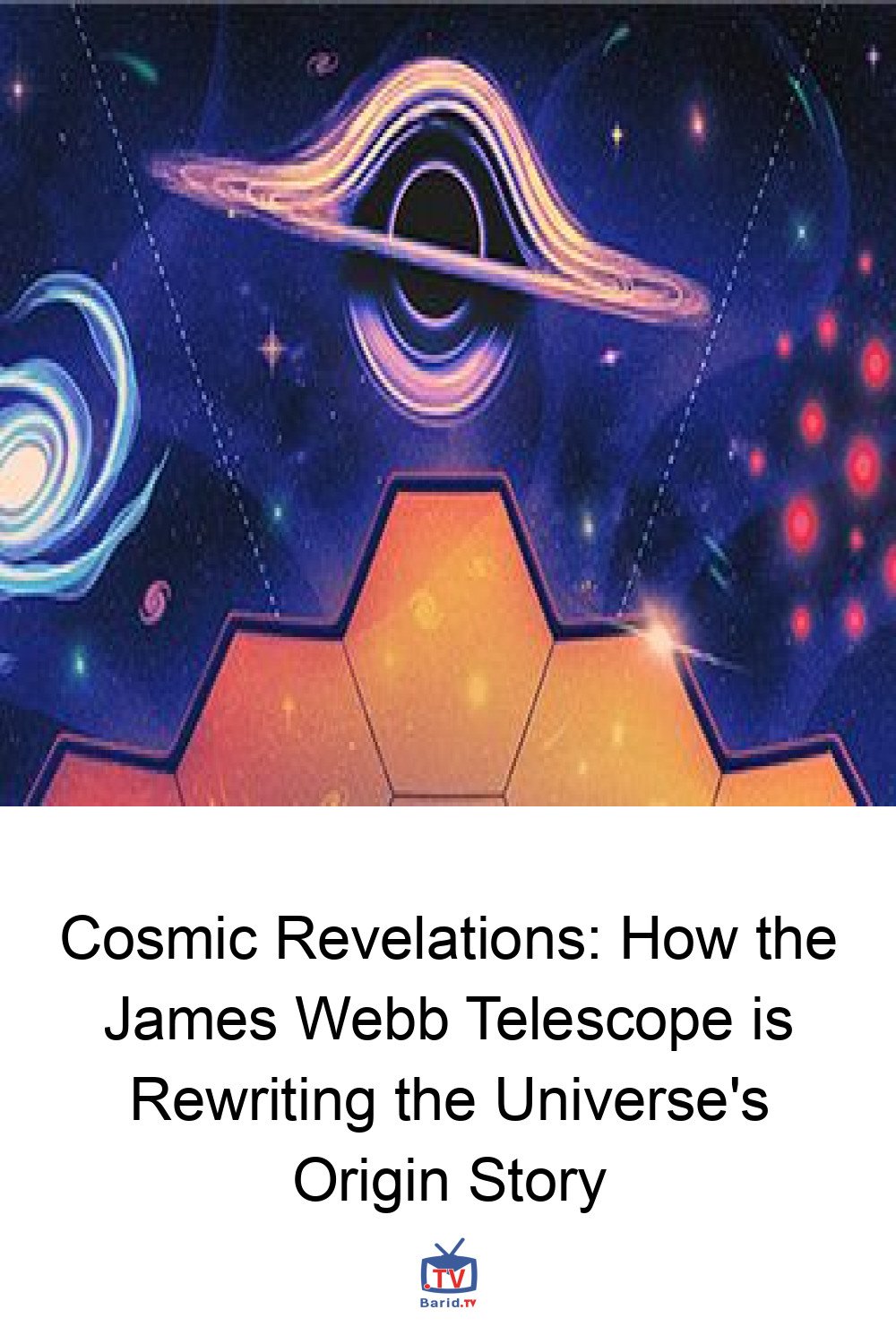
These ‘little red dots,’ previously unseen before JWST’s launch in 2022, began appearing in significant numbers approximately 650 million years after the Big Bang. They represent just one of the many thrilling puzzles emerging from JWST’s unprecedented gaze into the early universe. Other discoveries include black holes that appear astonishingly massive for their age, and ancient galaxies that defy our established understanding of the first billion years post-Big Bang. Initially, the scientific community was stunned; the universe unveiled by JWST simply didn’t align with conventional astrophysical models. Now, a surge of new theories offers compelling potential solutions, though which ones accurately reflect reality remains an open question.
The Enigma of the ‘Little Red Dots’
One leading hypothesis suggests these ‘little red dots’ could be black holes shrouded in dense gas, potentially representing a novel cosmic entity dubbed a ‘black hole star.’ In this scenario, the tight gaseous cocoon emits light akin to a stellar atmosphere. Mason illustrates her concept: “This would be my black hole,” she says, sketching a filled circle. “I might put a disk on it, because we think that’s where some of the emission comes from.” After drawing a line through its center, she adds, “Then the kind of naïve picture is just this dense gas cloud around the black hole,” encircling the object with a larger sphere.
However, Mason suspects there’s more to these cosmic curiosities. Her recent analysis of the light spectrum from one ‘little red dot’ challenged the dense-cloud model. If the gas shroud were uniformly thick, the light passing through it should have been altered in a specific way – a phenomenon not observed. “Now what do I do? Start again. But now if I make my gas clumpy,” Mason muses, sketching a new diagram with gaps in the gas cloud surrounding the black hole, “I should be able to get [a signal] that looks closer.” This iterative process of observation, theory, and refinement is at the heart of modern astrophysics.
Across the globe, researchers like Mason are meticulously assembling JWST’s fragmented glimpses of the ancient cosmos, striving to forge a clearer picture of our universe’s genesis. With every photon traveling billions of light-years to reach us, new pieces of this grand cosmic puzzle are continually falling into place.
Black Holes: Too Big, Too Soon
The narrative surrounding black holes has grown significantly more complex thanks to JWST, which consistently detects ancient black holes that are simply too massive to be explained by current theories. These colossal entities emerged far earlier than previously thought.
In the immediate aftermath of the Big Bang, the universe was largely uniform. Yet, a mere few hundred million years later, “we already see billion-sun black holes growing,” notes Jenny Greene, an astrophysicist at Princeton University. “In order to get them that big so quickly, you have to do some gymnastics.”
Scientists typically consider two primary factors influencing a black hole’s ultimate size: the initial mass of its ‘seed’ and the subsequent rate of its growth. The challenge lies in explaining how black holes either formed with immense initial mass or accreted matter rapidly enough to reach a billion times the sun’s mass in the universe’s infancy.
In the contemporary universe, black holes typically form from the collapse of a massive star’s core. While the first stars were indeed quite large, they are estimated to have left behind black hole seeds of up to about 100 solar masses, according to Greene. “We know that happens, but it’s really, really hard to get them to a billion so quickly,” she emphasizes. “You really have to force-feed them.”
Challenging the Eddington Limit
Historically, a strict limit on black hole growth, known as the Eddington limit, has been accepted. As matter spirals into a black hole, it forms a superheated “accretion disk.” The intense radiation emitted by this disk exerts an outward pressure, counteracting the inward pull of gravity and preventing the black hole from consuming matter indefinitely. This limit should, in theory, make it impossible for black holes to grow tens of millions of times larger within the available cosmic timeframe.
However, recent computer simulations offer a potential workaround. If an accretion disk can ‘puff up’ in a specific configuration, the incoming gas might overwhelm the outward radiation pressure. This phenomenon, termed “super-Eddington accretion,” would allow gas to funnel into the black hole at extraordinary rates, potentially bypassing the traditional growth constraints.
Even with super-Eddington accretion, astronomers are still debating whether there would have been sufficient gas available in the early universe to fuel such rapid growth for the largest black holes. Some researchers propose that ancient, exceptionally dense star clusters might have generated numerous black hole seeds that then merged rapidly, contributing to the formation of these early cosmic giants.
For more details, visit our website.
Source: Link