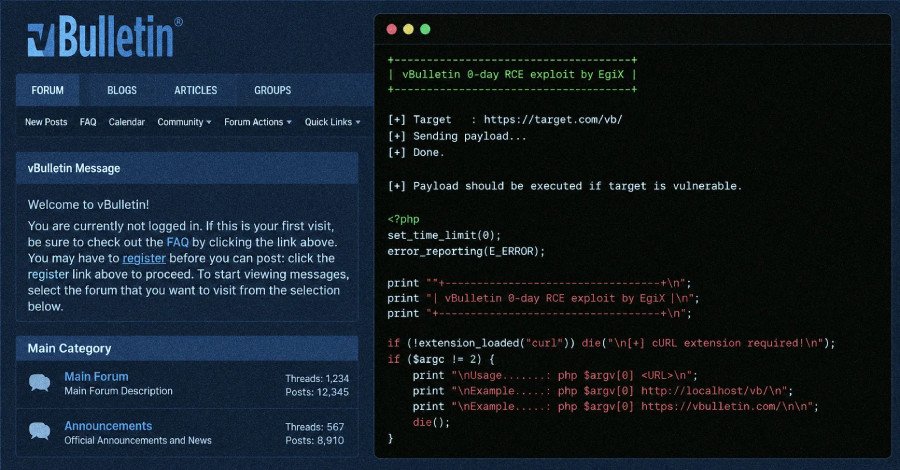

A significant security vulnerability affecting vBulletin forum software has been brought to light with the public release of exploit details. This flaw, identified as CVE-2026-61511, allows an unauthenticated attacker to execute arbitrary code on vulnerable servers, posing a severe risk to self-hosted installations that have not yet applied critical patches.
The Unsettling Details of CVE-2026-61511
On July 27, 2026, SSD Secure Disclosure unveiled the technical specifics of a pre-authentication remote code execution (RCE) vulnerability within vBulletin. This critical flaw permits an attacker to trigger PHP’s
eval() function through an unauthenticated request, meaning no user account, administrative access, or user interaction is required for a successful exploit.
Affected Versions and the Patch Timeline
The vulnerability impacts vBulletin versions 6.2.1 and earlier, as well as 6.1.6 and earlier. Crucially, vBulletin had already addressed this issue, releasing security patches for versions 6.2.1, 6.2.0, and 6.1.6 at the end of June, followed by the fixed version 6.2.2 on July 1. This means the public exploit emerged nearly four weeks after the vendor had provided a fix.
While vBulletin’s Cloud sites were reportedly patched proactively, administrators of self-hosted installations bear the responsibility of applying the relevant patch for their branch or upgrading to 6.2.2. The delay between the patch release and public exploit disclosure leaves a concerning window during which the flaw could have been silently exploited, though SSD has not reported active exploitation in the wild as of July 27, 2026.
How the Exploit Works: A Deep Dive into ‘phpfuck’
The core of CVE-2026-61511 lies within vBulletin’s template engine, specifically in the vB5_Template_Runtime::runMaths() method located in /includes/vb5/template/runtime.php. This method, designed to handle inline mathematical expressions, contains a critical flaw: it strips characters outside a restricted set but then passes the remaining input directly to eval().
The filter is designed to block letters but permits digits, parentheses, concatenation, arithmetic, and binary operators like XOR. This seemingly restrictive set is, in fact, sufficient for an attacker to reconstruct PHP strings and callable function names without using any letters – a technique dubbed “phpfuck” by the advisory. The exploit leverages a public route, ajax/render/pagenav, where the pagenav[pagenumber] value supplied by a visitor is copied into a {vb:math} tag, subsequently passed to runMaths(). This chain transforms a template bug into a pre-authentication RCE, allowing the execution of operating-system commands and returning the output in the HTTP response.
An interactive proof-of-concept (PoC) was published, initially containing a minor typo. Once corrected, security researchers, including The Hacker News, confirmed the expression-building flaw, validating the underlying vulnerability.
The Lingering Threat and Defender’s Call to Action
Despite the vendor’s proactive patching, the public release of exploit details elevates the risk for a specific, yet significant, population: self-hosted, internet-facing vBulletin forums that have not yet updated. The exploit, though new, targets an already fixed flaw, making timely patching paramount.
Defenders should immediately review their vBulletin installations and apply the necessary updates. Additionally, monitoring POST requests for routestring=ajax/render/pagenav with unusually long or operator-heavy pagenav[pagenumber] values can serve as a detection pattern, though this is derived from the public PoC rather than official vendor guidance.
This incident echoes past vBulletin vulnerabilities. A similar pre-authentication RCE chain in May 2025 (CVE-2025-48827 and CVE-2025-48828) also exploited the template engine and saw exploitation attempts shortly after disclosure, despite earlier quiet patches. The recurring pattern underscores the critical need for forum administrators to remain vigilant and prioritize security updates.
Stay informed on the latest cybersecurity threats. Follow us on Google News, Twitter, and LinkedIn for more exclusive content.
For more details, visit our website.
Source: Link