

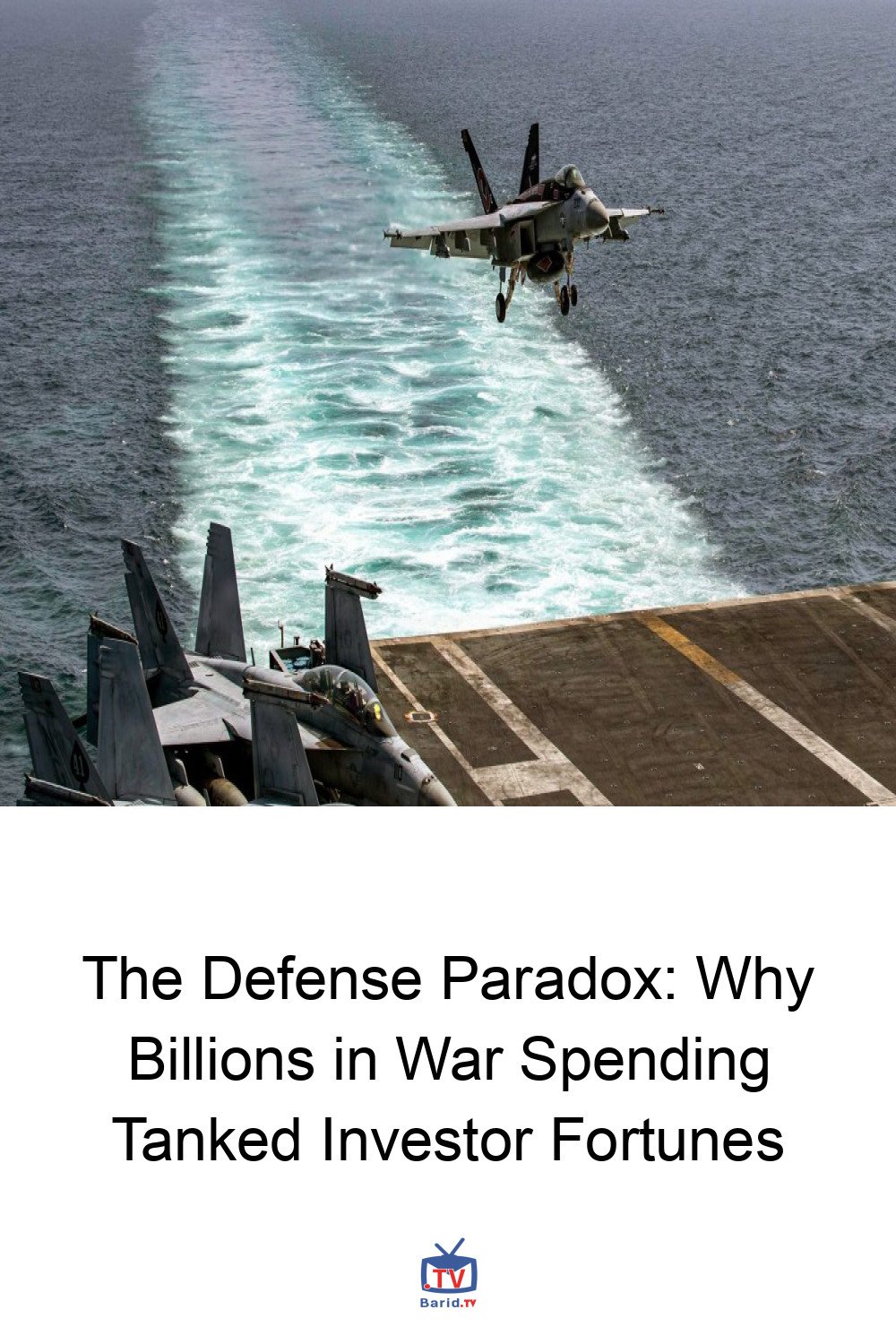
The echoes of conflict in Iran, ignited by President Donald Trump’s Operation Epic Fury, have left the U.S. with a staggering $37.5 billion bill. Yet, in a counterintuitive twist, the very investors who anticipated a defense industry boom have instead witnessed a significant downturn for many of the sector’s giants on Wall Street. Despite sustained conflict and the Pentagon’s requests for historic defense budgets, the expected windfall has largely eluded those who bet big.
The Initial Surge and Subsequent Slide
In the opening days of the conflict, trading volumes for major defense contractors soared, with some experiencing a remarkable 140% increase above their average during Trump’s second term. However, this initial enthusiasm proved fleeting. Companies like Northrop Grumman have seen their value plummet by over 30%, L3Harris Technologies by more than 20%, and Lockheed Martin by nearly 13%. Raytheon Technologies (RTX), a Fortune 500 stalwart, initially dropped by approximately 18% before a strong second-quarter earnings report helped its stock recover to a 4% gain.
Why the Market Remained Unimpressed
The selloff appears perplexing given the sheer scale of military expenditure. The Pentagon deployed thousands of high-end munitions, including over 1,000 Tomahawk cruise missiles and hundreds of THAAD, Patriot, and SM-3 interceptors, according to the Center for Strategic and International Studies. The replenishment of these depleted stockpiles, coupled with the Trump administration’s ambitious $1.5 trillion defense budget—a 42% increase—should, in theory, fuel contractor profits. So, what went wrong?
Guy Rozentsveig, managing director at Solomon Partners, offers a straightforward explanation: “The consensus opinion is that a lot of that good news was already priced in.” Investors are now in a holding pattern, scrutinizing whether increased defense budgets will genuinely translate into new contracts, accelerated production, and robust earnings, or if political and economic headwinds will stifle long-term momentum. Meanwhile, a new wave of defense technology startups is also vying for a share of this future spending pie.
History’s Unflinching Lesson: Timing is Everything
Evaluating defense stocks requires a deeper understanding than simply tracking quarterly earnings or missile counts. The true determinant of investment value often lies in governments’ long-term spending commitments. Mike Derrios, executive director of the Baroni Center for Government Contracting at George Mason University, highlights a crucial historical pattern: the most significant returns, or ‘investor alpha,’ are typically realized well before a conflict even begins.
“Investor ‘alpha’ is most likely gained when investments are made before wars and before legislated funding, not after a war has begun, become unpopular, or when associated plus-ups are in doubt,” Derrios explained to Fortune. This sentiment is echoed by historical data. For instance, while some contractors saw initial gains following Russia’s invasion of Ukraine in February 2022, a Fisher Investment analysis revealed that much of this growth had already occurred prior to the conflict. Post-invasion, defense stocks largely mirrored the broader market, underscoring that armed conflict alone does not guarantee sustained, market-beating returns. The firm concluded, “The rationale sounds logical, but history suggests this isn’t necessarily a winning move.” For astute investors, the key isn’t the war itself, but strategic positioning before it commences.
Beyond the Battlefield: Broader Economic and Political Currents
Investors must also grapple with the multifaceted nature of many leading defense companies. Giants like Boeing, for example, derive substantial revenue from their commercial aviation divisions. This means their stock performance can be equally influenced by broader economic conditions as by Pentagon spending, diluting the impact of defense contracts.
Looking ahead, potential shifts in the U.S. political landscape pose another significant variable. Byron Callan, managing director at Capital Alpha Partners, an independent research firm, raised concerns about public sentiment. “If the public reacts even more negatively to a resumption of fighting with Iran, that’s going to bode even worse for GOP prospects in the midterm elections—what will that say about defense in ‘27 and ‘28?” he pondered on the Defense & Aerospace Report podcast. The broader economy, with risks of spiking energy prices, higher inflation, and subsequent interest rate hikes by the Federal Reserve, also casts a long shadow over future investment prospects.
The New Guard vs. The Old: Who Will Win the Future?
Despite these challenges, many established defense players are entering the latter half of the year with robust foundations, bolstered by impressive order books. Raytheon Technologies and Northrop Grumman, for instance, have reported record backlogs of $289 billion and $105 billion, respectively, while Lockheed Martin’s backlog stands at a formidable $167 billion.
However, even if Washington delivers on its defense spending promises, not all investors are convinced that the traditional industry behemoths will be the sole, or even primary, beneficiaries. Over recent years, venture capital has poured billions into a new generation of defense technology companies, signaling a potential shift in where future windfalls might land. The race is on to see whether the established ‘old guard’ will continue to dominate or if agile, innovative newcomers will capture the lion’s share of the evolving defense market.
For more details, visit our website.
Source: Link