
Januscape: The 16-Year-Old Linux KVM Flaw That Threatened Cloud Security
For over a decade and a half, a critical vulnerability lay dormant within the heart of Linux’s Kernel-based Virtual Machine (KVM) hypervisor, silently posing a significant threat to virtualized environments worldwide. Dubbed ‘Januscape’ and tracked as CVE-2026-53359, this insidious flaw allowed malicious guest virtual machines to break free from their confines and execute code on the host system itself. Its discovery marks a pivotal moment in cybersecurity, particularly as it represents the first known guest-to-host exploit affecting both Intel and AMD x86 architectures.
What is Januscape?
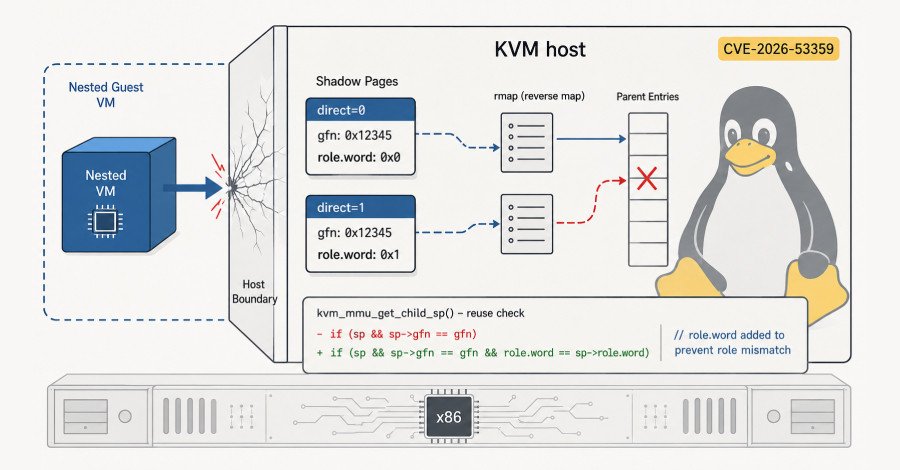
At its core, Januscape is a use-after-free bug nestled within KVM’s shadow Memory Management Unit (MMU) code. This shared component, critical for managing memory access for virtual machines across both Intel and AMD platforms, harbored a defect that could be triggered by a guest VM to corrupt the host kernel’s shadow-page state. While a publicly released proof-of-concept (PoC) merely causes the host to panic – effectively crashing all virtual machines running on it – the security researcher behind the discovery claims a separate, unreleased exploit can leverage the same bug for full host code execution.
The flaw was unearthed and reported by security researcher Hyunwoo Kim (@v4bel), who highlighted its unprecedented cross-platform impact. The fact that such a significant vulnerability remained undetected for approximately 16 years underscores the complexity and subtle nature of kernel-level bugs.
Unpacking the Vulnerability: How it Works
The Shadow MMU’s Fatal Flaw
To efficiently manage virtual machines, KVM maintains its own set of page tables that mirror the memory layout of each guest. When KVM requires one of these tracking pages, it attempts to reuse an existing one. The fundamental problem with Januscape lay in this reuse mechanism: KVM matched these pages solely by their memory address, neglecting to verify the
type of tracking page it was retrieving. Since different types of tracking pages could share the same address but perform entirely distinct functions, KVM would sometimes inadvertently reuse the wrong kind.
This critical mix-up scrambled KVM’s internal records, leading to an inconsistent and corrupted state regarding which memory page belonged where. In most scenarios, the kernel’s integrity checks would detect this corruption, leading to an immediate shutdown (panic) of the host system to prevent further damage. This is precisely what the public demonstration PoC achieves: a guest VM can unilaterally crash the entire host, taking down every other tenant VM with it.
From Crash to Control
The more severe, albeit rarer, outcome occurs when a freed tracking page is reallocated for another purpose before the kernel can perform its cleanup routine. When the cleanup then attempts to write a value into this memory, it’s writing into a region it no longer legitimately owns. While an attacker typically only controls the location of this write, not the value itself, even this limited foothold can be meticulously exploited to achieve arbitrary code execution as root on the host system. The core vulnerability behaves identically on both Intel and AMD chips; only the final, most intricate step of escalating it to full control requires architecture-specific exploitation techniques.
Who Was at Risk?
A Widespread Threat
The vulnerable code has been a part of the Linux kernel since commit 2032a93d66fa in August 2010 (dating back to the kernel 2.6.36 era) and was finally addressed by commit 81ccda30b4e8, which was merged into the mainline kernel on June 19, 2026.
Exploiting Januscape requires two key conditions from the guest VM’s perspective: root access within the virtual machine (a common scenario in rented cloud instances) and the host exposing nested virtualization. Even on hosts that utilize hardware-assisted virtualization features like EPT or NPT by default, enabling nested virtualization forces KVM to revert to its legacy shadow MMU – precisely where this bug resides. Importantly, this exploit is a pure in-kernel KVM bug, requiring no cooperation from QEMU or any userspace Virtual Machine Monitor (VMM).
Cloud Implications
The primary concern for Januscape is any x86 environment hosting untrusted guests with nested virtualization enabled. An attacker renting a single such instance could trigger a host panic, disrupting all other tenant VMs on the same physical machine. Furthermore, Kim’s withheld full exploit demonstrates root code execution on the host, potentially exposing other guests to that same level of access. For distributions like RHEL, where /dev/kvm is world-writable (0666), the bug could also serve as a local privilege escalation to root, though the guest-to-host escape remains the higher-impact scenario.
The Researcher Behind the Discovery
Januscape marks Hyunwoo Kim’s third significant Linux kernel exploit disclosure in a remarkably short span of two months. In May 2026, he unveiled ‘Dirty Frag’ (CVE-2026-43284 / CVE-2026-43500), a page-cache write vulnerability chain providing deterministic root access across major distributions, building on the legacy of ‘Dirty Pipe’ and ‘Copy Fail’. Following this, in June, he published ‘ITScape’ (CVE-2026-46316), the first publicly demonstrated guest-to-host escape on KVM/arm64, achieved by exploiting a race condition in the virtual interrupt controller. Januscape now completes the picture by addressing the x86 side, with its trigger working on both Intel and AMD, each with its own specific code path in the PoC.
Google’s kvmCTF, a vulnerability reward program launched in 2024 specifically because KVM underpins Android and Google Cloud, was the platform for Januscape’s zero-day submission, offering up to $250,000 for full guest-to-host escapes. This discovery follows another KVM x86 shadow paging use-after-free (CVE-2026-46113) involving a related but distinct rmap mismatch, fixed in May 2026, highlighting a busy period for security researchers focusing on this critical component.
The Solution and What You Need to Do
The Simple Fix
The resolution for Januscape is surprisingly straightforward: a single line of code added to the kvm_mmu_get_child_sp() function. The reuse condition now rigorously checks role.word alongside the guest frame number (gfn), ensuring that a shadow page is only reused when both the frame number and its intended role precisely match. This crucial patch was authored by KVM maintainer Paolo Bonzini.
Urgent Action Required
Fixed stable kernel versions were released on July 4, 2026, and include: 7.1.3, 6.18.38, 6.12.95, 6.6.144, 6.1.177, 5.15.211, and 5.10.260. While the National Vulnerability Database (NVD) has not yet assigned a CVSS score, organizations should not delay patching.
If you operate an x86 KVM host that supports multi-tenant guests with nested virtualization enabled, it is imperative to confirm that your kernel includes commit 81ccda30b4e8
. Be aware that distribution-specific backports may incorporate this fix under a different version number. Proactive patching is the only way to mitigate the significant risks posed by Januscape and protect your virtualized infrastructure from potential guest-to-host escapes.
For more details, visit our website.
Source: Link