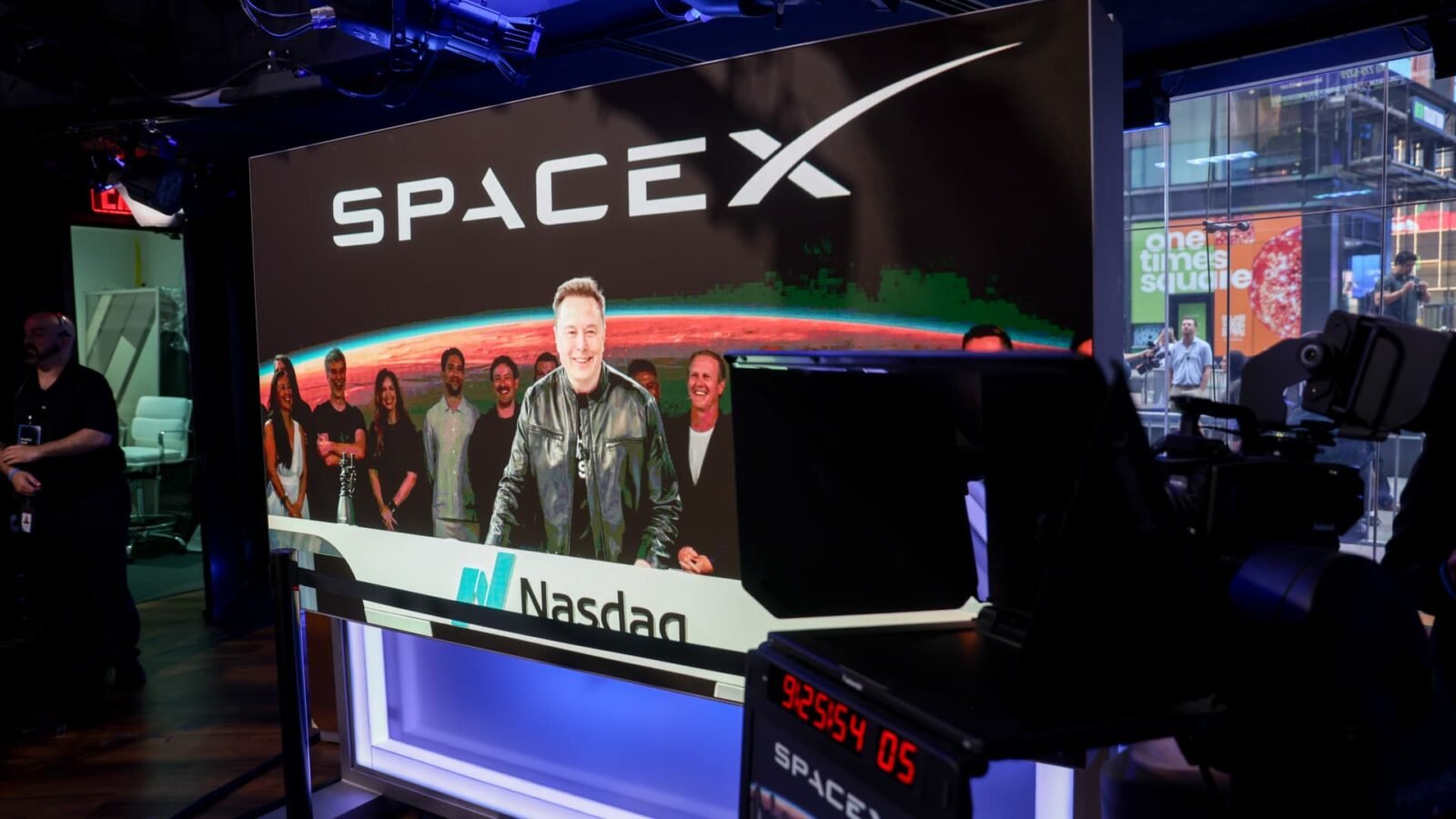

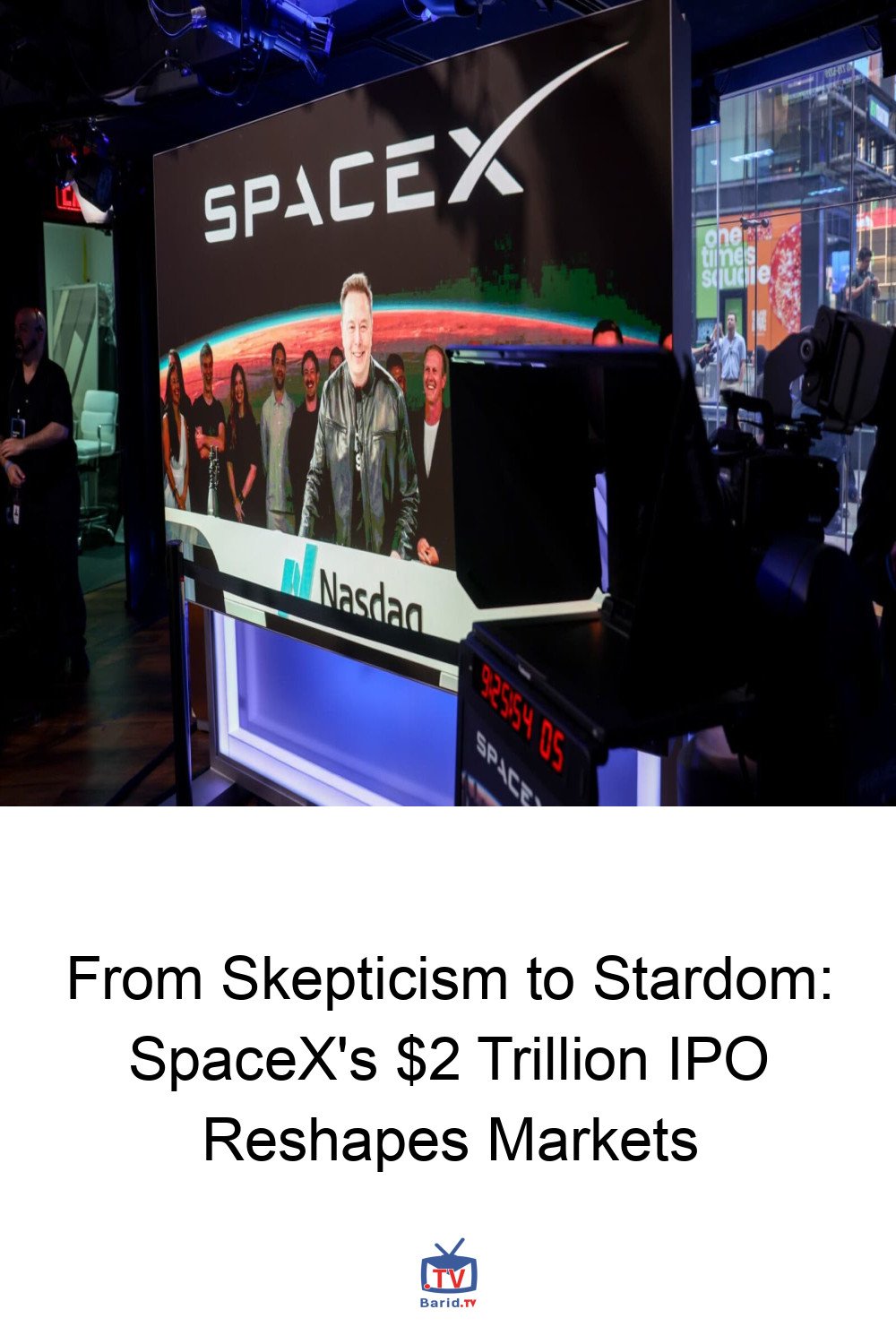
In a stunning market debut that defied all odds, SpaceX, Elon Musk’s ambitious rocket company, closed its first day of trading with a staggering market capitalization exceeding $2 trillion. This monumental achievement instantly positioned SpaceX as the sixth most valuable U.S. company and, perhaps more remarkably, propelled its founder, Elon Musk, to become the world’s first trillionaire. The irony is palpable, considering Musk himself once gave the venture less than a 10% chance of success.
A Trillion-Dollar Triumph: SpaceX’s Unprecedented Debut
Friday’s trading saw over 500 million SpaceX shares change hands, marking an extraordinary entry into the public market. The initial public offering (IPO) raised an astounding $75 billion, dwarfing Alibaba’s 2014 offering, which previously held the record for the largest U.S. debut. This colossal sum is roughly triple the size of the next-biggest U.S. offering, underscoring the unprecedented scale of SpaceX’s financial milestone.
Musk, just weeks shy of his 55th birthday, addressed a jubilant crowd at SpaceX’s Texas town, reflecting on the company’s humble beginnings in 2002. With a workforce now numbering 22,000 full-time employees, his early skepticism — “If people had told me this was going to happen, I was like, man, you must be smoking some really good crack… Because I think this company is going to fail” — now serves as a testament to the company’s improbable journey to the pinnacle of global finance.
Musk’s Maverick Approach: An IPO on His Own Terms
The SpaceX IPO was anything but conventional. Eschewing traditional market mechanisms, the company priced its shares at $135 in an abbreviated roadshow, presenting investors with a stark ‘take it or leave it’ proposition. There was no price range to gauge demand, no haggling with prospective shareholders – a testament to Musk’s singular vision and market leverage. This unconventional approach prevailed despite SpaceX’s revenue being a fraction of other tech giants and the company reporting a $4.9 billion loss last year.
Post-debut, SpaceX’s valuation of $2.1 trillion translated to a multiple of 112 times last year’s revenue, a figure that left many analysts astonished. Lloyd Greif, CEO of investment bank Greif & Co., succinctly captured the sentiment: “This was not a deal that was priced based on market forces… This was a deal based on what one man wanted. And when one man wants it, one man gets it, if that one man is Elon Musk.”
The Trillionaire Debate: Wealth Disparity in the Spotlight
While Wall Street celebrated, Musk’s new trillionaire status ignited a fierce debate on wealth disparity, particularly as consumers grapple with crippling inflation exacerbated by global conflicts. Senator Bernie Sanders of Vermont, a self-proclaimed Democratic Socialist, took to social media, declaring Musk’s wealth a “call to action to take on the unprecedented income and wealth inequality that now exists.” California Governor Gavin Newsom echoed these concerns on X (owned by SpaceX), stating, “Americans are struggling to pay for groceries and gas while Elon Musk becomes a TRILLIONAIRE.”
Reigniting Wall Street: A Catalyst for Future Tech IPOs
Despite the social commentary, the mood on Wall Street remained buoyant. The market had been starved for new offerings since late 2021, and SpaceX’s robust performance—closing up 19% and consistently holding above its offer price—injected much-needed confidence. The success is seen as a positive harbinger for potential deals later this year from artificial intelligence model giants like OpenAI and Anthropic, both privately valued at close to $1 trillion. Former Nasdaq CEO Robert Greifeld expressed strong conviction, stating he “would definitely bet” on both companies going public in 2026, following their confidential IPO paperwork filings this month.
Beyond Facebook: Setting a New Benchmark for Public Offerings
SpaceX’s IPO not only broke records but also redefined benchmarks. The 500 million shares traded on Friday approached Facebook’s 2012 debut, which saw 580 million shares change hands. However, the scale of SpaceX’s valuation is in a league of its own: Facebook’s first-day market cap was around $100 billion, a mere one-twentieth of SpaceX’s current valuation. Both companies are founder-controlled, but Musk’s grip on SpaceX is even more formidable, with over 82% of the voting power, compared to Mark Zuckerberg’s 56% at Facebook’s IPO.
The financial windfall extended beyond Musk. Alphabet’s initial $900 million investment in SpaceX in 2015 now translates to a stake worth over $100 billion. Valor Equity Partners, led by Musk’s long-time associate Antonio Gracias, holds a stake exceeding $80 billion for its clients. Furthermore, the IPO reportedly minted some 4,400 millionaires among current and former SpaceX employees, solidifying its impact across a broad spectrum of stakeholders.
For more details, visit our website.
Source: Link