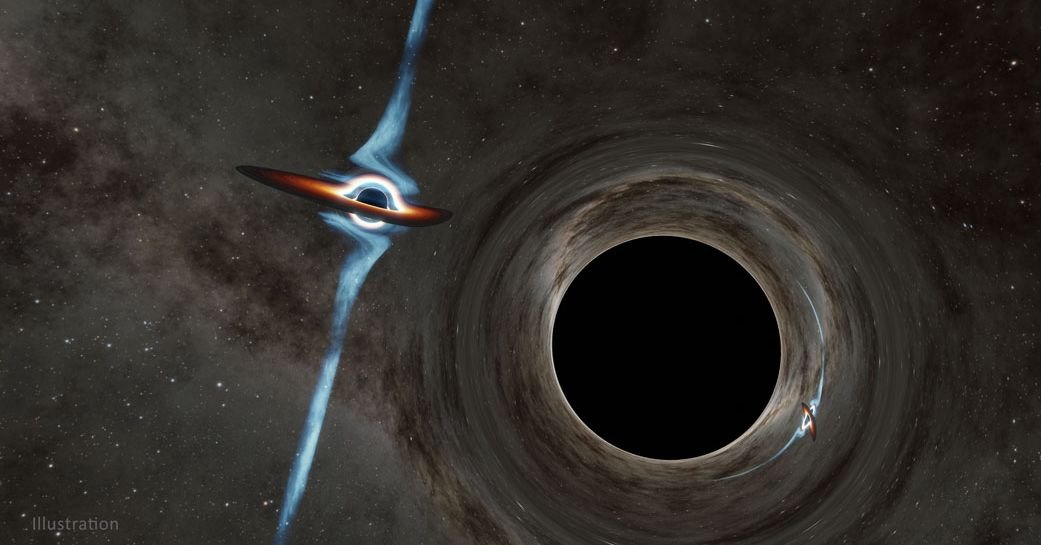

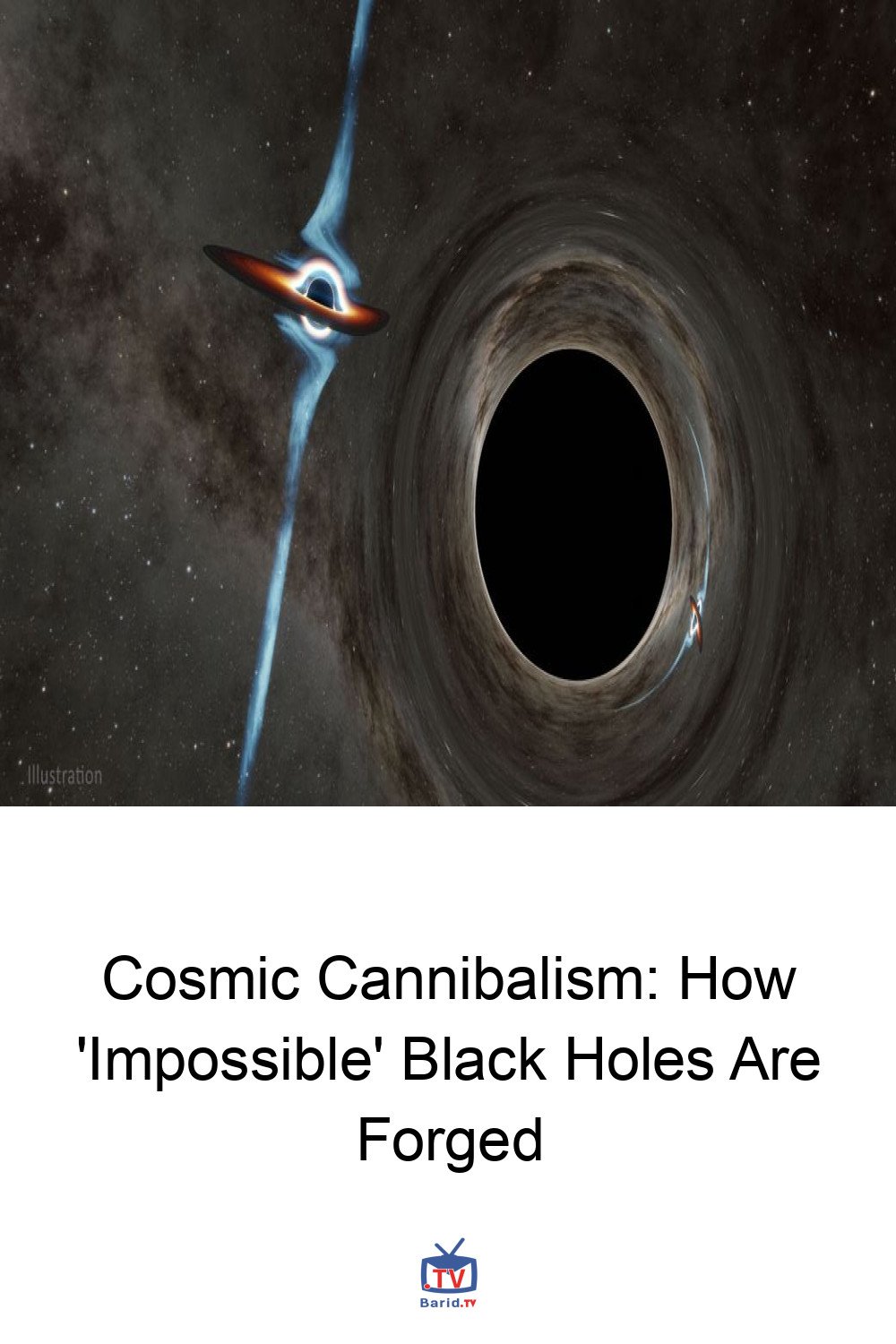
For years, a perplexing cosmic enigma has haunted astrophysicists: the existence of “impossible” black holes. These colossal entities, far too massive to be born from the demise of a single star yet not quite reaching supermassive proportions, defied conventional stellar evolutionary theories. Now, groundbreaking research, fueled by the revolutionary capabilities of gravitational wave detectors, has finally unveiled their secret: the universe is a grand recycler, forging these cosmic behemoths through repeated mergers.
The Cosmic Conundrum: Black Holes That Shouldn’t Exist
Traditional stellar physics neatly categorizes black holes into two main types. On one end, we have the “stellar-mass” black holes, typically 10 to 40 times the mass of our sun, born from the catastrophic collapse of giant stars. On the other, the “supermassive” black holes, lurking at the hearts of galaxies, boasting millions or even billions of solar masses, their origins tied to the universe’s earliest epochs.
However, between these well-understood extremes lay a forbidden zone: black holes weighing between 40 and 100 solar masses. These objects presented a paradox. They were too heavy to be the direct result of a star’s death, yet not large enough to form from the collapse of primordial gas clouds. They were, by all accounts, “impossible” – a theoretical gap that observations increasingly refused to ignore.
Gravitational Waves: The Universe’s Echoes Reveal All
The solution to this cosmic mystery emerged with the advent of gravitational wave astronomy. These sophisticated instruments, employing ultra-precise lasers, can detect the minuscule ripples in spacetime generated by the most violent events in the cosmos, such as the collision of black holes. The inaugural detection in 2015 confirmed the first black hole merger, opening an entirely new window into the universe.
Since then, a torrent of new signals has poured in, allowing scientists to characterize these mergers with unprecedented detail. These detections revealed that black hole collisions are far more common than previously imagined, providing the crucial evidence needed to explain the “impossible” black holes.
The Signature of Second-Generation Giants
A recent study, published in Nature Astronomy, meticulously analyzed a catalog of 153 reliable black hole merger detections from the world’s leading observatories. Among these, 34 involved particularly heavy objects, prompting a deeper investigation.
By scrutinizing the characteristics of these mergers, the international team identified two distinct populations. Lighter black holes, up to approximately 40 solar masses, exhibited small, aligned spins – a hallmark consistent with their birth from a single collapsing star. But beyond the 45-solar-mass threshold, a different story unfolded.
This heavier population displayed rapid, chaotically oriented spins. This unique “statistical signature” is a smoking gun, indicating that these black holes had already participated in previous mergers. As Isobel M. Romero-Shaw, a coauthor from Cardiff University, explained, “This is the exact signature you would expect if black holes repeatedly merged into dense stellar clusters.”
While these “impossible” black holes remain invisible to traditional X-ray or visible light telescopes, their gravitational echoes speak volumes. They are not born; they are built. They are the cosmic offspring of previous generations of collisions, assembled in the densest, most dynamic environments of the cosmos, continually growing through a process of gravitational cannibalism.
This groundbreaking research fundamentally reshapes our understanding of black hole evolution, proving that the universe is far more dynamic and self-recycling than we ever conceived.
For more details, visit our website.
Source: Link