
“The most common form of despair is not being who you are.” ~Søren Kierkegaard
The erosion of self isn’t always a sudden collapse; often, it’s a quiet, persistent wearing away, a subtle shift in the landscape of one’s identity. This was my experience within a friendship that, at first glance, seemed like a gift. I didn’t lose her all at once; I lost myself first—slowly, quietly, in the insidious way that only happens when someone you trust begins to systematically dismantle everything you believe and feel.
The Allure and the Unraveling
When we first met, she was a force of nature. Magnetic, intense, radiating a warmth that made you feel uniquely chosen by her attention. To be her friend felt like a privilege, a stroke of luck. This intoxicating feeling, however, served as a potent veil, blurring the edges of what was to come.
A Gradual Drift from Self
The shifts began subtly, almost imperceptibly. A personal plan would somehow morph into her agenda. An opinion I voiced would be gently, yet relentlessly, deconstructed until its original conviction evaporated, leaving me questioning its very foundation. A decision made independently would be met with such a profound silence that I’d find myself apologizing, often unsure for what transgression. This became our unspoken rhythm: my action, her reaction, my apology, my adjustment. Each concession felt entirely reasonable in the moment, much like a minor course correction at sea. Yet, with each degree of change, I drifted further from my intended path, eventually finding myself in a place I barely recognized.
The Insidious Nature of Control
What made this dynamic so challenging to identify was its utter lack of overt hostility. There were no raised voices, no explicit threats, no dramatic confrontations to pinpoint and label as ‘control.’ Instead, it was a far more nuanced, psychological architecture of influence. It manifested as the crushing weight of her disappointment, a guilt so expertly woven that I genuinely believed I was its sole architect. I began to pre-emptively edit my thoughts and words, rehearsing conversations to avoid the dreaded reactions I had learned to anticipate. My instincts, once a reliable compass, gradually atrophied from disuse.
The Narrative of Doubt
A hundred indirect messages reinforced the idea that my judgment was flawed, my sensitivity excessive, my memory unreliable. My reactions, I was told, were the problem, not the actions that provoked them. And, devastatingly, I began to internalize this narrative. The most unexpected part of this journey was the profound extent to which I accepted the story she crafted about me, allowing it to overshadow my own truth.
Unmasking the Red Flags
In hindsight, the warning signs were present from the very beginning, though I lacked the vocabulary to name them then. Her needs, her crises, her plans—everything she touched seemed imbued with an urgent, undeniable priority. Any attempt to share my own life’s happenings would invariably circle back to her within minutes. Unconsciously, I stopped bringing my concerns to her; there simply wasn’t room for my problems in a friendship perpetually overflowing with hers.
Generosity with Invisible Chains
Her generosity, too, came with unseen strings. Favors rendered would later resurface, not as complaints, but subtly woven into conversations, creating a quiet sense of indebtedness. Phrases like, “I was there when nobody else was,” delivered lightly but frequently, began to accumulate, compelling me to keep a mental ledger of what I ‘owed’ her. When I deviated from her expectations—making plans without her, voicing a disagreement, or simply being unavailable—a distinct coldness would descend. It wasn’t anger, but a withdrawal of warmth, a subtle emotional chill that compelled me to work tirelessly to regain her favour, usually by abandoning whatever had caused the initial distance.
I rationalized this as the natural ebb and flow of close friendships, believing that all relationships demanded compromise, flexibility, and adjustment. I convinced myself I was being too independent, too rigid, too unwilling to prioritize someone who clearly needed me. I was profoundly mistaken, but the realization would take time to fully crystallize.
The Quiet Revelation: A Turning Point
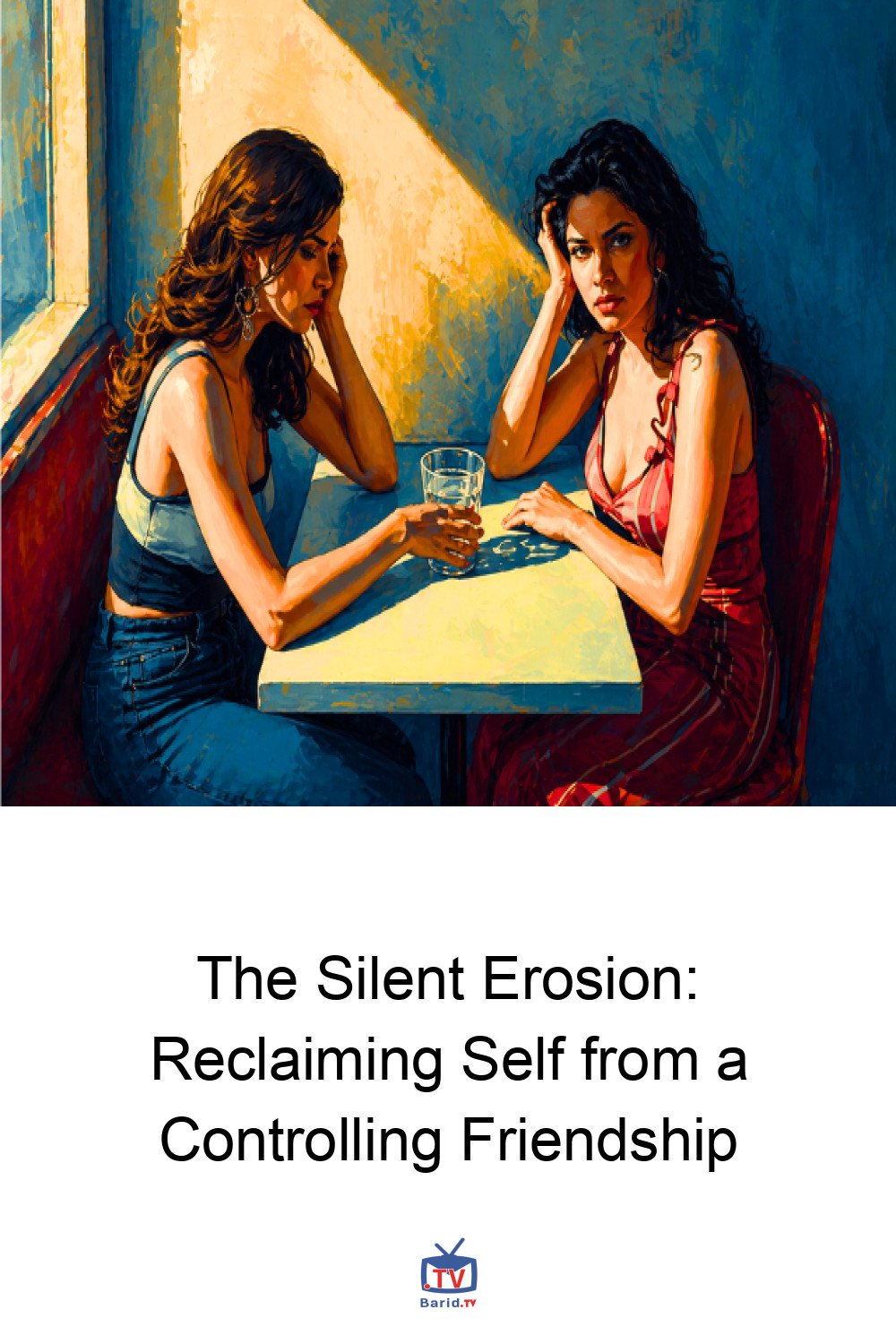
The moment of clarity wasn’t a dramatic explosion, but a quiet, almost mundane Tuesday. She was, for the third time that week, recounting a grievance about a coworker. I remember her characteristic lean forward, a physical cue signaling the climax of her narrative, where she was unequivocally right, and everyone else was wrong. I tried, I truly did, to perform the expected empathy. I made the appropriate facial expressions, uttered a perfectly timed, “That’s so unfair,” a well-practiced response.
When Performance Replaced Feeling
But beneath the surface of my performance, something had quietly fractured. I had cancelled dinner with a friend who genuinely inquired about my well-being, rearranging my entire evening for this. And here I was, nodding through a thrice-told tale, so adept at feigning care that I hadn’t noticed I’d stopped actually feeling it. When she finally paused, a fleeting thought crossed my mind: “Maybe now. Maybe she’ll ask.” I took a breath, beginning to voice something that had weighed heavily on me for days. I barely managed half a sentence before she interrupted, adding a new, seemingly vital detail to her ongoing story, continuing without a break, an apology, or any acknowledgment that I had even spoken. Just her voice, filling the room again, demanding my attention. And I complied, as I always did. But in that precise moment—being stopped mid-sentence, yet still expected to nod, still expected to care, still expected to perform—something irrevocably broke within me. It was the realization that my presence had been reduced to an audience, my voice silenced, and my very being rendered invisible in the shadow of her relentless narrative.
Reclaiming My Narrative: Lessons Learned
That quiet Tuesday marked the beginning of my journey back to myself. It wasn’t an immediate escape, but a slow, deliberate process of disentanglement. I began to recognize the patterns, to name the subtle manipulations, and to understand that true friendship is a reciprocal exchange, not a one-sided performance. Reclaiming my voice, my opinions, and my instincts was a challenging ascent, but with each step, the fog of self-doubt began to lift. I learned that valuing myself meant setting boundaries, even if it meant risking the ‘coldness’ I once dreaded. The most profound lesson was that losing a friendship, even one that once felt essential, can be the very act that allows you to find the most important friend of all: yourself.
For more details, visit our website.
Source: Link