
The Silent Revolution: How I Broke Free from a Narcissist’s Grip
“Knowledge is not skill. Knowledge plus ten thousand times is skill.” ~Shinichi Suzuki
For two decades, I lived a frustrating paradox. I was an armchair expert in navigating interactions with my narcissistic mother, fluent in strategies like ‘gray rocking,’ ‘broken record,’ and the critical ‘Don’t JADE’ (Justify, Argue, Defend, Explain). I could articulate these techniques with crystal clarity to anyone who would listen. Yet, when faced with her across a dinner table, her familiar provocations would instantly dismantle my resolve. My body would betray me: chest tightening, palms sweating, and within moments, I was either frozen in silence or launching into the very emotional reaction she sought. The drive home was always a replay of regret, a mental script of what I should have said. This cycle was my constant companion for twenty long years.
The Echo Chamber of Abuse: A Two-Decade Struggle
Both my parents exhibited classic patterns of narcissistic abuse. With my father often absent, my mother became the primary architect of this dynamic from my teenage years onward. Our relationship was a revolving door of conflict and temporary estrangements, including one three-year period of no contact after a particularly toxic incident involving my wife. I harbored the naive hope that distance would heal, but it merely paused the inevitable. Complete severance felt equally unfeasible, leading to a predictable return, a brief calm, and then the insidious cycle would restart. A seemingly innocuous family dinner, a phone call, a carefully crafted comment designed to needle – and I would react, every single time.
The most infuriating aspect was my acute awareness. I’d consumed countless hours of content from psychologists specializing in narcissistic abuse, devoured books, engaged in online forums, and resonated with every shared experience. Intellectually, I understood the theory inside out. But theory, I discovered, is a fragile shield when someone is looking you in the eye, twisting the knife of your past vulnerabilities.
The Dinner That Rewrote the Script
Last December, my father’s cancer diagnosis brought me back home. He declined to see me, unwilling to be seen “like that,” leaving me to spend time with my mother. We shared a surprisingly pleasant day, skirting personal topics, discussing everything and nothing. I was almost lulled into a false sense of security. Then, after dinner, she delivered the familiar opening: “We need to talk about what happened three years ago.”
A New Mental Framework: The Alzheimer’s Analogy
This time, something was different. In the days leading up to our meeting, I had diligently rehearsed a single, powerful idea: If she had Alzheimer’s or dementia, I wouldn’t argue. There would be no point. Her brain wouldn’t process my logic, no matter how perfect my argument. I decided to apply this exact framework. She was ill, I reasoned; it was her illness speaking. There was zero utility in explaining myself or justifying anything.
So, when she began, I calmly stated, “I’m not going back to the past. What happened, happened. Let’s focus on the present and on supporting Dad with his recovery.”
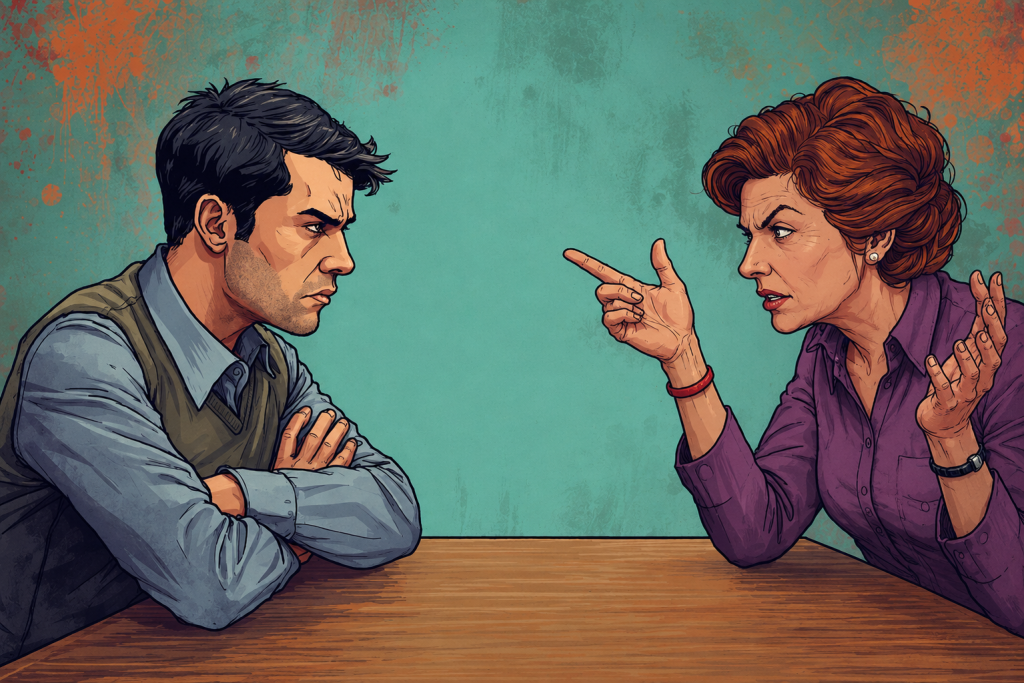
She didn’t accept it. She pressed on, dredging up old grievances she knew would sting: “Your wife is cold and heartless. She didn’t even offer me coffee when I was at your house.” “You sat me at the worst table at your wedding.” These were wounds from years past, and I had a ready retort for each, as I always did. But I knew, from bitter experience, that comebacks only fueled her. She recycled these topics precisely because they triggered me.
The tension was palpable. It felt like a high-stakes interrogation. Sweat beaded on my back. Every fiber of my being screamed to retaliate, to “put her in her place.” But I clung to my mantra: Alzheimer’s. No point. She’s very ill. After about ten excruciating minutes, she stopped. Abruptly, she shifted the conversation to a random news item. I was stunned.
Twenty minutes later, she tried again. It was late, my defenses were waning, and she escalated her tactics with even more provocative subjects. Yet, I held the line. The same sentence, repeated calmly, became my shield: “I’m not discussing things from the past.” And then, she stopped again. Her entire demeanor softened. “Thanks so much for coming,” she said. “I’m so happy you’re back.”
That night, I called my wife, describing the encounter as transformational. For the first time, I walked away from a conversation with my mother feeling completely intact, not wrecked. I felt liberated, empowered. I felt as though I had actively chosen to cease being a victim. That sensation was the most profound experience of my adult life.
The Power of Vocalized Practice: Why This Time Was Different
I hadn’t discovered a new technique that night. The ‘broken record’ strategy was one I’d known for years. The crucial difference was the
practice. In the days leading up to the meeting, I had rehearsed those specific words out loud, repeatedly. Not just in my head, but vocally. There’s an immense chasm between merely thinking, “I’ll just gray rock her,” and actually hearing your own voice articulate, “I’m not discussing things from the past,” fifteen times in a row until it becomes a boring, automatic response.
Athletes don’t prepare for big games by simply reading theory alone; they drill, they practice, they internalize movements until they become second nature. Similarly, breaking free from deeply ingrained reactive patterns requires more than intellectual understanding. It demands vocalized, repetitive practice, transforming knowledge into an unshakeable skill, ready for the moment of truth.
For more details, visit our website.
Source: Link