

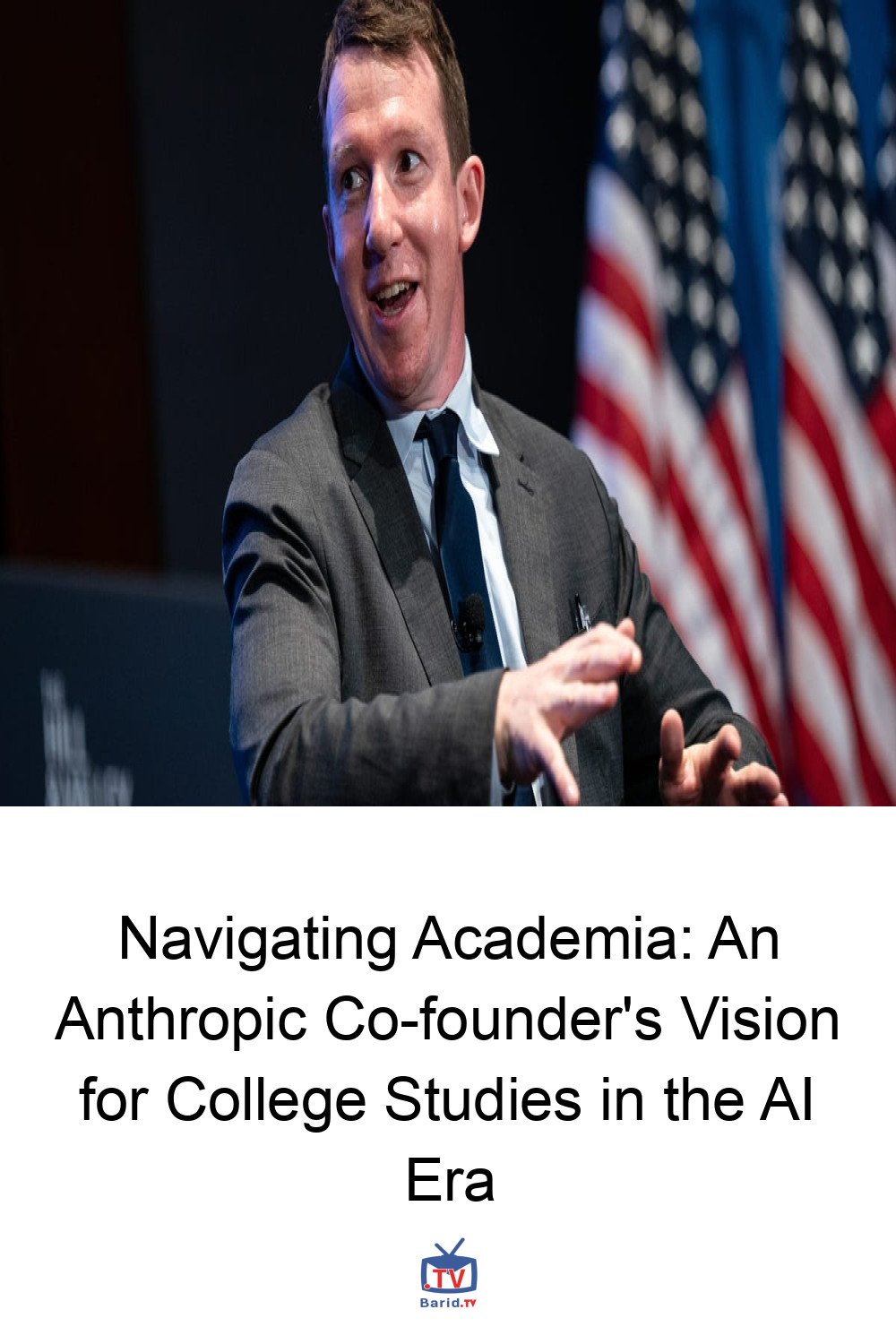
In an era increasingly shaped by artificial intelligence, the question of what to study in college has never been more pressing. While traditional paths remain valuable, the insights from leaders at the forefront of AI development offer a unique perspective on preparing for the future. We delve into the hypothetical advice from an Anthropic co-founder, exploring their vision for a curriculum that fosters innovation, critical thinking, and ethical leadership.
Beyond the Code: A Holistic Approach to AI Education
While coding and computer science are undeniably foundational to AI, an Anthropic co-founder would likely advocate for a broader, more interdisciplinary educational journey. The complexities of AI development and deployment extend far beyond algorithms, touching upon philosophy, psychology, ethics, and societal impact.
The Imperative of Interdisciplinary Learning
The challenges posed by advanced AI systems are not purely technical; they are deeply human. Understanding human cognition, societal structures, and ethical frameworks becomes paramount. Therefore, subjects like philosophy, cognitive science, sociology, and even literature could be highlighted as crucial complements to a STEM education. These disciplines cultivate critical thinking, empathy, and the ability to foresee and mitigate potential risks associated with powerful technologies.
Foundational Sciences and Mathematics
Regardless of the interdisciplinary emphasis, a strong grounding in core sciences and mathematics remains indispensable. Linear algebra, calculus, statistics, and probability form the bedrock of machine learning. Physics and biology can also offer valuable insights into complex systems and emergent behaviors, mirroring some of the challenges in AI research.
Cultivating Essential Skills for the AI Age
Beyond specific subjects, an Anthropic co-founder would likely stress the development of certain transferable skills that are vital for navigating a rapidly evolving technological landscape.
Critical Thinking and Problem Solving
The ability to dissect complex problems, question assumptions, and think creatively to find novel solutions is more valuable than ever. AI is a tool, and its effective and responsible application requires human ingenuity and discernment.
Ethical Reasoning and Responsibility
Given Anthropic’s focus on AI safety and alignment, ethical reasoning would undoubtedly be a cornerstone of their advice. Students should engage with courses that explore the ethical implications of technology, data privacy, bias in algorithms, and the societal impact of automation. Developing a strong moral compass is crucial for future leaders in AI.
Communication and Collaboration
AI development is rarely a solitary endeavor. The ability to articulate complex technical concepts to non-technical audiences, collaborate effectively in diverse teams, and engage in constructive debate are skills that transcend any single major and are essential for successful innovation.
Preparing for an Unpredictable Future
Ultimately, the advice from an Anthropic co-founder would likely revolve around preparing students not just for current job roles, but for a future that is still being written. This means fostering adaptability, a lifelong love of learning, and a deep sense of responsibility towards the technologies they will help create. A college education, in this view, is less about acquiring a fixed set of facts and more about developing the intellectual toolkit to thrive in a world increasingly shaped by intelligent machines.
For more details, visit our website.
Source: Link