



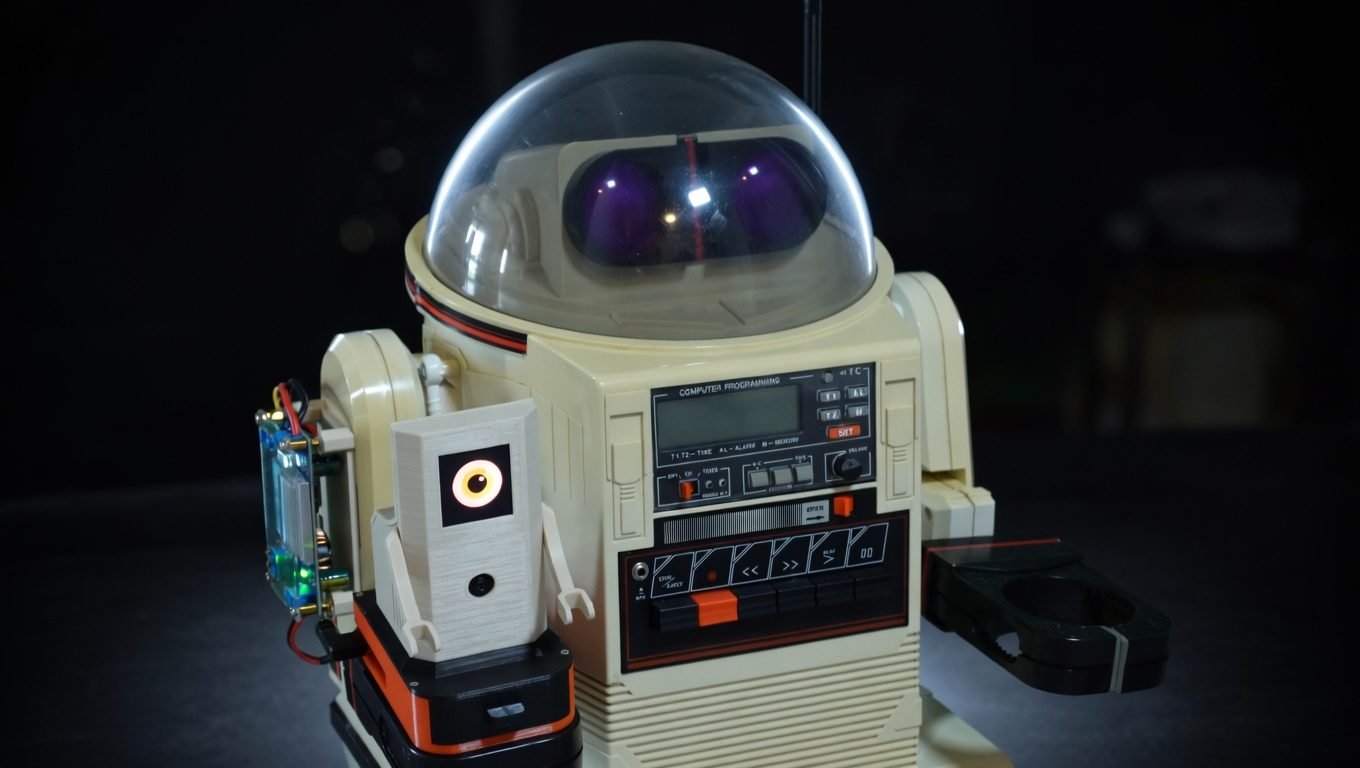

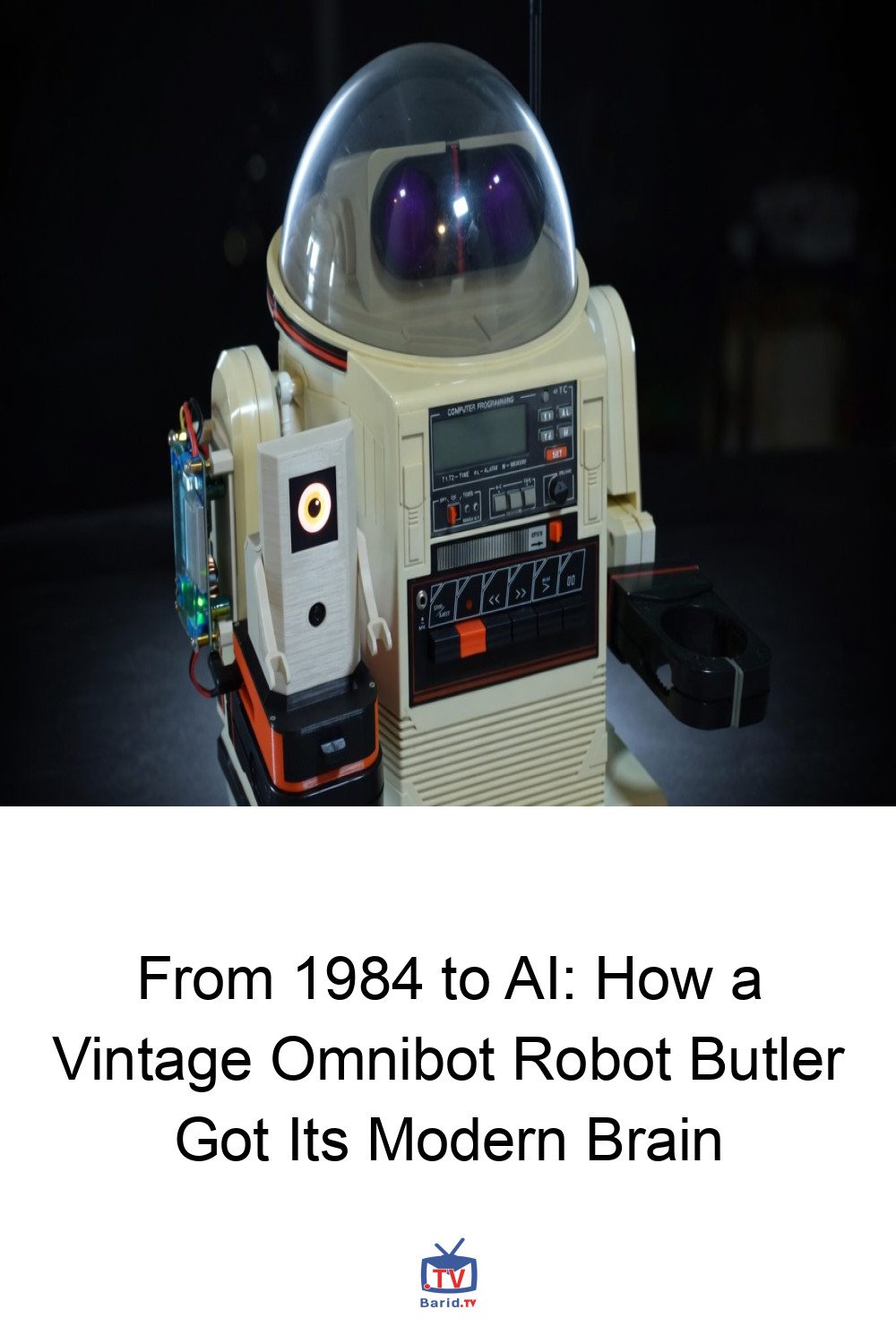
In a fascinating blend of retro charm and cutting-edge artificial intelligence, a classic 1984 Tomy Omnibot, once a symbol of futuristic domesticity, has been dramatically resurrected and upgraded. What began as a meticulous restoration project quickly evolved into an ambitious endeavor to imbue the vintage robot with the advanced intelligence it was always promised, thanks to a dedicated maker and a clever integration of modern AI.
A Blast from the Past: The Omnibot’s Original Vision
Picture this: a workbench at Moonlighter FabLab in Miami, where a two-foot-tall, white plastic robot, straight out of Reagan’s first term, stands sentinel. This is no ordinary machine; it’s a Tomy Omnibot from 1984, complete with tank-style wheels, a serving tray, and that iconic smoked-plastic dome that instantly screams “robot” to anyone who grew up on sci-fi classics like Lost in Space. Originally marketed as a domestic robot from the future, the Omnibot could be remote-controlled, play cassette tapes, and even record messages. Commercials hinted at it fetching you a soda. Retailing for around $600 (roughly $1,800 today), hundreds of thousands were sold, yet few survived the ravages of time – leaking batteries, crumbling rubber, and fading dreams.
The Phoenix Rises: A Challenging Restoration
The journey to rebirth began when a corroded Omnibot, a gift donation to a maker space, arrived with its PCB marred by the tell-tale crystalline white bloom of battery acid. Its remote control suffered a similar fate, with several traces on the main board completely eaten away. Hours of painstaking work – involving isopropyl alcohol, a toothbrush, and a soldering iron – were dedicated to coaxing the 40-year-old logic back to life. The moment power returned, the motors whirred, and the Omnibot took its first drive in decades. The joy was short-lived as the brittle rubber wheels disintegrated, but the plastic shell remained remarkably intact, a testament to its original build quality.
Beyond Repair: The Bluetooth Brain Transplant
What started as a simple fix-it project soon spiraled into a full-blown technological reimagining. The turning point came with the discovery of the Omnibot’s ingenious cassette deck mechanism. It interpreted audio frequencies recorded on tape as motor commands: 1614Hz for forward, 2208Hz for left, and 1422Hz to toggle an internal relay. This wasn’t just a tape player; it was a command language encoded in sine waves.
This revelation opened up a world of possibilities. By integrating a Bluetooth cassette adapter into the deck and writing a Raspberry Pi script to synthesize these tones on the fly, the Omnibot could now be controlled wirelessly. It rolled across a kitchen, obeying commands from a laptop. A synthesized “Hello, I am Omnibot” through its audio path momentarily blurred the lines between 1984 and the present. But why stop there?
Enter Ring-O: The AI Companion
The next logical step was to give the Omnibot true autonomy. This led to the creation of Ring-O, a small, 3D-printed companion robot designed by Miami Maker Placitech. Ring-O, with its round body, stubby arms, and a single glowing cyan eye reminiscent of a Ring doorbell crossed with WALL-E, sits neatly atop the Omnibot. It houses a Raspberry Pi 5, an AI camera, a cooling fan, a tiny OLED display, and a battery.
Ring-O doesn’t move on its own; it’s the Omnibot that provides the locomotion. However, Ring-O is the brains of the operation. It sees, processes, and communicates, fundamentally altering how humans interact with the vintage machine. Instead of looking at the Omnibot’s original visor, eyes are now drawn to Ring-O’s tracking pupil, a clear indicator of its newfound intelligence.
The Initial AI Challenge: A Learning Curve
While Placitech handled the intricate physical build and soldering, the software fell to the project’s instigator. The initial architecture, a very “2026” approach, involved feeding camera detections to a cloud-hosted large language model (LLM) for scene reasoning and command generation. The AI camera itself, running YOLO (a neural network capable of recognizing 87 everyday objects) at 30 frames per second directly on its silicon, performed admirably, delivering structured metadata like “person 87%” or “chair 72%.” These detections were then piped into Groq, a service that serves…
The article ends here, leaving us on the cusp of understanding the challenges faced with the LLM. However, the journey so far showcases an incredible dedication to not just restoring a piece of technological history, but evolving it into a functional, intelligent robot for the modern era.
For more details, visit our website.
Source: Link





Leave a comment