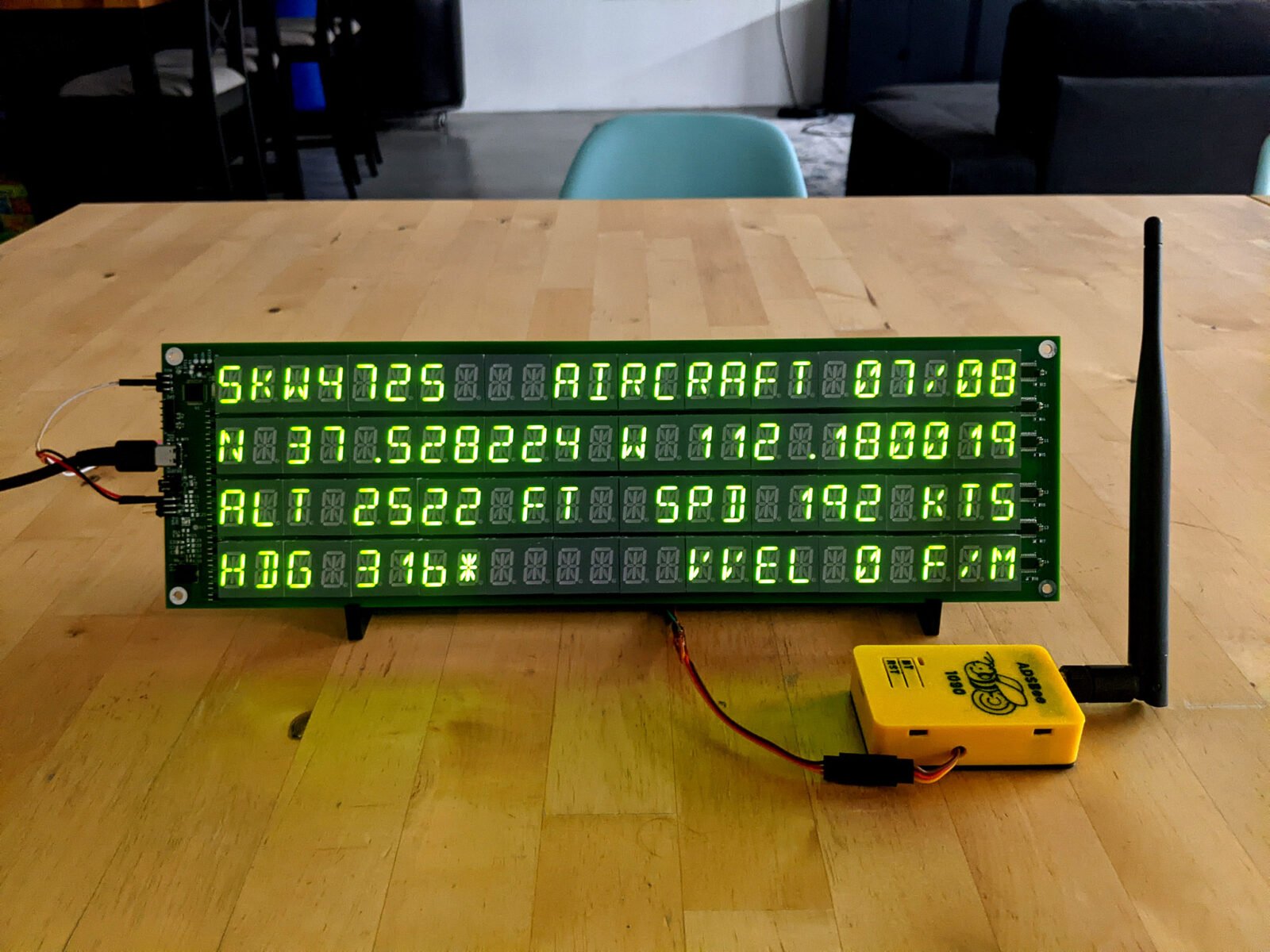

In the vast expanse of our skies, a silent conversation constantly unfolds between aircraft and air traffic control. This dialogue, known as Automatic Dependent Surveillance — Broadcast (ADS-B), transmits vital location and flight information, forming the backbone of modern air navigation. For decades, aviation enthusiasts and professionals alike have sought ways to tap into this unencrypted data stream, leading to a vibrant community of ground stations and data aggregators. Now, a groundbreaking open-source project called ADSBee is set to democratize aircraft tracking, making it more accessible, affordable, and versatile than ever before.
Decoding the Digital Sky: What is ADS-B?
ADS-B is essentially the language airplanes “speak” to share their position and other critical data. Operating primarily on the 1090MHz frequency via a pulse position modulation protocol known as Mode S, it has become a global standard. Because this protocol is unencrypted, a passionate community has emerged, developing hardware and software to decode, save, and share this rich aviation data. From popular community sites like airplanes.live to commercial giants like FlightAware and FlightRadar24, ADS-B data fuels everything from airline route optimization and air crash investigations to tracking high-profile private jets and supporting academic studies on weather patterns or GPS interference.
The vast network of ADS-B data available online is largely thanks to thousands of community-maintained ground stations. These typically comprise a Raspberry Pi single-board computer paired with one or more software-defined radio (SDR) dongles, all working in concert with open-source decoders like dump1090 to extract meaningful ADS-B messages from raw radio signals.
The ADSBee Innovation: Small, Smart, and Open
While existing solutions are effective, they often come with trade-offs. Traditional open designs, relying on SDR dongles and external computing, can be bulky and power-hungry, limiting their use in embedded applications like drones or portable devices. Commercial alternatives, while robust, often carry a hefty price tag (upwards of $350) due to their reliance on expensive FPGAs and proprietary, closed-source designs.
This is where ADSBee steps in. Born from a desire to make low-power, small-footprint ADS-B receivers truly open source and accessible, the ADSBee project introduces a novel demodulator design. Utilizing the powerful yet affordable RP2040 microcontroller and its Programmable I/O (PIO) peripherals, the ADSBee 1090 board delivers commercial-grade ADS-B decoding without the need for an FPGA or an external computer. This innovation translates into a device that is not only cost-effective but also remarkably power-efficient (consuming around 1W) and incredibly compact.
ADSBee’s versatility extends to its data output, offering multiple interfaces including USB, UART, Wi-Fi, and even Ethernet (with an accessory board). This flexibility allows seamless integration with a wide array of systems, from tablets and online databases to sophisticated drone autopilot flight computers.
Embracing the Open-Source Ethos
One of ADSBee’s most compelling features is its commitment to open source. Unlike certified aircraft transponders, portable ADS-B receivers are not subject to stringent certification standards. Yet, many commercial receivers remain closed-source, leading to slow evolution and potential hidden bugs. By open-sourcing its schematic and firmware, ADSBee has cultivated a dynamic community of beta testers. This collaborative environment ensures rapid bug identification and resolution, alongside the continuous integration of innovative ideas – from new configuration commands to advanced aircraft position filtering algorithms. Every new application of ADSBee seems to spark a fresh wave of community-driven enhancements.
The Evolution of ADSBee: Dual-Band and Beyond
Now two years into its development, the ADSBee project has been in a successful beta phase since late 2024, with firmware features continually refined based on invaluable user feedback. A significant milestone arrived in July 2025 with the launch of the ADSBee 1090U. This new dual-band hardware maintains the compact form factor of its predecessor while incorporating an additional radio and microcontroller. While the original ADSBee 1090 focuses on the standard 1090MHz ADS-B frequency, the 1090U can simultaneously receive messages from aircraft transmitting on the 978MHz UAT (Universal Access Transceiver) band, which accounts for approximately 5% of U.S. aircraft. This dual-band capability not only enhances coverage but also opens doors for decoding other aircraft protocols in the future.
“Pants” for Your Bee: Expanding Functionality
The innovation doesn’t stop there. More ADSBee-powered hardware is currently under development, including a range of accessory boards. Playfully dubbed “pants” by beta testers (a nod to the creator’s business, Pants for Birds LLC), these accessories will further expand ADSBee’s capabilities. A Power over Ethernet (PoE) “pant,” for instance, is already in production, promising even more flexible deployment options for this remarkable open-source receiver.
For more details, visit our website.
Source: Link