
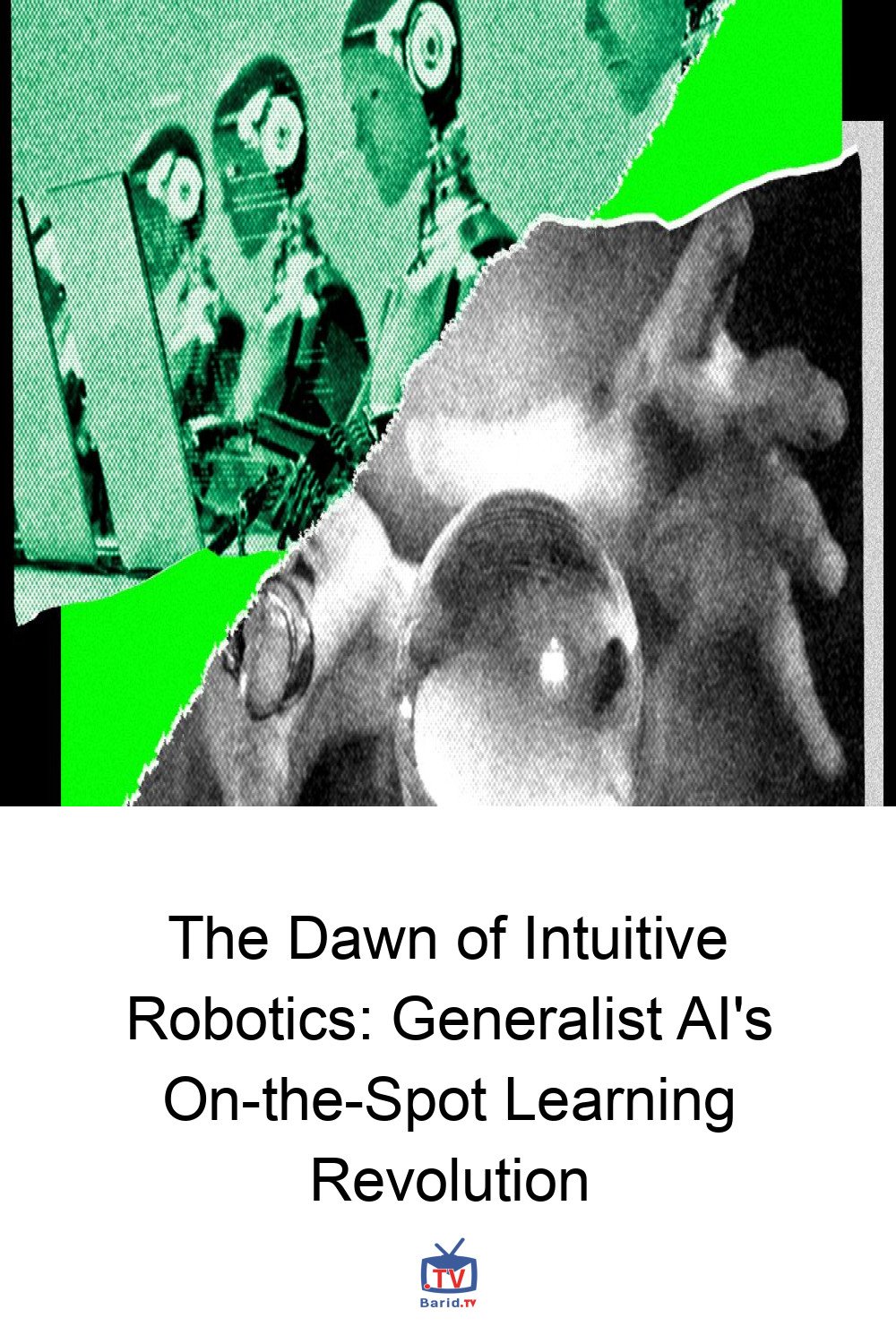
Last week, a short journey from my doorstep led me to a revelation: the future of artificial intelligence, embodied in robots capable of astonishing on-the-spot learning. At the Cambridge, Massachusetts, headquarters of Generalist AI, I witnessed robotic arms perform mundane tasks with an uncanny, almost human-like, adaptability.
These aren’t your typical programmed machines. After ingesting a brief instructional video, these robots mastered a variety of tasks without any specific, pre-programmed training. The speed and fluidity with which they grasped new concepts were truly remarkable, reminiscent of a person figuring things out for the first time.
The Spark of Intuition: Robots That Learn, Not Just Repeat
One demonstration particularly stood out. A robot, tasked with sweeping a block into a bowl using a dustpan and brush, faced an unexpected challenge: the brush was removed. Without hesitation, the robot improvised, using the dustpan itself as a brush to flick the block into its target. This wasn’t a pre-coded contingency; it was genuine, on-the-fly problem-solving.
Another impressive feat involved a two-armed robot observing a video of someone unzipping a purse and extracting banknotes. I watched, captivated, as the robot replicated the action on a different purse. When it struggled to grasp the money with one gripper, it seamlessly switched to the other arm, finding a better angle of attack. An engineer nearby exclaimed, “It never did that before!”—a testament to the robot’s spontaneous ingenuity.
Generalist AI cofounder and CEO Pete Florence drew a parallel to OpenAI’s GPT-3, noting, “This is exactly the kind of thing people were really excited about with GPT-3. You could take that model and just prompt it to do a new task and it would have a real shot at doing it.” This comparison underscores the profound implications for robotics.
Beyond Traditional Training: A New Paradigm for Robotics
Generalist AI’s approach is rooted in teaching robots about the fundamental physics of the world, mirroring the intuitive understanding humans develop from infancy. This focus on physical intelligence appears to be key to their models’ ability to transfer learned skills from one scenario to another. The company’s demos often evoke the image of children experimenting and improvising, with researchers sometimes surprised by the robots’ novel solutions—like one robot opting to sweep items with a banana placed in its path.
This seemingly trivial improvisation highlights a critical gap in current machine capabilities: physical intelligence. The efficiency with which babies learn about their physical environment offers invaluable insights for AI researchers striving to imbue machines with similar adaptability.
The company’s founders—Florence, Andrew Barry (CTO), and Andy Zeng (Chief Scientist)—bring formidable expertise, having previously contributed to advanced robotics at Google DeepMind and Boston Dynamics.
Traditionally, training AI-powered robots involves feeding thousands of examples into a model, a method notoriously brittle and sensitive to minor environmental changes, such as lighting. Generalist AI, however, is pioneering a general robotic model trained extensively by humans. They develop specialized gloves, resembling robot pincers and equipped with cameras, which people use to perform various chores, generating a vast amount of high-quality training data. Unlike many competitors, Generalist AI has built its AI models from scratch, eschewing reliance on open-source language models.
Expert Endorsement and Future Horizons
Roboticist Danfei Xu of Georgia Tech, familiar with Generalist’s work, praises the startup for pushing the boundaries of general robot models. “They have pushed this to the extreme, and they’ve done a really good job executing,” Xu states, adding, “they are excellent roboticists, and they have done really good science.” He believes Generalist’s demonstrations indicate a clear path toward deploying robots in commercial settings, calling them “the closest to something that’s deployable.”
Karen Liu, a roboticist at Stanford University, also highlights the strength of Generalist’s data approach: “Generalist’s data approach is collecting physical interaction data at large scale without tying it too closely to one particular robot. Their strongest results suggest that this bet may be working.”
While the progress is undeniable, Generalist acknowledges that its models’ learning skills are not yet fully reliable, achieving an average task completion rate of 59 percent—far from the ideal 99 percent-plus. The extent to which these skills will generalize across every conceivable task and environment also remains to be fully explored. Nevertheless, the strides made by Generalist AI offer a tantalizing glimpse into a future where robots are not just tools, but adaptable, intuitive partners.
For more details, visit our website.
Source: Link