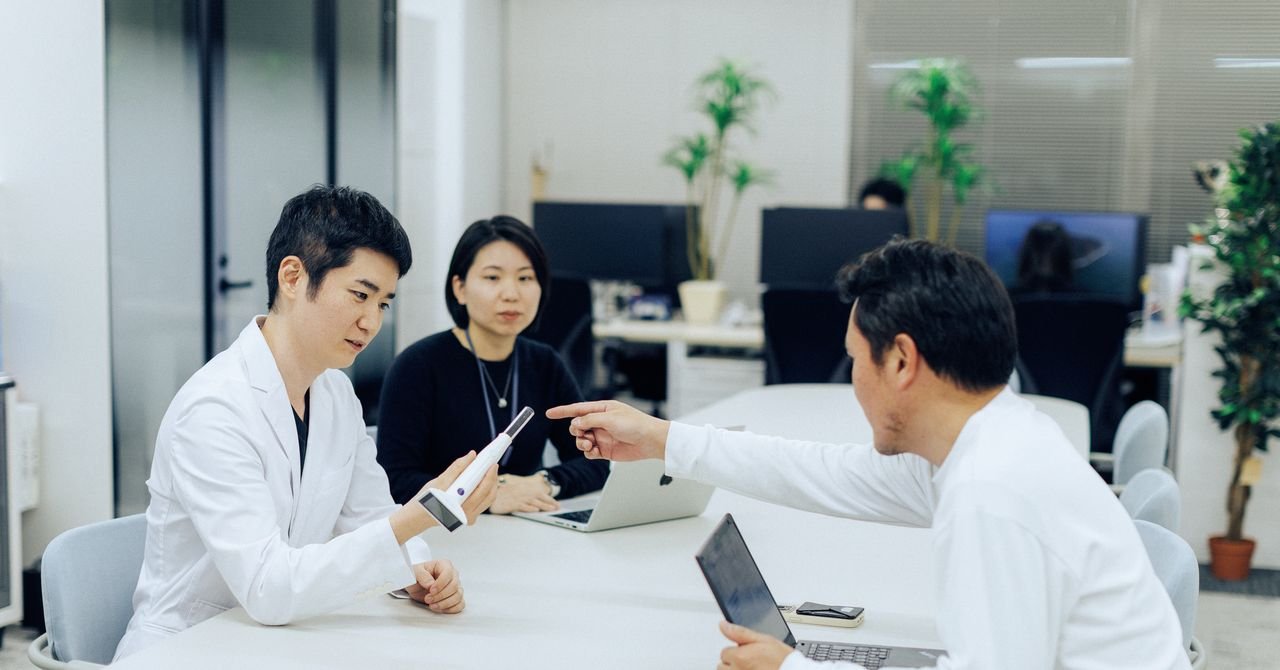

For centuries, the doctor’s throat examination has remained largely unchanged, a cornerstone of the physical alongside temperature checks and heart auscultation. Yet, within the subtle patterns of the pharynx lies a wealth of diagnostic information, often overlooked. Japanese company Iris, spearheaded by former emergency physician Sho Okuyama, is now harnessing the power of artificial intelligence to decode these hidden messages, transforming a historically uncomfortable procedure into a swift, insightful diagnostic tool.
Nodoca: A Glimpse into the Future of Diagnosis
Iris’s groundbreaking system, Nodoca, employs AI to analyze high-resolution images of the pharynx captured by a compact, camera-equipped device. Coupled with patient medical history, Nodoca can deliver an influenza assessment in a mere 10 seconds. This innovation eliminates the need for the traditional, often painful, nasal swab test and allows for earlier detection of symptoms, significantly improving patient comfort and diagnostic efficiency.
Nodoca’s impact has been swift and substantial. In 2022, it made history as Japan’s first AI-equipped medical device to receive approval as a “new medical device” and secure coverage under the national health insurance system. Since then, it has been adopted by over 2,000 medical institutions across Japan. Its capabilities expanded further in October 2025, with approval for an additional function related to Covid-19 diagnosis, cementing its role in modern infectious disease management.
From Remote Islands to AI Innovation: Sho Okuyama’s Vision
Okuyama’s journey to medical AI entrepreneurship is rooted in his experiences as an emergency physician, including practicing on remote islands where medical resources were scarce. “On an island with only a few hundred residents, the only medical equipment available was essentially a stethoscope,” Okuyama recalls, highlighting his reliance on keen observation. This background instilled in him a profound appreciation for fundamental diagnostic cues, which he now seeks to amplify with technology.
“When people hear ‘medical AI,’ they tend to think of the part that makes diagnoses,” Okuyama explains. “But the real differentiating factor lies in sensing—how the data is acquired. We developed our own hardware and ventured into the area of pharyngeal images, which no one had touched.” This focus on novel data acquisition, rather than just algorithmic processing, set Iris apart.
Overcoming Hurdles: The Genesis of Nodoca
Founded in 2017, Iris faced a significant challenge: the complete absence of AI training data specifically for throat analysis. Undeterred, Okuyama distributed dedicated cameras to approximately 100 medical institutions, meticulously collecting patient-consented data over three years. This monumental effort, combined with the development of proprietary hardware and the validation of AI-assisted diagnosis, paved the way for Nodoca’s practical implementation.
Post-commercialization, Nodoca’s accuracy has soared. Each clinical use contributes anonymized data, expanding its image database from hundreds of thousands before launch to several million today. This powerful network effect has created a formidable barrier to entry, ensuring Iris’s leadership in this specialized field.
Beyond Infectious Diseases: A Comprehensive Health Snapshot
The potential of Nodoca extends far beyond diagnosing infectious diseases. The intricate patterns of mucous membranes and blood vessels visible in throat images hold clues to a broader spectrum of health conditions. Iris is actively researching and developing AI capabilities to detect lifestyle-related diseases such as diabetes and hypertension by identifying subtle changes in these patterns.
“I think that in about 10 years, we’ll reach an era in which a single photograph of the throat can be used to perform a comprehensive range of tests,” Okuyama predicts. He emphasizes the economic advantage: “The cost of AI inference is extremely low, so even if we increase the number of tests, the cost of providing them hardly changes.”
Redesigning Healthcare for Tomorrow
Okuyama’s vision extends to a complete overhaul of healthcare delivery, with AI as its foundational pillar. He envisions AI seamlessly integrated into every stage, from initial medical interviews and online consultations to primary care and specialist treatments. To realize this ambitious future, Okuyama is actively engaging with government ministries, advocating for necessary regulatory reforms.
“The ‘future of health care’ that I talk about doesn’t actually include a single future technology,” he asserts. “Everything can be achieved with technology that already exists today. Our job is to close the gap that makes these things have to be talked about as ‘the future.’”
Given the consistent nature of the body’s mucous membranes, the data and algorithms refined in Japan are expected to be highly transferable globally. Iris is already preparing for international expansion, with clinical trials in the United States currently under consideration, promising a worldwide revolution in routine medical examinations.
For more details, visit our website.
Source: Link