
The roar of the Eaton Fire in January 2025 didn’t just consume structures; it devoured dreams. For Sylvie Andrews and her partner, it meant the loss of a home they had poured a decade of “blood, sweat, and tears” into, a symbol of their roots in Altadena, California. This personal tragedy, alongside the devastating Palisades Fire, collectively destroyed over 16,000 structures and claimed 31 lives, leaving thousands of Angelenos scrambling for safety and facing unimaginable loss.
Yet, amidst this unfolding catastrophe, another narrative emerged – one of financial opportunity. As communities burned, individuals flocked to Polymarket, the world’s largest prediction market platform, placing bets on the fires’ trajectory, duration, and destructive potential. This unsettling juxtaposition highlights a burgeoning, controversial trend: the commodification of disaster.
The Mechanics of Disaster Betting: A “Wild, Wild West”
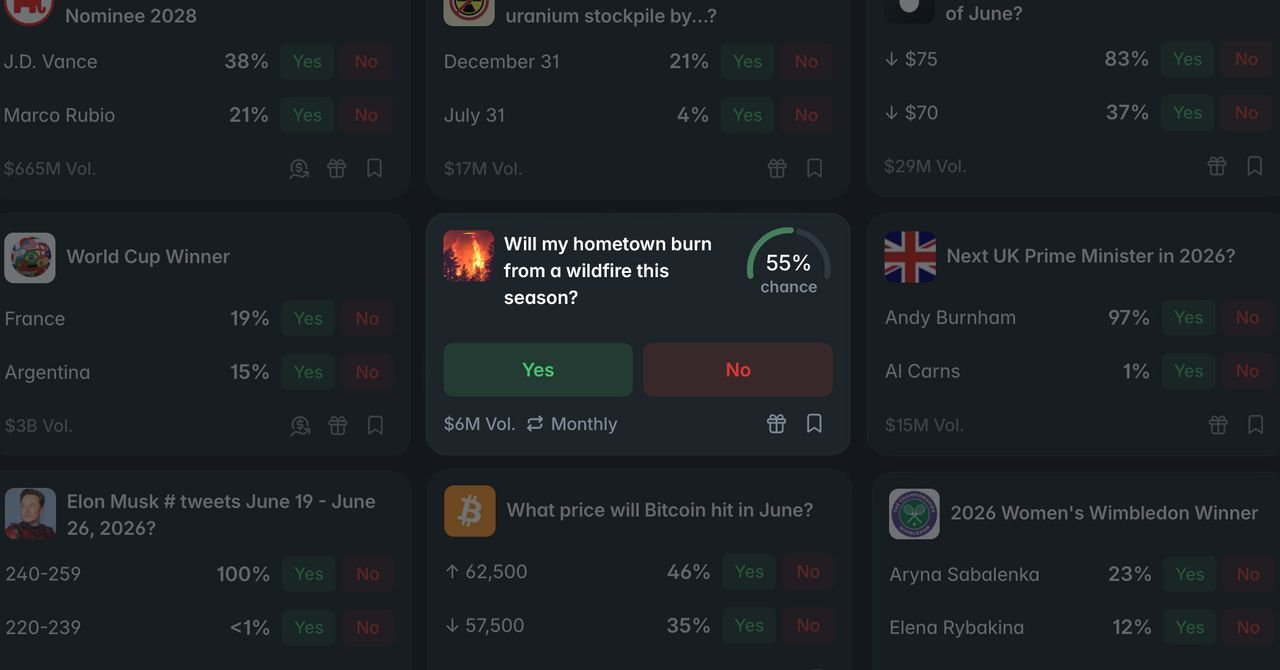
Prediction markets are, at their core, online gambling platforms. Participants wager on the outcomes of future events, ranging from political elections and sports results to global oil prices and the spread of diseases. The principle is simple: questions are typically framed as “yes” or “no,” with contract prices fluctuating between $0 and $1. A 50-cent price on a “yes” contract implies a collective belief among bettors that the event has a 50% chance of occurring. The platforms, like Polymarket, profit by charging a fee on these wagers.
In January 2025, Polymarket’s “markets team” listed nearly 20 questions directly related to the Southern California wildfires. Queries included: “How many acres will the Palisades Fire burn by Friday?” “Will the Palisades Fire reach Santa Monica by Sunday?” “When will the Palisades fire be 50 percent contained?” and “Will the Palisades and Eaton fires be contained before February?” According to Aeon Magazine, a staggering $1.2 million was wagered on these questions.
A Moral Outcry from the Ashes
For survivors like Sylvie Andrews, learning of these bets was a profound shock. “Wow,” she repeated, aghast. “My first take is that it’s morally reprehensible. The fact that someone would feel OK doing that flabbergasts me.”
Susan Sherman, who lost her childhood home in the Palisades Fire – a property her late parents had owned since 1963 – echoed Andrews’ sentiment. “The prediction markets are just the wild, wild West,” she stated, describing the act of betting on such devastation as “very crass and heartless.” As a new wildfire season looms, the booming prediction market industry faces increasing scrutiny from fire survivors and ethicists alike, who argue that these platforms foster callous thinking and, more alarmingly, potentially dangerous behavior.
The Perilous Incentives: Arson and Insider Trading
One of the most chilling concerns surrounding wildfire prediction markets is the potential for arson. “That’s what has me nervous,” Sherman admitted. The theoretical possibility of a perverse incentive – where financial gain could motivate someone to start a fire or exacerbate an existing one – is a grave risk. Unlike other natural disasters such as hurricanes or floods, a wildfire’s trajectory can be manipulated by a single individual in a matter of minutes.
A spokesperson for the US Forest Service articulated this danger clearly: “Systems that tie financial gain to wildfire outcomes risk encouraging misuse, including arson, and are not compatible with our mission.” Ann Skeet, senior director of leadership ethics at Santa Clara University’s Markkula Center, warned, “Imagine what a bad actor might do. A market that might support that kind of activity, I think, is a dangerous market.” Furthermore, individuals with privileged information, such as firefighters or land managers, could be tempted to engage in insider trading by betting on fire outcomes, leveraging their exclusive knowledge of a fire’s behavior or agency response plans.
Dehumanizing Catastrophe: The Ethical Abyss
Beyond the immediate dangers, the most profound dilemma is ethical. Skeet emphasized the moral erosion inherent in such markets: “When you start gambling on somebody’s potential death or harm, you’re really diminishing the value that you’re placing on human life.” These platforms transform human suffering and environmental destruction into mere data points for speculative gain, stripping away the inherent dignity and tragedy of the events.
The New Frontier: Wyldfyre and Specialized Markets
The landscape of disaster betting is evolving. This year, a new platform specifically targeting California fires, named Wyldfyre, emerged with the tagline: “You can’t predict wildfire. But you can trade on it.” High Country News reported an inability to determine the platform’s ownership or IP address, highlighting its opaque nature and lack of contact information.
While Wyldfyre currently offers only simulated trading, its website promises real-money betting “coming soon.” It claims to be the first of its kind, providing real-time county and city wildfire risk pricing. The platform’s stark message, “California burns. Every year. And it’s getting worse. The question isn’t if—it’s where and when,” underscores the grim reality it seeks to capitalize on. By integrating hotspot data from NASA and fire perimeters from the National Interagency Fire Center, Wyldfyre equips its users with tools for their predictions, framing its service as a “public good” that turns “collective intelligence into bet.”
A Future Ignited by Speculation?
As wildfires intensify and prediction markets proliferate, the ethical firestorm surrounding them grows hotter. While proponents tout the crowdsourcing of information as a public benefit, the profound human cost and the potential for perverse incentives raise critical questions about the moral boundaries of financial speculation. The rise of platforms like Polymarket and Wyldfyre forces society to confront an uncomfortable truth: in an era of escalating climate disasters, some see not just tragedy, but a market opportunity, challenging our collective values and demanding urgent ethical consideration.
For more details, visit our website.
Source: Link