

Renowned globally for its exquisite skincare and fragrance offerings, Aesop has long been synonymous with audacious design and pioneering innovation. From its immersive retail spaces to its thoughtful product development, the Australian brand consistently ventures into uncharted creative territories. This spirit of innovation was vividly demonstrated earlier this year with the launch of Aposē, Aesop’s inaugural foray into furniture design – a limited-edition lighting series inspired by the very aluminum tubes used in their scent and cream formulations. This unexpected yet masterfully executed deviation was showcased amidst a striking Milan Design Week installation: a captivating, sloped landscape crafted from upcycled 50ml fragrance vials.
A New Frontier in Sustainable Retail: The Enduring Forms Initiative
Carrying this dynamic ethos of sustainability forward, Aesop arrived at this month’s influential 3daysofdesign in Copenhagen not with a mere presence, but with a purpose. The brand chose the occasion to unveil the latest evolution of its ‘Enduring Forms’ initiative. While previous iterations focused on the power of reuse and circularity, this new chapter spotlights the transformative potential of bio-based material alternatives. Together, these two strategic pillars – circularity and biodegradability – represent the dual imperatives of contemporary sustainability, offering a comprehensive approach to reducing environmental impact.
Introducing Algae-Based Bioplastic: A Game-Changer for Signage
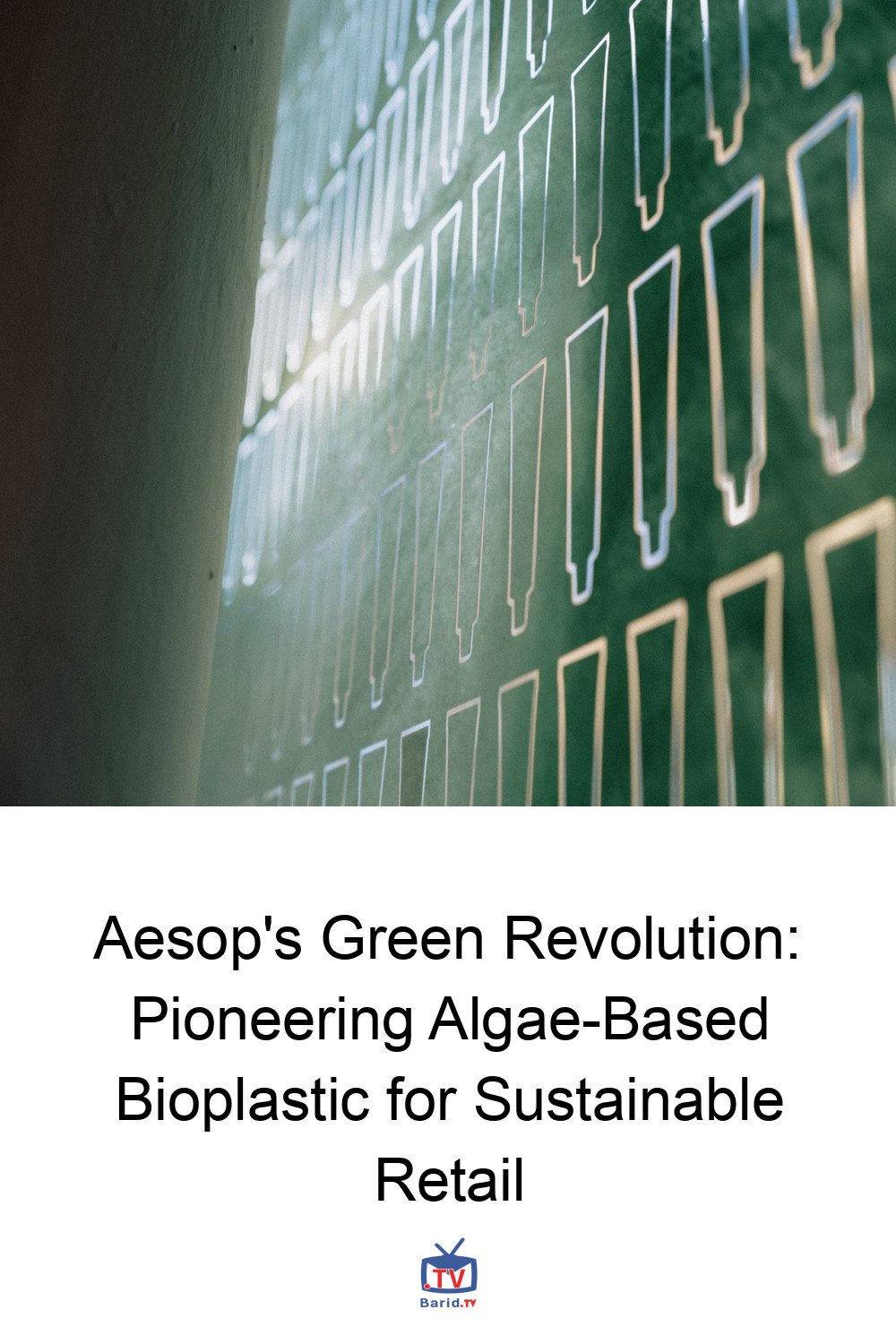
At the heart of this latest unveiling is a groundbreaking, leather-like bioplastic alternative designed to replace conventional signage and window decals. This innovative material is the brainchild of Jessie French, founder of Melbourne-based research practice Other Matter, renowned for her work in engineering renewable, non-petrochemical polymers. Crafted from algae, the flexible sheet material boasts a distinctive green ombré tone, perfectly complementing the launch of Aesop’s new Parsley Seed Skin Care range, a collection specifically formulated for urban skin.
The bioplastic made its debut in Aesop’s Copenhagen storefronts with compelling visual applications. At the Nyhavn location, it manifested as striking, oversized product silhouettes. Meanwhile, at the Kronprinsensgade shop, it transformed into an interactive window layer featuring peel-off cutout profiles of product packaging. Visitors were invited to detach these profiles and take them home, a tactile demonstration of the bioplastic’s impressive durability and versatility.
Beyond the Conventional: The Dual Power of Bio-Based Materials
Jessie French’s material innovation aligns seamlessly with both core tenets of sustainability: circularity and biodegradability. Unlike traditional methods that often seek to repurpose materials whose origins may not have been environmentally sound, this bioplastic begins with an inherently considered, naturally formulated base. This hardened substance is not only capable of being reused repeatedly but can also be allowed to biodegrade responsibly when its lifecycle concludes. This dual capability marks a significant stride, particularly when considering the immense waste generated by conventional – and especially temporary – street and retail-window signage.
The long-standing argument against greener solutions often cites prohibitive costs. However, with this bioplastic alternative offering both reuse and biodegradability, that familiar critique begins to lose its footing. Furthermore, this innovation unlocks entirely new creative possibilities for retail displays, moving beyond simple letter-pressed elements and icons. Retailers can now envision and experiment with diverse scales of visual application, and even explore advanced functionalities such as temperature-absorbing window fritting – an additional sustainable benefit that enhances energy efficiency.
Aesop’s Vision for a Sustainable Future
Aesop continues to lead by example, demonstrating that luxury and sustainability are not mutually exclusive but rather synergistic. By embracing materials like Jessie French’s algae-based bioplastic, the brand is not only enhancing its own ecological footprint but also inspiring a broader industry shift towards more responsible design and consumption. This commitment extends beyond materials to their skincare innovations, which can be explored further at aesop.com.
For more details, visit our website.
Source: Link