

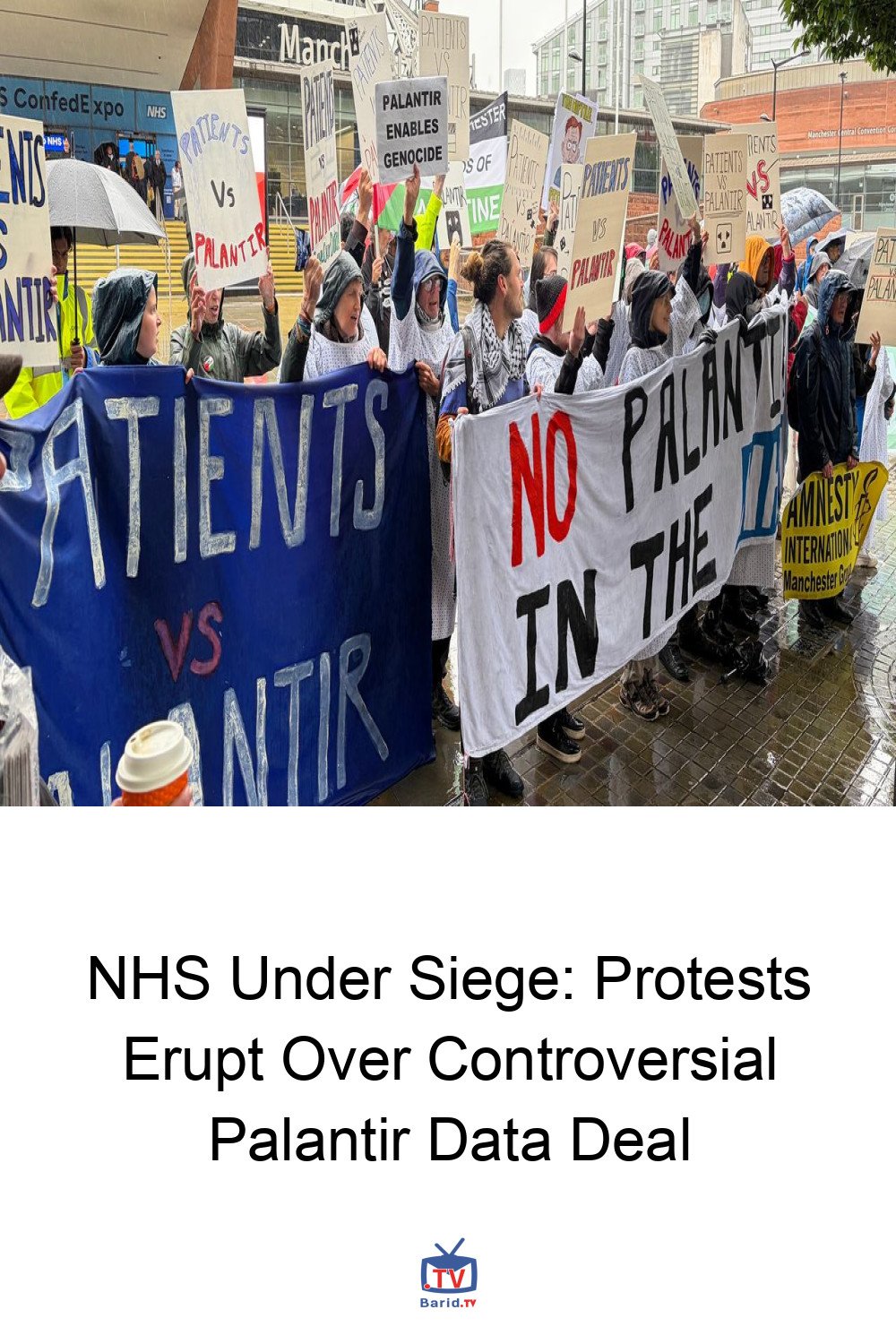
A storm of public discontent is brewing across the United Kingdom as citizens take to the streets, donning hospital gowns and wielding defiant placards, to challenge a controversial £440 million deal between the National Health Service (NHS) and American software giant Palantir. The protests, spearheaded by activist groups and healthcare unions, underscore deep-seated anxieties regarding data privacy, national security, and the increasing entanglement of private tech firms with Britain’s cherished public health system.
The Frontlines of Discontent: Manchester’s Protest
The latest flashpoint occurred outside the NHS ConfedExpo in Manchester, where approximately 80 impassioned protesters converged at 8 AM local time. Braving the pelting rain, they huddled under trees, their signs declaring “Patients vs. Palantir” as they chanted to the rhythm of a drum: “Hands off our NHS, hands off our health data!” and “Hey hey, ho ho, Palantir has got to go!” Their urgent appeal to NHS leadership: terminate the contract, which grants Palantir access to vast swathes of health data through its analytics and artificial intelligence services, citing profound concerns over national security, data privacy, and the company’s contentious political affiliations. While the contract is slated to run until 2031, a crucial break clause offers a potential exit for the government next February.
Among the voices of dissent was John, an NHS nurse, who expressed his alarm to WIRED, fearing the sensitive health data of Britons could fall into the hands of a foreign entity. He vehemently objects to Palantir’s documented work with US Immigration and Customs Enforcement (ICE) and the Israeli military. “Palantir should be kicked out of the NHS, forthwith,” John asserted, a sentiment echoed by others, some waving Palestinian flags to highlight their opposition to Palantir’s international ties.
Behind the Movement: Pull the Plug and Allies
The demonstration was meticulously organized by Pull the Plug, an activist collective dedicated to scrutinizing the societal implications of unchecked AI development. Their ranks were bolstered by prominent organizations such as Amnesty International and Unison, a powerful trade union representing healthcare workers. Frieda Lurken, cofounder of Pull the Plug, articulated the broader vision: “We want ordinary people to get a say in how AI is used in our lives.” She acknowledged the potential benefits of AI but warned against its uncritical implementation, stating, “It’s not all bad. But there are so many places where it’s being shoved down people’s throats.”
Palantir’s Role in the NHS: A Deepening Partnership
The UK government’s relationship with Palantir began in 2020, during the initial phases of the Covid-19 pandemic, when its technology was deployed to track the virus. Since then, Palantir and its partners have secured numerous public-sector contracts across the UK, promising enhanced efficiency through the analysis of complex, disparate data sets. Under its current NHS contract, Palantir is tasked with developing a “federated data platform” to aggregate and analyze health service information, with the ambitious goals of reducing wait times and identifying systemic waste.
Scrutiny and Skepticism: Political Ties and Efficacy Questions
A Question of Ideology
However, the burgeoning partnership has not been without its critics. Palantir cofounder Peter Thiel’s 2023 remarks—suggesting the UK should “rip the whole [NHS] from the ground and start over”—ignited a firestorm, prompting serious questions about the company’s suitability as a government contractor. Further concerns about potential political partisanship arose from a bullet-point manifesto published by Palantir, reportedly based on a recent book by CEO Alex Karp.
In response, Palantir has consistently refuted claims of political bias. Louis Mosley, head of Palantir’s European business, stated in a recent interview: “Palantir is not politically monolithic. We don’t represent party politics… We’re neither right-wing nor left-wing. We have the full spectrum of political views within the company.” Palantir did not provide a comment for this specific report.
Doubts on Effectiveness
Beyond the political discourse, questions also linger regarding the actual efficacy of Palantir’s NHS data platform. While the company touts successes in cutting wait times and optimizing operating theatre utilization, the NHS division responsible for Greater Manchester has notably declined to adopt Palantir’s system. They assert that their in-house software delivers demonstrably superior results.
Laura Gilbert, senior director of AI at the Tony Blair Institute, voiced a critical perspective to WIRED: “It’s exactly the use case that you don’t outsource, and you certainly don’t outsource outside the country. We should be learning from that data and building a better health service, not allowing an offshore company to learn and build better products they can sell to someone else.”
Conversely, Ayub Bhayat, the NHS’s director of data and analytics, defended the federated data platform, telling WIRED that it is actively benefiting patients and “saving money for NHS teams and taxpayers.” He also clarified that “There is no requirement for its use,” implying flexibility for local NHS trusts.
The Road Ahead: A Point of Weakness?
The debate intensified in early June when members of Parliament released a report cautioning that the UK’s increasing reliance on Palantir could represent “an unacceptable point of weakness.” The report highlighted the company’s trajectory towards becoming deeply integrated into the public sector, raising strategic concerns about national infrastructure and data sovereignty. As the February break clause approaches, the future of Palantir’s role within the NHS remains a pivotal point of contention, with public trust and the integrity of national health data hanging in the balance.
For more details, visit our website.
Source: Link