

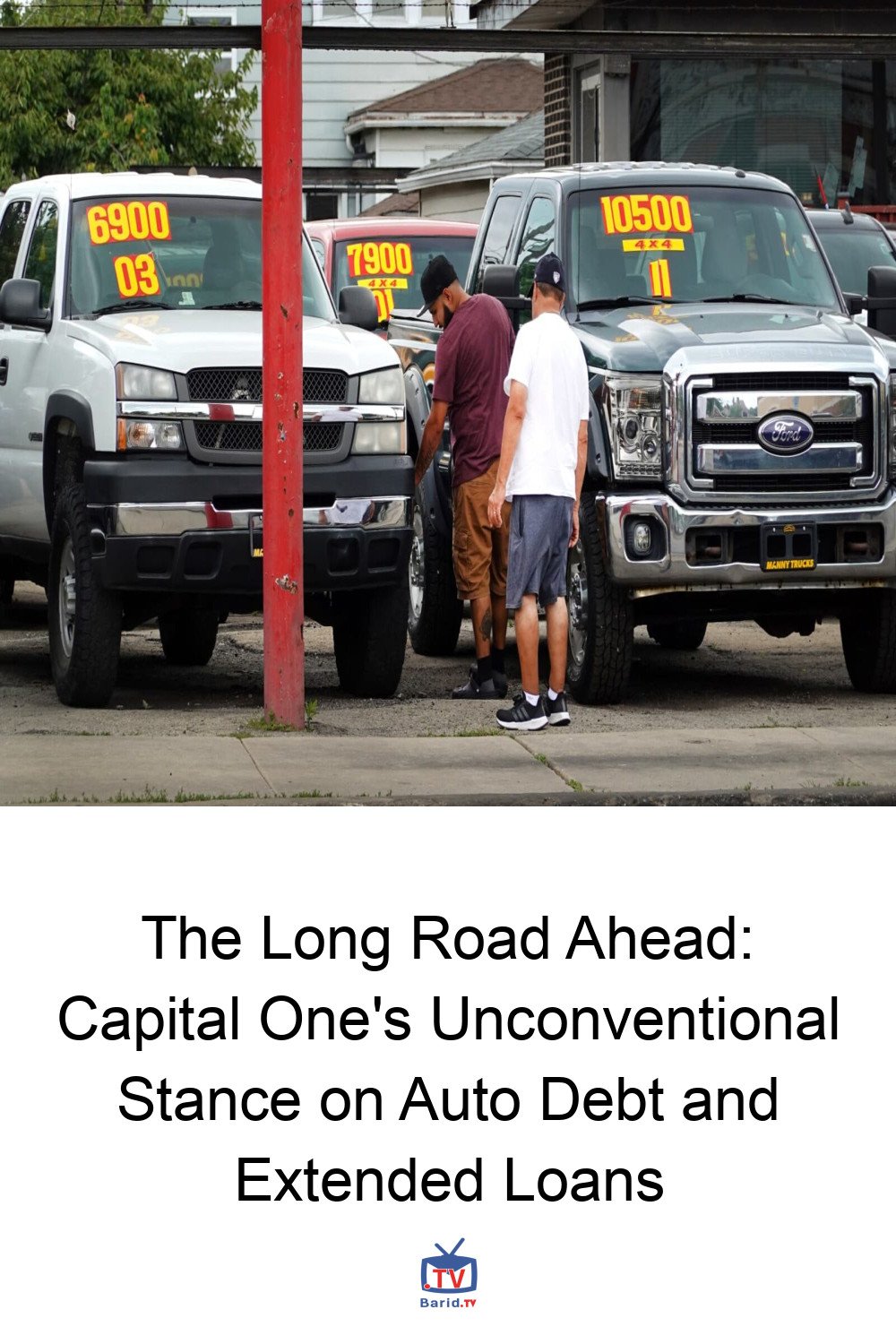
The automotive market has been a rollercoaster of inflated prices and evolving financing trends, leading many to question the sustainability of consumer auto debt. Amidst this backdrop, one of the nation’s largest auto lenders, Capital One Auto, offers a surprisingly calm perspective, asserting that the sky isn’t falling, even with the rise of so-called ‘forever loans.’
Capital One’s Counter-Narrative: Stability Amidst Soaring Costs
Sanjiv Yajnik, President of Capital One Auto, dismisses widespread concerns about escalating consumer automotive debt and the impact of high used car prices. His core argument hinges on a crucial metric: the percentage of income consumers are dedicating to their vehicle payments. Despite a notable jump in median monthly car payments from $390 in 2019 to $525 currently, Capital One’s internal data suggests that vehicle costs have remained remarkably stable relative to income.
“If I just told you, ‘Car prices going up, interest rates going up, insurance prices going up,’ you would say, ‘You know what, consumers must be paying more as a ratio to the income,'” Yajnik explained to CNBC. “However, if you look at every quintile of salary and earnings of people, the payment-to-income ratio has remained fairly flat.”
Indeed, Capital One’s automotive unit reports that the overall payment-to-income ratio has held steady at approximately 10% since 2019. Furthermore, a significant 80% of car purchasers who finance their vehicles are well below the commonly accepted 15% payment-to-income threshold. Yajnik views this as a sign of consumer prudence. “The consumer is being cautious. They’re being responsible. This is a much healthier way to do things than the alternative, because it’s not a discretionary spend,” he emphasized, highlighting the essential nature of vehicle ownership for transportation, particularly for work.
The ‘Forever Loan’ Debate: A Tale of Two Perspectives
While Capital One expresses confidence, its stance diverges from other industry voices who raise red flags about the proliferation of longer-term loans.
The Industry’s Warning: Negative Equity Risks
Critics argue that these extended financing terms, often stretching six years or more and dubbed ‘forever loans,’ are pushing many buyers into negative equity. This means they owe more on their vehicle than it’s worth, a precarious position should they need to trade it in prematurely. Data from Edmunds underscores these concerns: roughly 26% of used vehicles traded in through April of this year carried negative equity, averaging $5,105 – a 35% increase since 2019.
Jessica Caldwell, head of insights for CarMax’s Edmunds, noted, “As loan term lengths increase on average, the pace at which consumers make progress paying down their balance slows. If consumers then trade in their vehicle too soon for any reason, they are increasingly left holding more loan debt.” The situation is even more pronounced for new vehicles, where 90.2% of loans involving negative equity trade-ins in Q1 had terms of at least 72 months, with 43% extending to 84 months, and an average negative equity of $7,183.
Capital One’s Defense: Affordability and Utility
Sanjiv Yajnik acknowledges the longer path to equity but counters that the utility and affordability benefits outweigh the risks for many consumers. He suggests that buyers simply need to commit to keeping their vehicles for a longer duration to realize the value of these extended loans. “Yes, it takes longer to get your equity, but in the meantime, you get a use of the car, and you’re earning money,” he stated.
He points to the significant difference in monthly payments that longer terms offer. For instance, financing a $30,000 vehicle at a 9% annual percentage rate would cost an additional $3,100 over an 84-month term compared to a 48-month loan. However, the crucial factor for many is the $264 difference in monthly payments, making vehicle ownership accessible to a broader range of consumers, particularly those in lower income brackets. While acknowledging that “there’s obviously going to be pockets that have problems,” Yajnik maintains that the overall picture for consumers is one of responsible management and strategic affordability.
In a market rife with financial complexities, Capital One’s perspective offers a compelling, albeit controversial, argument for the resilience of the average auto consumer, suggesting that longer loans are not necessarily a trap but a tool for managing essential transportation costs.
For more details, visit our website.
Source: Link