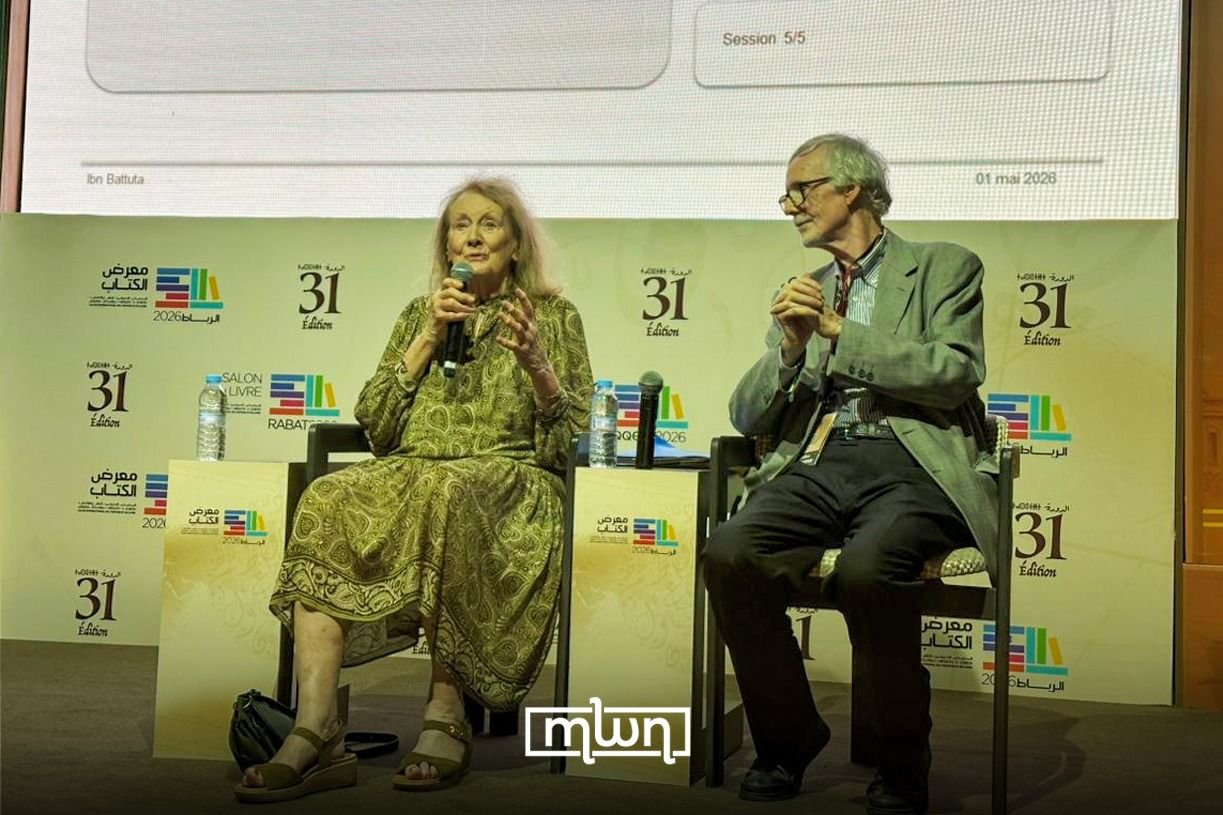

Rabat bore witness to a profound literary event at the International Publishing and Book Fair (SIEL) 2026, as Nobel laureate Annie Ernaux took to the stage. Far from constructing elaborate fictional worlds, Ernaux, a radical practitioner of literary “subtraction,” arrived to dismantle the very foundations of what many perceive literature to be. Her appearance in the Salle Ibn Battuta, moderated by Abderrahman Tenkoul, unfolded as a meticulous deconstruction of literature’s most enduring myths – that writing redeems, memory heals, or language transcends its social origins.
Annie Ernaux: Literature as Raw Truth
For Ernaux, writing is a far simpler, yet infinitely more potent, act. “Writing is much simpler than that,” she stated with characteristic austerity. “It speaks of a life. Childhood, adolescence, and then we are in the world. Our identity never ceases.” This seemingly modest declaration carries a powerful rebuke against any notion of metaphysical ambition in literature. It firmly anchors writing in the realm of the contingent, the historical, and the deeply embodied human experience.
Her oeuvre has long navigated the intricate terrain between autobiography and sociology, memory and material conditions – a unique space critics have aptly termed “autosociobiography.” In Rabat, this ethos resonated strongly: writing as a sincere act of resistance against aesthetic illusion, a commitment to unvarnished truth over embellished narrative.
The Art of ‘Desacralization’
Born in 1940 into a working-class family running a café-grocery in Normandy, Ernaux’s life experiences have profoundly shaped her literary vision. For decades, she has relentlessly probed the fault lines of class mobility, gender, and historical consciousness. From her debut novel, Les Armoires vides, which unflinchingly tackled abortion and female emancipation, to her monumental “collective autobiography,” Les Années, Ernaux has consistently eschewed the comforting illusions of fiction.
“I want to desacralize,” she declared, a sentiment that echoes her response to receiving the Nobel Prize in Literature in 2022. Her writing stands as a defiant counterpoint to the idea of literature existing above life, or the writer occupying a privileged, detached vantage point. This stance places her within a rich French literary tradition, alongside figures like Jean-Paul Sartre and Simone de Beauvoir, yet simultaneously distinguishes her. While sharing their commitment to writing as engagement, Ernaux strips it bare of philosophical abstraction.
Beyond Bourgeois Narratives: Écriture Plate
Where Sartre envisioned literature as a moral project, Ernaux refines it to a practice of exposure – not just of the self, but crucially, of the societal structures that forge the self. Her intellectual kinship with sociologist Pierre Bourdieu is palpable. She critiques the binary ways in which non-bourgeois lives are often depicted: either glorified as heroic workers or portrayed as perpetually dominated. Both, she argues, are distortions, serving reader expectations rather than reality.
Her radical alternative is écriture plate, or “flat writing.” While the English translation struggles to capture its precise nuance, Ernaux explained it as writing “brought back to essentiality,” a “factual writing.” This factuality is not about neutrality; it is, fundamentally, an ethical stance. To reject metaphor and embellishment is to refuse the aestheticization of social reality. Ernaux’s prose does not seek to elevate or beautify experience; it seeks, rather, to lay it bare.
The Paradox of Self-Erasure
A cornerstone of Ernaux’s project lies in the profound paradox that to write oneself is, ultimately, to erase oneself. It is a journey “from the human to the effacement of the human,” as she eloquently put it. This is powerfully illustrated in La Place
, her poignant account of her father’s life. “I did not want the reader, whom I defined internally as bourgeois, to judge,” she revealed. “I described not only my father’s life, but an entire culture.” This statement encapsulates the inherent double bind of her work: she must employ the language of the dominant class to articulate the experiences of those excluded from it.
Fragmentation, too, is not merely a stylistic choice but a structural imperative in Ernaux’s writing. Terms like “fragment” and “discontinuity” recur as fundamental conditions of human experience. For Ernaux, identity is not a neat, coherent narrative, but rather a complex accumulation of disparate moments, each contributing to a multifaceted, often contradictory, whole.
For more details, visit our website.
Source: Link