

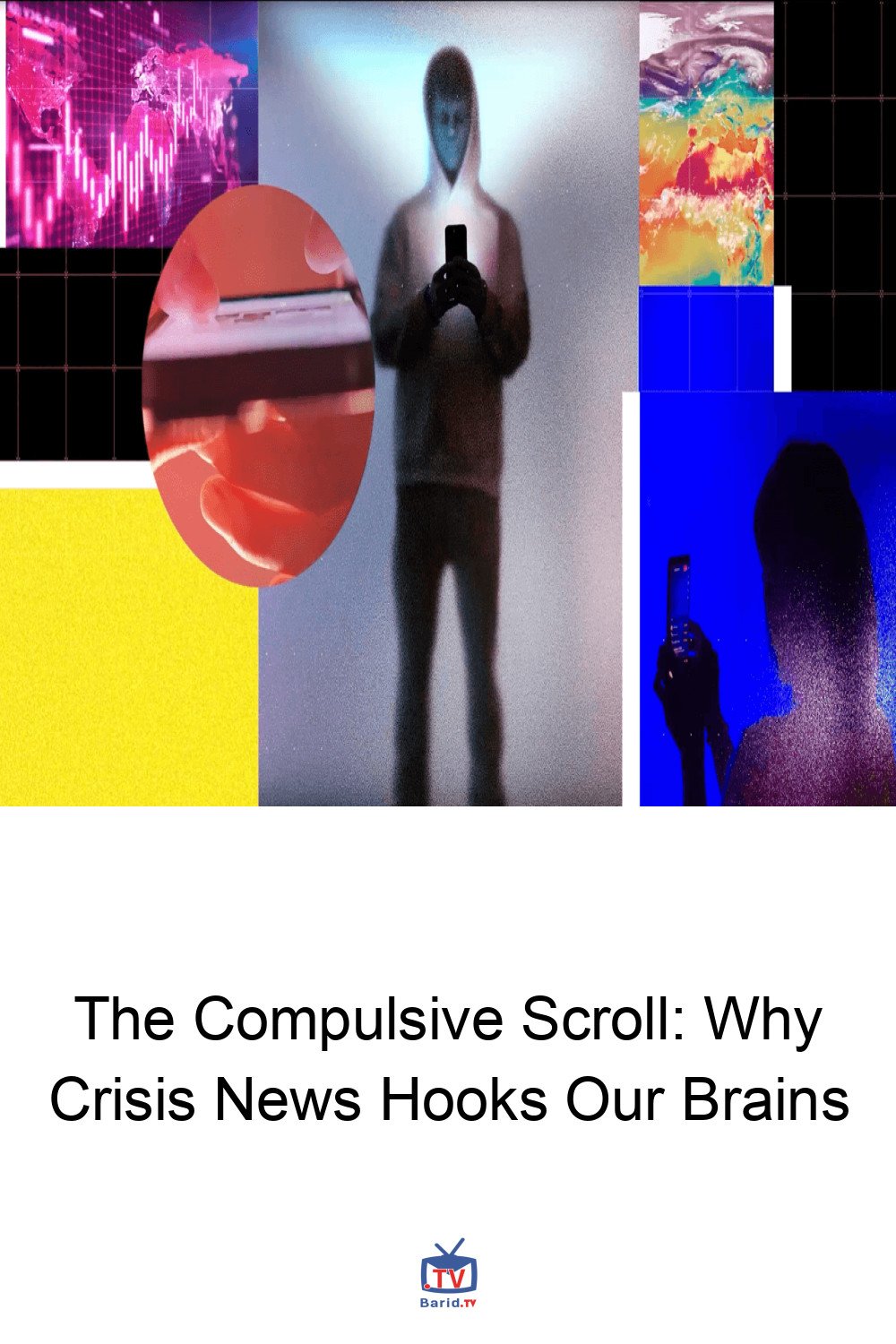
As geopolitical tensions flare and missiles arc across distant skies, a familiar, almost involuntary, reflex grips millions: reaching for their phones. In moments of global instability, like the recent exchanges across the Persian Gulf, social media transforms into an immediate, often overwhelming, conduit for breaking news, raw footage, and rampant speculation. What begins as a quest for information quickly morphs into a relentless cycle of updates on war, political upheaval, cyberattacks, and pervasive crisis coverage.
This phenomenon has a name: doomscrolling. It’s the compulsive consumption of negative news, delivered through an endless stream of alerts and algorithmically amplified crises. Videos of missile interceptions, airspace closures, and alleged cyber incidents — often mixed with a potent dose of misinformation — flood feeds within minutes of each development. With verified information emerging slowly, yet updates arriving constantly, users find themselves in a perpetual refresh loop, desperately trying to piece together a real-time narrative.
Beyond Information: The Brain’s Threat Detector
What feels like a responsible effort to stay informed can rapidly become a detrimental feedback loop between our brain’s ancient threat-detection system and platforms meticulously engineered for engagement. Not all digital scrolling is created equal. Alexander TR Sharpe, an associate lecturer at the University of Chichester, distinguishes doomscrolling from “dopamine scrolling.”
“Doomscrolling refers to repetitive consumption of negative or crisis-related information,” Sharpe explains. “It’s less about fleeting stimulation and more about staying locked into threat-related material, a primal vigilance.”
Why We Can’t Look Away: Our Evolutionary Wiring
Cognitive scientists assert that this pattern is no accident; it’s deeply embedded in our evolutionary heritage. Humans are hardwired to prioritize threats, making negative news exceptionally difficult to disregard.
Reza Shabahang, a media psychology researcher, elaborates: “Human memory, shaped by evolutionary pressures, is biased towards prioritizing information related to danger, threat, and emergencies to support survival. Consequently, memory processes are particularly effective at encoding and retaining negative news content, making such information easier to recall. Negative information, and the memories associated with it, therefore tend to be especially salient and enduring.”
The psychological toll is significant. A 2026 study by Sharpe revealed strong links between frequent doomscrolling and rumination, emotional exhaustion, and an intolerance of uncertainty. Participants who engaged in this behavior reported higher levels of anxiety, depression, and stress, coupled with diminished resilience.
The Shadow of Indirect Trauma
Shabahang suggests that this behavior can even mimic a form of indirect trauma exposure. “Trauma is not experienced solely through direct personal exposure,” he states. “Consistent exposure to images or reports of traumatic incidents can elicit acute stress responses and, in some cases, symptoms associated with post-traumatic stress.” While not always leading to full-blown trauma, the outcome is often a nervous system struggling to return to a state of calm, perpetually on high alert.
The Relentless Check: Uncertainty and Activation
Experiments consistently demonstrate that people will endure physical discomfort to resolve uncertainty. In moments of crisis, refreshing a social media feed can feel not just responsible, but almost protective, a desperate attempt to gain control or understanding.
A 2024 report by Shabahang underscored this, linking prolonged exposure to negative news with increased anxiety, insecurity, and maladaptive stress responses. The news itself isn’t inherently harmful, but the incessant, unresolved exposure appears to keep our stress systems perpetually activated. Learning research indicates that emotional activation without closure strengthens stress responses rather than extinguishing them.
Hamad Almheiri, founder of BrainScroller, an app designed to replace doomscrolling with microlearning, describes the visceral impact: “The amygdala remains sensitized. Even without physical danger, the brain responds as if risk is ongoing.” While acknowledging the need for more biomarker research, Sharpe confirms consistent links to hypervigilance, rumination, and difficulty tolerating uncertainty within the doomscrolling literature.
How Feeds Engineer the Scroll
Doomscrolling doesn’t happen in a vacuum; it thrives in environments meticulously optimized for user engagement. Social media algorithms are designed to keep us hooked.
The Slot Machine Effect
At a behavioral level, scrolling operates on the same principle as a slot machine: unpredictability. Each refresh offers the tantalizing possibility of something new—a breaking headline, a critical update, a shocking video. This inherent uncertainty is precisely what compels users to check again and again, chasing the elusive “next big thing.”
Engineered Emotions
Digital media psychologist and artist Assim Kalouaz terms this “emotional conditioning.” Notifications and badges act as urgent cues, drawing us back in. Kalouaz notes, “Content that reliably triggers fear, anger, or sadness is more likely to be promoted because it drives engagement.” The result is a self-perpetuating feedback loop: uncertainty fuels scrolling, which in turn increases exposure to emotionally charged content, further intensifying the cycle of anxiety and the irresistible urge to scroll.
For more details, visit our website.
Source: Link