




AI-Powered Cyberattacks Unleash Chaos: Chainstack, WorkOS, and Others Fall Victim to ARTEX Campaign
In an alarming development for the digital security landscape, blockchain infrastructure giant Chainstack has revealed it was the target of a sophisticated cyberattack, exposing sensitive customer data and password hashes. This incident is not isolated, forming part of a wider, artificial intelligence (AI)-powered offensive campaign dubbed ARTEX, which has already claimed other high-profile victims including API platform WorkOS and blockchain analysis firm Chainalysis.
Chainstack’s Compromise: A Detailed Timeline
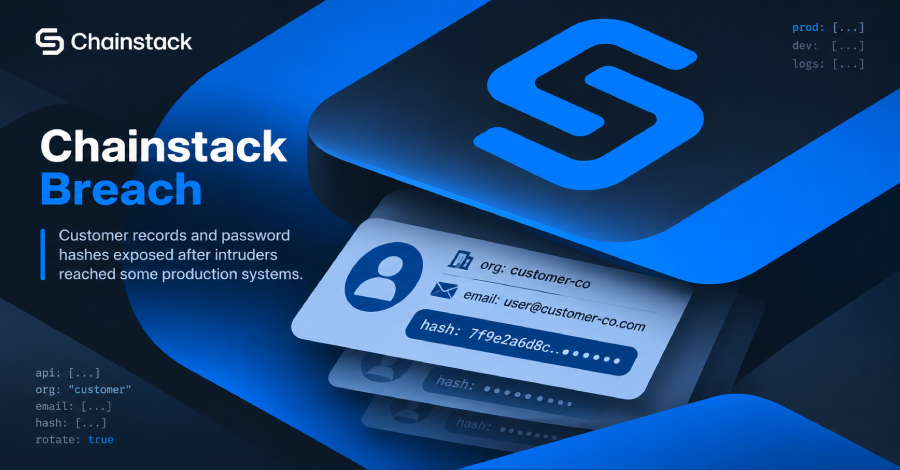
Chainstack disclosed the breach on Tuesday, detailing how an unauthorized party gained access to parts of its critical infrastructure. The company confirmed that an “external attacker gained unauthorized access to part of Chainstack’s infrastructure through a third-party component.” Swift action was taken: “We detected the intrusion, cut the access paths, and are hardening our systems,” Chainstack stated.
The timeline of the breach paints a concerning picture:
- October 26, 2026: The attacker first infiltrated a development environment.
- Escalation: Access was then escalated to compromise “some parts of our production environment.”
- October 31, 2026: The intrusion was detected, and the attacker’s access was immediately severed.
During the breach, the threat actor accessed a database containing crucial customer account information, including organization names, account holder names, email addresses of organization members, and password hashes. Furthermore, systems holding node credentials were also accessed. While Chainstack has “no evidence they were read,” they are being treated as exposed, prompting an urgent call for customers to rotate them.
Immediate Actions for Chainstack Customers
In light of the exposure, Chainstack has issued critical recommendations for its users:
- Rotate Node Credentials: This is paramount to secure blockchain operations.
- Regenerate Platform API Keys: Ensure all access points are refreshed.
- Update Passwords: Change passwords for Chainstack and any other services where the same password might have been reused.
- Vigilance Against Phishing: Remain highly alert to suspicious communications.
ARTEX: The AI-Driven Threat Campaign
While Chainstack has not publicly attributed the attack, assessments suggest a strong overlap with a campaign orchestrated by a China-linked cluster leveraging ARTEX, an autonomous AI agent framework designed for offensive security operations. This framework significantly enhances the speed, scale, and sophistication of cyberattacks, exploiting vulnerabilities like exposed applications and stolen credentials with unprecedented efficiency.
A Growing List of Victims: WorkOS, Chainalysis, and DIVD
The ARTEX campaign’s reach extends far beyond Chainstack, underscoring a disturbing trend in modern cyber warfare:
WorkOS: GTM Systems Compromised
API platform WorkOS also disclosed a security incident, confirming it was targeted by the same AI agent framework. Discovered on October 30, 2026, this breach was confined to WorkOS’s Go-To-Market (GTM) systems, fortunately leaving production systems and customer platform data unaffected. However, the accessed data included business contact details, account histories, customer communications (summaries of calls, support discussions, Slack conversations), and operational metadata.
Chainalysis: Reactor and Data Solutions Offline
Blockchain analysis firm Chainalysis reported detecting an “external actor using offensive agentic techniques” to access its systems and internal tools. As a precautionary measure, the company proactively took its Reactor and Data Solutions products offline on November 2, 2026, while closely monitoring for unusual activity.
Dutch Institute for Vulnerability Disclosure (DIVD): Zero-Day Exploitation
The Dutch Institute for Vulnerability Disclosure (DIVD) was also hit by ARTEX on September 21, 2026. This attack involved the exploitation of two zero-day flaws (CVE-2026-102489 and CVE-2026-102490) in the open-source Zammad ticketing system. These vulnerabilities allowed attackers to escalate privileges, execute remote code, and exfiltrate data, demonstrating the framework’s capability to leverage critical software flaws.
The Dawn of AI-Powered Cyber Warfare
These incidents collectively highlight a critical shift in the cybersecurity landscape. The rise of AI agents like ARTEX enables attackers to devise highly tailored strategies and automate various phases of an intrusion, from reconnaissance to data exfiltration. As WorkOS aptly put it, this “increases the speed and scale of attacks that exploit weaknesses such as exposed applications and stolen credentials,” demanding “timely remediation and monitoring that can connect suspicious activity across systems.”
The digital world is entering an era where autonomous AI agents are not just tools but active participants in offensive operations. Businesses and individuals alike must bolster their defenses, prioritize robust security practices, and remain vigilant against an evolving and increasingly intelligent threat landscape.
For more details, visit our website.
Source: Link







Leave a comment