




The hallowed halls of Bologna, Italy, recently played host to Cersaie 2026, the 43rd edition of the world-renowned international exhibition of ceramic tile and bathroom furnishings. For five vibrant days in late September, over 90,000 visitors, including leading manufacturers, visionary architects, and discerning designers, converged to witness the unveiling of the next era in surface design. And what an era it promises to be! From a palpable buzz in the temporary showrooms to groundbreaking product debuts from 600 exhibitors across 24 countries, Cersaie 2026 was a testament to innovation, creativity, and a bold new direction for interior aesthetics.
According to Danielle McWilliams, principal at Novità, the communications agency for Ceramics of Italy, a dominant theme was immediately apparent: “Warm, moody colors dominated the aisles of Cersaie 2026 and the windows of almost every storefront in Bologna.” This sentiment echoed throughout the fair, signaling a significant shift. Beyond this chromatic revolution, other key trends emerged: the embrace of large-format tiles, a heightened focus on texture and dimension, the intricate artistry of digital printing, and the sophisticated reinterpretation of natural material effects.
The Resurgence of Color: A Bold New Palette
While the timeless elegance of stark white and neutral tiles will always hold its place, Cersaie 2026 heralded a confident return to richer, more saturated hues. Benedetta Borghi, from external affairs at Atlas Concorde, observed, “We are certainly seeing a renewed confidence in color. There is a much greater willingness to use stronger colors as part of the architectural palette.” This isn’t merely about adding a splash; it’s about integrating color as a fundamental design tool.
A Palette of Passion: Warm & Moody Tones
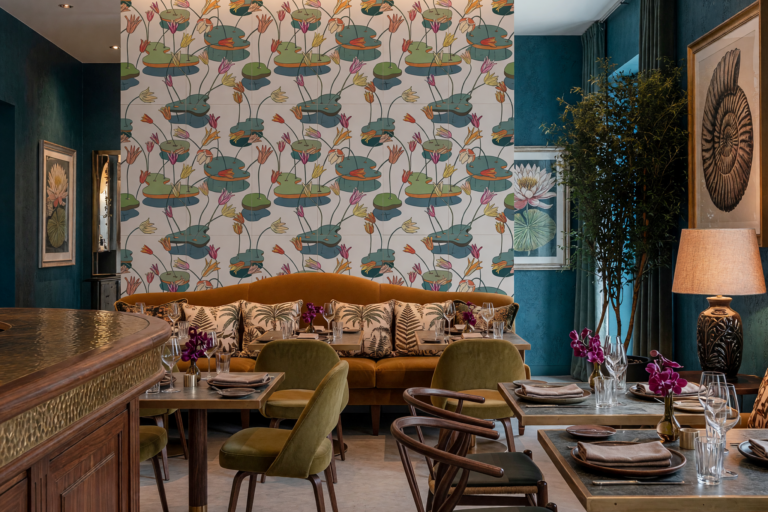
Italian tile manufacturers, much like their counterparts in fashion, showcased collections steeped in deep burgundy, luxurious browns, earthy terracottas, and vibrant reds and yellows. Faetano’s Era collection, for instance, beautifully mimics the rustic charm of terracotta, available in a spectrum of six natural and neutral shades. The trend extends to dynamic combinations, with Atlas Concorde’s Boost Hux pairing warm natural tones with striking accents of green, red, blue, and ember. Their Vivia collection further exemplifies this, featuring vivid glazed colors inspired by traditional Italian ceramics. Cristina Faedi, a renowned tile trend expert and consultant to Confindustria Ceramica, affirmed this shift, noting that some Italian companies have even doubled their color ranges or introduced multiple densities of the same shade, underscoring color’s evolving role from mere accent to essential design element.
Green’s Serene Embrace
Could the current global climate be subtly influencing our aesthetic choices? Cristina Faedi suggests a connection between the chaotic state of the world and the emerging tile palettes, drawing parallels to the seven chakras and their corresponding colors. Green, often associated with empathy and emotional healing, is undeniably having its moment. “It’s a color that clearly gives a lot of calm and is inspired by nature,” Faedi explains. “It’s a narrative of landscapes, of places, of wild herbs, but also of thermal waters and even of oceans.”
From deep forest to pale sage, greens permeated the collections. Earthy palettes, including various terracotta and natural tones, also made a strong statement. Terratinta Group’s Sartoria collection, Plinth, exemplifies this trend with shades like Moss and Stone Green. These greens, especially when paired with glossy finishes, truly pop, amplifying their inherent vibrancy. Plinth further enhances this with a 3D surface, adding texture and dimension to walls, transforming a simple color into a multi-sensory experience.
Redefining Form and Function: Beyond Flat Surfaces
The evolution of ceramic tile is moving beyond mere material reproduction. As Benedetta Borghi articulates, “Ceramic is no longer simply reproducing a material: the surface itself is becoming an architectural element. That’s an interesting evolution.” This shift is evident in the innovative ways manufacturers are playing with perception and reimagining natural aesthetics.
Tactile Illusions: Playing with Perception
The boundaries between visual and tactile are blurring. Marca Corona’s Multiforme Mira wall tiles, for instance, perfectly complement their concrete-effect porcelain floor tiles. A standout is the Tassello decorative variant, which features small, three-dimensional tesserae meticulously arranged to create the illusion of a continuous mosaic. These designs often incorporate glossy and luster-glazed details set against a matte background, creating a captivating interplay of light and shadow.
Collaborations are also pushing the envelope. Moooi Ceramic Surfaces, in partnership with ABK, introduced Hypnotic Owl as part of The Nesting Room collection. This floor and wall tile boasts a tactile 3D-relief surface, achieved through ABK’s proprietary 3DTECH technology, which digitally applies glazes and textures to porcelain stoneware. Similarly, Gruppo Bardelli brand Appiani unveiled Lamiere, from its Pastelli Strutture collection. Inspired by sheet metal, these through-body ceramic tiles masterfully employ the chiaroscuro effect to create a striking illusion of a 3D surface. What’s truly remarkable is the interplay of light and reflectivity, creating a mind-bending effect where the tiles appear dimensional yet feel perfectly flat to the touch.
Nature Reimagined (and Enhanced)
When the inherent properties of real stone or marble fall short of durability requirements, ceramic innovation steps in to offer stunning, enhanced alternatives. Cersaie 2026 showcased how manufacturers are not just replicating nature, but elevating it, providing surfaces that offer superior performance without compromising on authentic aesthetic appeal. This trend sees the intricate veining of marble, the rugged texture of stone, and the subtle variations of wood meticulously recreated and often improved upon, offering designers unparalleled versatility and resilience.
For more details, visit our website.
Source: Link





Leave a comment