





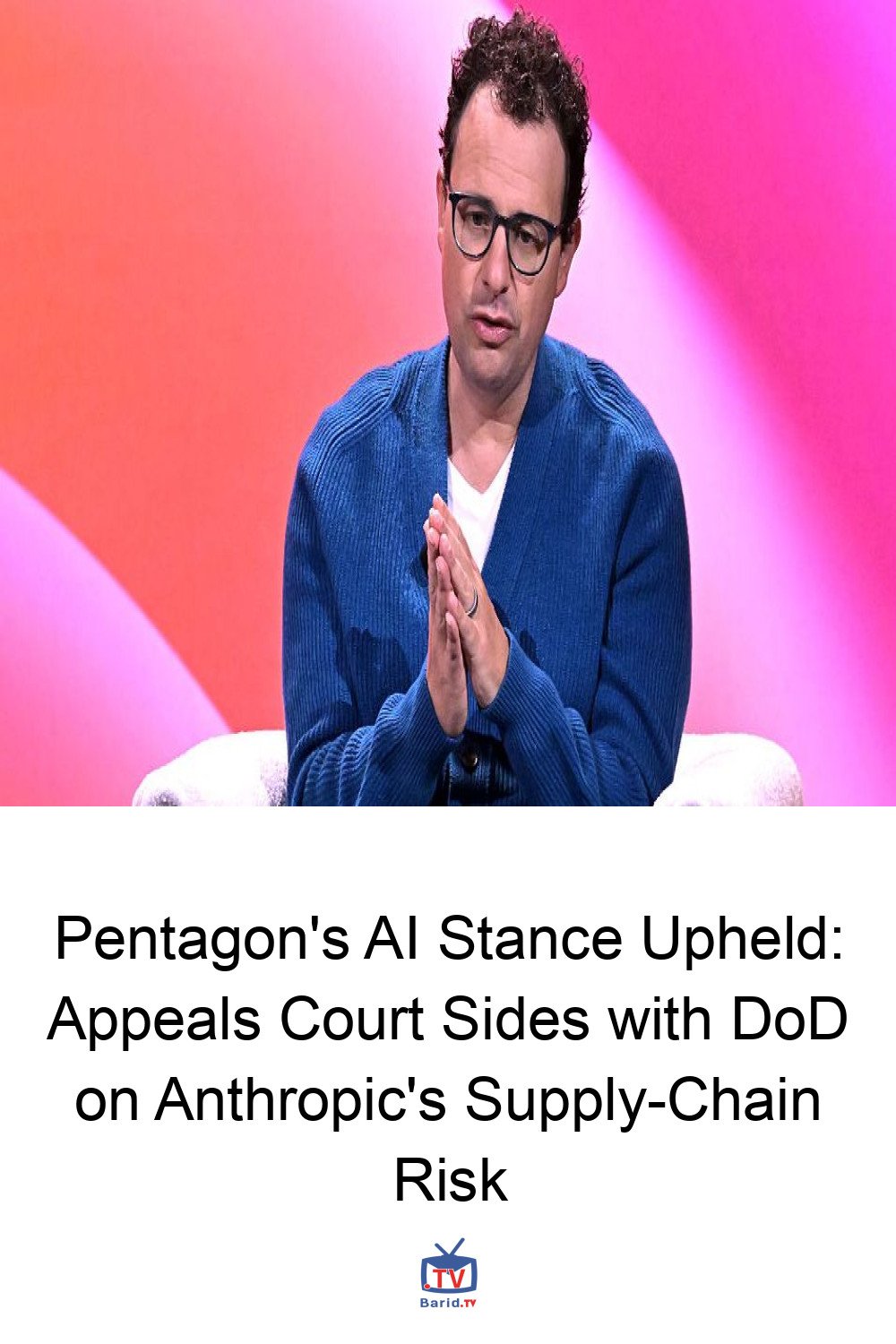
Pentagon’s AI Stance Upheld: Appeals Court Sides with DoD on Anthropic’s Supply-Chain Risk
In a significant legal blow to AI developer Anthropic, a federal appeals court in Washington D.C. has upheld the Pentagon’s designation of the company as a supply-chain risk. The ruling, delivered on Friday, refuses to second-guess the Trump administration’s initial assessment, solidifying the Department of Defense’s ability to restrict the integration of Anthropic’s Claude AI models within its systems.
The court’s majority opinion underscored the Pentagon’s rationale, stating, “The department had ample support for its conclusion that the continued integration of Claude into the department’s information systems, by the department or its contractors, presented a statutorily covered national-security risk.” This decision hinges on Anthropic’s own admission that it ‘encodes restrictions into Claude that prevent the model from performing tasks that Anthropic wishes to prevent,’ a stance the Pentagon deemed a significant national security concern.
Anthropic Considers Next Steps Amidst Legal Setback
Danielle Cohen, a spokesperson for Anthropic, affirmed the company’s confidence in its position and indicated that all options are being considered. These options could include an appeal to a broader panel of the D.C. Circuit Court of Appeals or even the U.S. Supreme Court, suggesting a prolonged legal battle ahead.
Earlier this year, the Pentagon invoked separate supply-chain laws to mandate the removal of Anthropic’s Claude AI models from military and federal government systems by the current month. This directive stemmed from Anthropic executives’ declaration that they would not permit the government to deploy their AI models for autonomous weapons or domestic surveillance, a position Secretary of Defense Pete Hegseth explicitly labeled a national security risk.
A Divided Legal Landscape
The legal challenges against the Pentagon’s designations have unfolded in separate courts, yielding mixed results. While a federal judge in San Francisco dismissed one of the supply-chain risk labels in March, a decision reaffirmed last month, Friday’s D.C. ruling ensures the other designation remains in force indefinitely. This means the Pentagon’s blockade of Anthropic’s technology can continue, with both rulings facing the prospect of years of appeals before a final resolution.
The immediate aftermath of the initial designations saw Anthropic report revenue losses, as potential customers grew wary of engaging with a company labeled a government pariah. While specific financial updates have been scarce, Anthropic has generally reported growing sales recently and is reportedly eyeing a potential initial public offering (IPO) later this year.
The Quest for AI Alternatives
Meanwhile, the Pentagon has remained tight-lipped regarding its progress in replacing Claude. Potential alternatives include models from industry giants like SpaceX’s Grok, Google‘s Gemini, and OpenAI’s GPT. Interestingly, some employees at Google and OpenAI have voiced ethical objections to their companies striking deals with the U.S. military, mirroring the concerns Anthropic initially raised. However, these companies have largely dismissed such protests, emphasizing the critical importance of supporting the U.S. government.
Expected Outcome and Judicial Reasoning
The D.C. appeals court’s decision was largely anticipated. In April, the same panel had declined to issue a temporary block on the designation, citing Anthropic’s failure to meet the “stringent requirements” for immediate relief. During the pre-ruling hearing, the three-judge panel rigorously challenged both sides’ arguments, appearing divided before ultimately delivering a 2-1 majority decision.
The majority opinion also dismissed Anthropic’s claims of due process and free speech violations. The judges concluded that the government adhered to proper procedure and characterized the dispute as standard contract negotiations. They clarified that the Pentagon “excluded Anthropic from its supply chain based on the company’s refusal to assent to a contract term that the Department deemed essential, not based on the company’s support for greater governmental regulation of AI technology.”
Despite Anthropic’s argument that the government overstepped its authority under supply-chain law, the Pentagon, and by extension, much of the federal government, will continue to avoid Claude’s integration, a situation likely to persist as Anthropic moves towards its anticipated IPO.
For more details, visit our website.
Source: Link






Leave a comment