
For decades, solar scientists have theorized that the Sun’s fiery surface must be a chaotic tapestry of tiny plasma vortices. These swirling structures, believed to be born from the dynamic interplay between the Sun’s powerful magnetic fields and its constantly flowing superheated material, have remained elusive – until now.
Groundbreaking Discovery from Hawaii
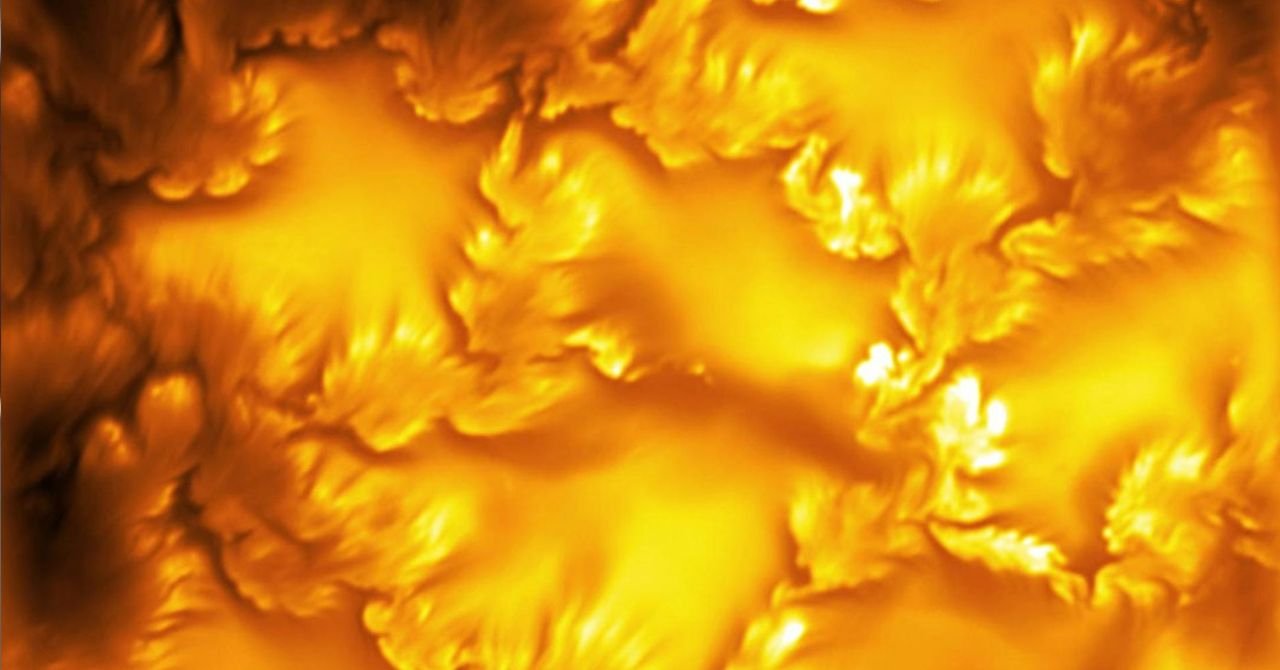
This week marks a monumental achievement in solar astronomy. The world’s most powerful solar telescope, the Daniel K. Inouye Solar Telescope (DKIST), perched atop the Haleakalā volcano in Hawaii, has delivered the first direct visual evidence of these long-theorized phenomena. Its latest image is not just a picture; it’s a confirmation of the Kelvin-Helmholtz instability, a physical phenomenon predicted over a century ago.
Shared by NASA, this unprecedented image offers a view of the Sun unlike any before. While not as dramatically colored as the famous ultraviolet or X-ray captures from space observatories, this visible-light image presents a perspective closest to what the human eye would perceive, if it could withstand the Sun’s blinding intensity. It reveals a mesmerizing landscape of “petals,” swirls, and folds across our star’s surface, a stark contrast to the previously smooth views.
Understanding the Kelvin-Helmholtz Instability
The captivating “petals” and swirling patterns visible in the new image are direct manifestations of the Kelvin-Helmholtz instability. This phenomenon occurs when two fluid currents move at different speeds, creating friction at their boundary that causes ripples and ultimately forms vortices. It’s not exclusive to the Sun; we observe it on Earth when wind skims over water or within cloud formations, creating distinct wavy patterns.
On the Sun, these “fluids” are streams of plasma – an incredibly hot state of matter where gas atoms have shed their electrons. Scientists had long hypothesized that in specific solar regions, these plasma streams would interact much like colliding air or water currents, generating these characteristic vortices.
A New Era of Solar Observation
Prior to the Inouye telescope’s advanced capabilities, visible-light observations of the Sun’s surface offered a seemingly uniform appearance. However, thanks to the innovative techniques employed by DKIST, researchers can now peer into the Sun’s dynamic surface with unparalleled detail. This has allowed them to observe the constant formation and dissipation of small vortices, some merely a few dozen kilometers in diameter. These structures have always been an inherent part of the Sun’s activity; it is only now that humanity possesses the tools to visualize them.
NASA reports that this groundbreaking image captures a section of the Sun approximately the size of Earth’s radius, making it the highest-resolution visible-light image ever obtained. The wealth of new details promises to revolutionize our understanding of how the Sun transfers its immense energy to its outer layers and influences the temperature of its solar corona. The solar corona is of particular scientific interest as it is the origin point for coronal mass ejections (CMEs) – powerful eruptions of plasma and magnetic field that can trigger geomagnetic storms, posing a significant threat to Earth’s electronic systems and infrastructure.
This discovery, originally reported by WIRED en Español, opens new avenues for solar research, promising deeper insights into the mechanisms that drive our star and its profound impact on our planet.
For more details, visit our website.
Source: Link