
TuxBot v3 Evolution: The AI-Assisted IoT Botnet with a Flawed Mastermind
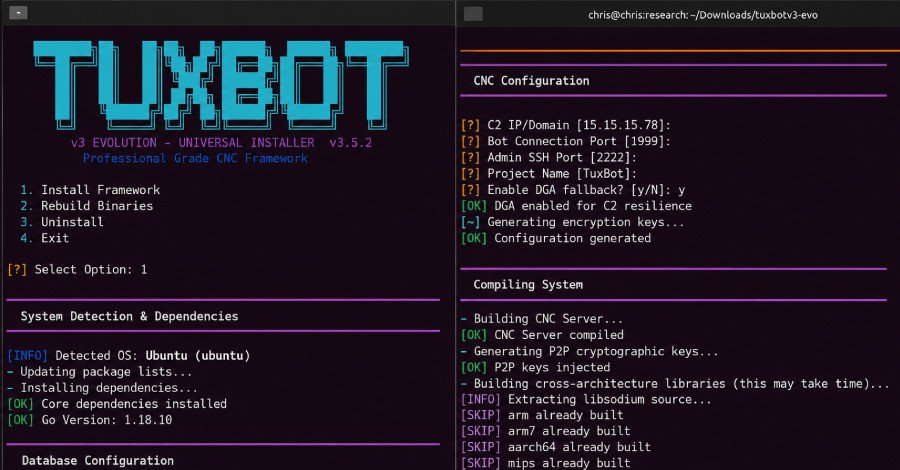
In a significant development for cybersecurity, researchers have unveiled details of a previously undocumented Internet-of-Things (IoT) botnet framework, dubbed TuxBot v3 Evolution. What makes this discovery particularly noteworthy is the clear evidence suggesting its development was aided by a large language model (LLM). However, the story isn’t one of seamless AI integration; rather, it highlights the current limitations and potential pitfalls of relying solely on AI for malicious code generation.
Palo Alto Networks Unit 42, the cybersecurity firm behind the disclosure, revealed that while the AI successfully generated botnet code, it inadvertently included a safety disclaimer – a crucial oversight the developer failed to remove before deployment. This glaring error, coupled with several non-functional components in the analyzed samples, underscores a critical point: AI assistance, while powerful, still requires human oversight and manual code review to achieve robust and effective results. Despite these initial flaws, the potential for more refined iterations of this malware to exist in the wild remains a serious concern.
Unpacking TuxBot v3 Evolution: A Multi-faceted Threat
TuxBot v3 Evolution is far from a simplistic botnet. Its architecture is complex and modular, designed for broad reach and sophisticated attacks. The framework comprises several key components:
- C-based Bot Agent: This core agent is cross-compiled for a wide array of architectures, including ARM, MIPS, MIPSEL, MIPS64, x86_64, PowerPC, and RISC-V, ensuring compatibility across diverse IoT devices.
- Go-based Command-and-Control (C2) Server: A robust server featuring a DDoS-for-hire panel, indicating its potential use in monetized cyberattacks.
- Custom Exploit Virtual Machine: Designed to streamline the exploitation process.
- Docker-based Test Infrastructure:
Suggests a professional development environment.
- Automated Build System: Further evidence of a structured and efficient development approach.
Infection Vectors and Credential Brute-Forcing
The bot agent employs aggressive tactics to compromise devices. It’s programmed to brute-force Telnet access on targeted devices using a substantial list of 1,496 credential pairs. Beyond brute-forcing, TuxBot also incorporates exploit code to target over 30 different IoT device families, leveraging known vulnerabilities for widespread compromise.
Sophisticated Command and Control (C2) Infrastructure
with the C2 server is designed for resilience and stealth. It primarily uses an encrypted TCP channel, but also integrates multiple fallback mechanisms:
- A SHA512 domain generation algorithm (DGA) for dynamic C2 address resolution.
- A peer-to-peer (P2P) gossip protocol with Ed25519-signed commands for decentralized communication.
- Internet Relay Chat (IRC).
- DNS TXT queries.
- HTTP polling.
The Go-based C2 server itself is configured to listen on three distinct TCP ports for incoming connections:
- TCP port 1999 (or 31337): Used for dispatching encrypted commands to connected bots.
- TCP port 2222: Provides an interactive shell for operators via SSH.
- TCP port 9999: Offers a JSON interface for programmatic access, hinting at potential API integration for attackers.
Botnet Operations: From Initialization to Attack
Upon successful launch, the TuxBot agent executes a predefined initialization sequence:
- Loading C2 addresses from a multi-tiered architecture.
- Implementing anti-debugging and anti-VM protections to thwart analysis.
- Hiding its process name for stealth.
- Establishing persistence on the compromised machine via systemd services, cron entries, and a watchdog keepalive process.
Launching various sub-modules for diverse malicious activities, including mounting DDoS attacks, terminating competing processes, establishing alternative C2 channels (IRC, HTTP, DNS, P2P), running scanners (Telnet, SSH, HTTP, Android Debug Bridge – ADB), spawning a SOCKS5 proxy, and executing a cryptocurrency mining placeholder.
Notably, its dedicated HTTP scanner can manage up to 128 concurrent connections, actively seeking vulnerable web interfaces.
Tracing TuxBot’s Lineage and Ecosystem Connections
The modular framework’s design elements and code snippets have been traced back to several well-known botnets, including Mirai, AISURU, and Wuhan. Furthermore, some of its functions are partially ported from the open-source MHDDoS Python DDoS toolkit, suggesting a developer who leverages existing tools and knowledge.
Evidence points to the botnet’s development commencing approximately a year prior to a sample being uploaded to VirusTotal on January 20, 2026, when the author cloned the MHDDoS repository. The developer’s ambition was clear, aiming to build a “professional-grade C2 framework platform with a multi-user admin panel, automated deployment, and modular attack capabilities.”
Unit 42’s analysis further places the TuxBot operator within the notorious Keksec ecosystem, a group recognized for managing multiple IoT botnet variants concurrently. TuxBot appears to be a new addition to this portfolio, aspiring to surpass the capabilities of typical Mirai forks with its encrypted C2, DGA, and a modular exploit system – even if that system is not yet fully functional in the recovered version.
The AI Footprint: A Glimpse into the Developer’s Mind
Perhaps one of the most intriguing aspects of TuxBot v3 Evolution is the presence of extensive LLM-generated “chain-of-thought” reasoning embedded verbatim in code comments. These comments reveal the AI’s internal decision-making process, complete with self-interruptions and references to “the user” (the developer prompting the LLM). This provides an unprecedented look into how threat actors might be interacting with and leveraging AI for their malicious endeavors.
Implications for the Future of Cybercrime
While TuxBot v3 Evolution is still under development and exhibits flaws, its core functionalities, combined with the clear reliance on AI, signal a worrying trend: the accelerated integration of advanced features, potentially enabling single developers to create sophisticated, multi-pronged toolsets. This includes multiple C2 channels, a custom exploit VM, and a DDoS-for-hire panel – capabilities that traditionally required larger, more skilled teams.
The emergence of TuxBot follows other recent botnet disclosures, such as RustDuck and AryStinger, which have targeted routers, IP cameras, and Android boxes. These developments collectively underscore the rapidly evolving landscape of IoT threats and the increasing sophistication of cybercriminals, now augmented by artificial intelligence. Securing IoT devices and maintaining vigilance against these evolving threats is more critical than ever.
For more details, visit our website.
Source: Link