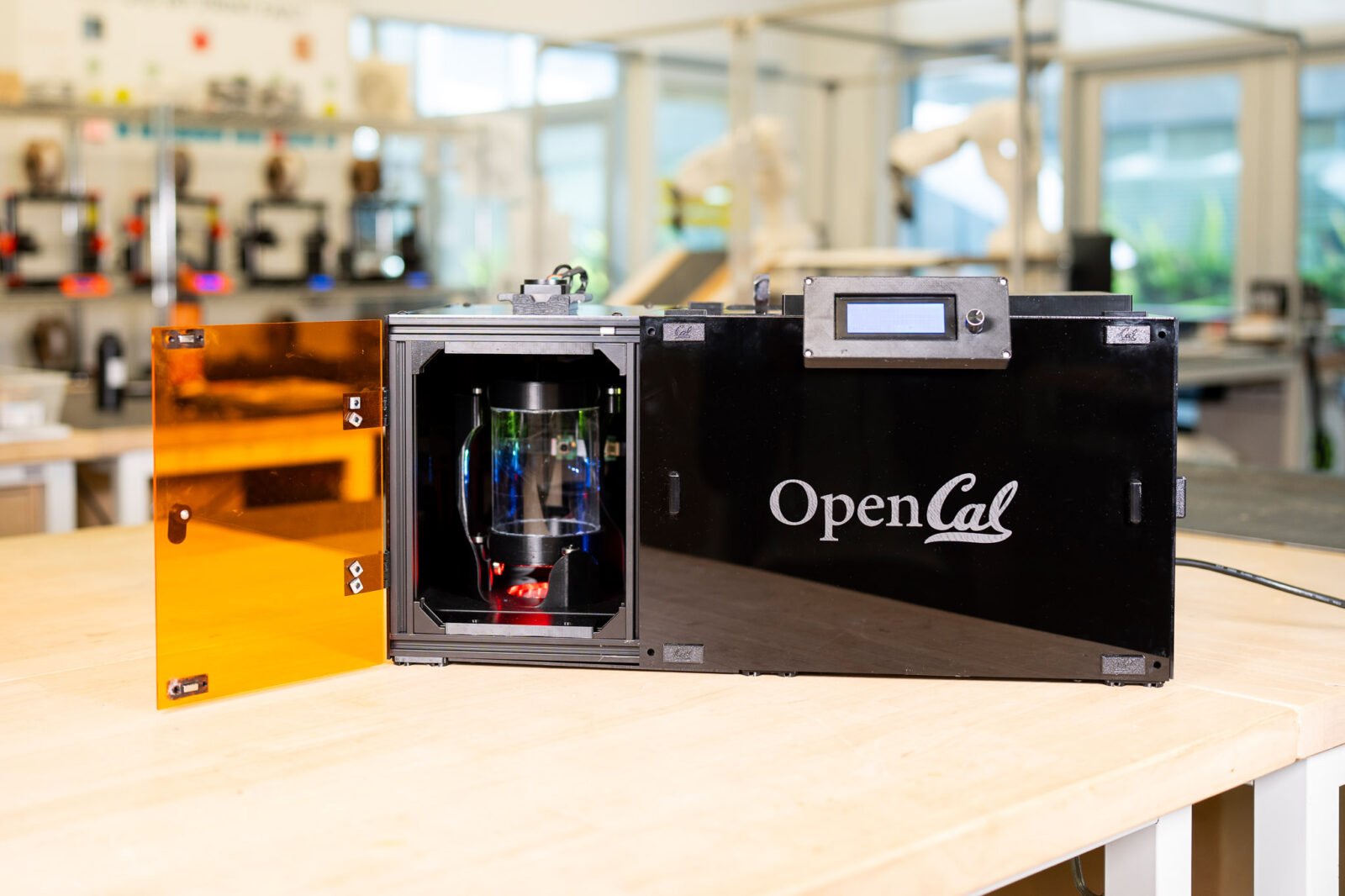

Revolutionizing Fabrication: The Dawn of Layerless 3D Printing with OpenCAL
For years, 3D printing has been synonymous with layers – slow, meticulous deposition, often requiring support structures that add to post-processing woes. But what if you could print an entire object, all at once, in mere minutes, without a single layer or support? Welcome to the world of Computed Axial Lithography (CAL), and its groundbreaking open-source iteration, OpenCAL.
First introduced by a pioneering team at UC Berkeley in 2019, CAL printing has been making waves in the additive manufacturing community. Now, thanks to the dedicated efforts of its creators, this revolutionary technology is no longer confined to the lab. OpenCAL brings the power of volumetric additive manufacturing (VAM) directly to your workshop, inviting makers worldwide to build, experiment, and contribute to the future of fabrication.
How OpenCAL Redefines 3D Printing
A CT Scan in Reverse: The Magic of Tomographic Reconstruction
At its heart, OpenCAL operates on a principle that might sound familiar to medical professionals: tomographic reconstruction. Imagine a CT scan, which uses X-rays to map internal structures and reconstruct a 3D image. CAL reverses this process. Instead of scanning an existing object, OpenCAL starts with a 3D digital model and computes a sequence of images. These images are then projected through a rotating vial of photosensitive resin.
The brilliance lies in the accumulation of light. Only where sufficient light dosage converges, dictated by the computed projections, does the resin solidify. The entire object forms simultaneously, in a single, seamless process. This ‘all-at-once’ method eliminates the need for layers, eradicates support structures, and dramatically accelerates print times – inch-scale objects can materialize in minutes, not hours.
VAMToolbox: The Brain Behind the Build
Driving this intricate process is VAMToolbox, the open-source software responsible for calculating the precise light dosage. It ensures that only the intended regions of the part receive enough photons to solidify, leaving the surrounding resin liquid. This sophisticated control is key to achieving high-fidelity, layerless prints.
Building Your Own OpenCAL Printer: A Maker’s Journey
OpenCAL is designed with the maker in mind, prioritizing accessibility and readily available components. While it represents a leap in technology, the construction process is surprisingly approachable, requiring a basic set of hand tools, a 3D printer for certain parts, and optionally a laser cutter.
The machine’s robust frame is constructed from pre-cut 2020 aluminum extrusion. Its optical system leverages a compact DLP laser projector and a Fresnel lens, while a Raspberry Pi 5 with a Pi Cam handles the electronics and control. The project encourages sourcing parts from common suppliers, and even allows for component substitutions, making it adaptable to a well-equipped makerspace or personal workshop.
Modular Design for Simplified Assembly
Following the paradigm of successful open-source machines, OpenCAL’s assembly is broken down into manageable subsystems: the frame, optics, and electronics. This modular approach simplifies the build, allowing users to tackle each section independently before integrating them into the final system. The design also serves as an educational tool, highlighting the critical subsystems and underlying technological principles.
It’s important to note that, like the early days of desktop 3D printing, OpenCAL is still an evolving platform. Achieving optimal results will demand attention to detail in areas like precise rotation, optical alignment, and projection generation. Early adopters should embrace the experimental nature, anticipating a learning curve and celebrating both successes and the insights gained from failed prints. The maker community’s collective ingenuity will be vital in refining OpenCAL from an experimental marvel into a ubiquitous fabrication tool.
Printing and Post-Processing: A New Workflow
Forget G-code; OpenCAL utilizes simple MP4 video files, uploaded to the Raspberry Pi, to drive the printing process. A user-friendly graphical interface (GUI) allows for easy selection of print files, adjustment of speeds, and control over other hardware parameters.
The VAMToolbox software, which generates these crucial projection videos, is also being streamlined into a more accessible GUI-based workflow. Users will import an STL model, voxelize it (convert to a volumetric representation), and then optimize the image sequence that forms the print video. This optimization phase is where much of the magic happens, and it’s an area where future software updates promise significant enhancements to print quality.
The OpenCAL project represents more than just a new printer; it’s an invitation to participate in the next frontier of additive manufacturing. By making this advanced technology open-source and accessible, the CAL team is empowering a new generation of innovators to push the boundaries of what’s possible in 3D printing.
For more details, visit our website.
Source: Link