
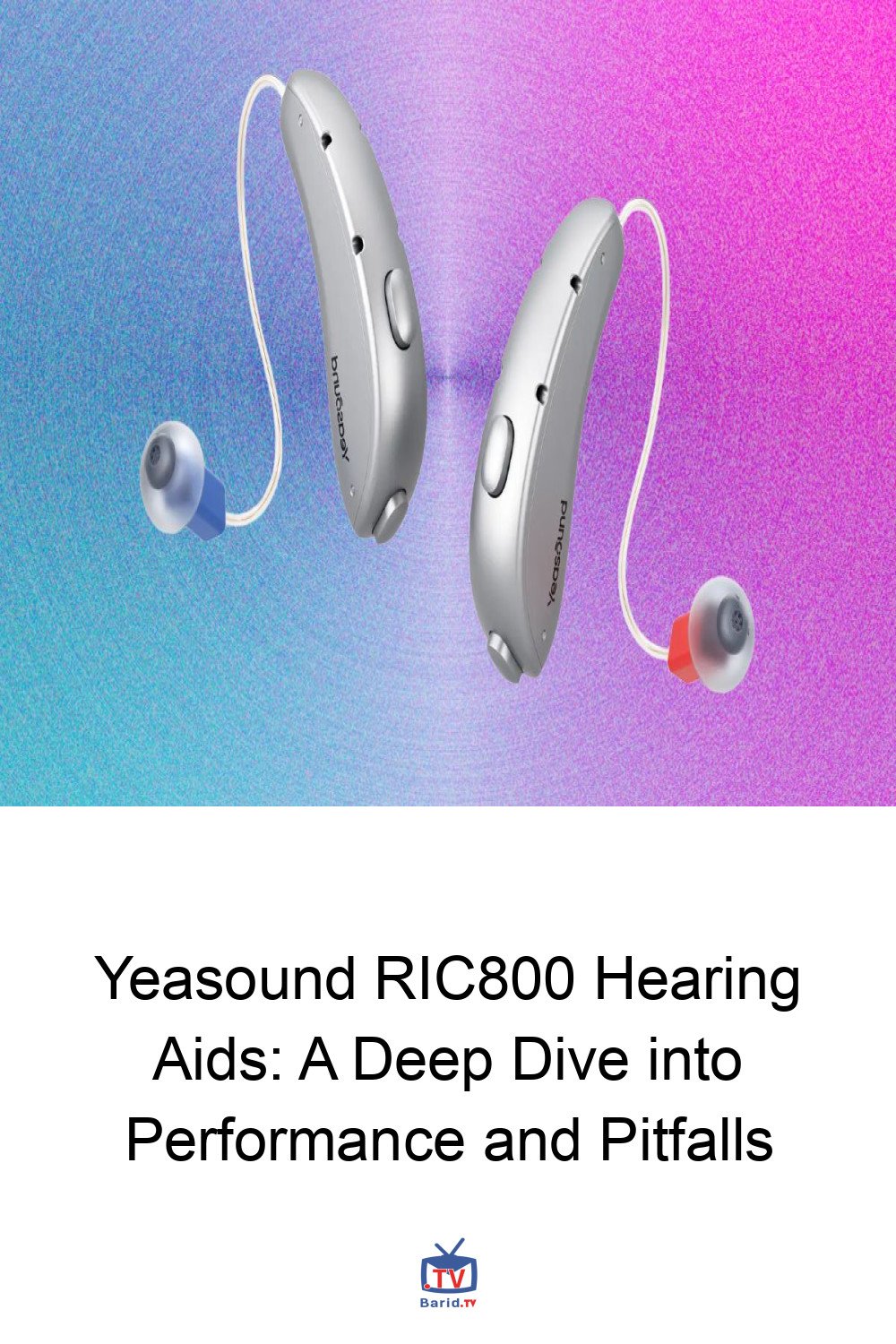
In an evolving market dominated by sleek, in-ear innovations, Yeasound, a new entrant backed by the 25-year legacy of Chinese telecom giant Yealink, is making a compelling case for the enduring relevance of traditional behind-the-ear (BTE) hearing aids. We put their higher-end RIC800 model to the test, exploring its promise of AI-powered noise reduction, automatic speech focusing, and broad compatibility, while also uncovering some notable challenges.
Design and Comfort: A Lightweight Contender
The Yeasound RIC800 units, aesthetically identical to their iOS-only RIC700 siblings, boast a remarkably light design, weighing just 2.76 grams each. This makes them only marginally heavier than premium BTE aids like the Jabra Enhance Select 700, contributing to excellent comfort even during prolonged wearing sessions. Physical controls are kept minimal: two buttons on each unit manage independent ear volume and facilitate phone call interactions via Bluetooth streaming.
The iYeasound App: Innovation Meets Frustration
Expedited Audiogram, Limited Flexibility
The iYeasound mobile app serves as the control hub, featuring a simplified home screen. Its integrated hearing test is a standout, delivering pings of various frequencies and volumes to each ear with impressive speed, completing the assessment in about five minutes—a significant improvement over lengthier market alternatives. While the results provided a reasonably aggressive baseline for an OTC device, a key limitation emerged: the inability to import existing audiograms or manually fine-tune the app’s test results without a complete re-test. This lack of granular control can be a hurdle for users seeking precise adjustments.
Environmental Modes and Customization
The app offers five environmental modes—Adaptive, General, Noisy, Music, and Outdoors—each largely self-explanatory. Volume controls are readily accessible, but more nuanced sound adjustments are tucked away in the ‘Sound Setting’ system. Here, users can roughly adjust low, mid, and high frequencies, select from three noise reduction levels, and choose microphone focus (all-around, forward-facing, or tighter focus). The Adaptive mode, leveraging the RIC800’s AI, simplifies control to just volume. However, I often found manual adjustments in General mode, particularly maximizing noise cancellation, yielded superior results, with less hiss and a more balanced sound profile, especially with closed ear tips. Yeasound thoughtfully includes a variety of ear tips for optimal fit.
Persistent Connectivity Glitches
Despite its innovative features, the iYeasound app proved to be the RIC800’s Achilles’ heel. Frequent and frustrating app/Bluetooth disconnects marred the user experience, requiring constant re-pairing and troubleshooting. This instability significantly impacted the seamless control and customization promised by the app.
Audio Performance: A Mixed Bag
The RIC800’s core function—audio assistance—was effective, though not without its imperfections. Mid-level frequencies often presented as somewhat muddy and muffled, a characteristic that extended, to a lesser degree, to lower-frequency tones. On the positive side, noise cancellation was surprisingly good, and the units could be pushed to very loud levels without introducing significant distortion.
Reliable Streaming, Disappointing Battery
Bluetooth streaming and phone calls performed admirably. Unlike many BTE hearing aids that deliver tinny music, the RIC800 boasts a surprisingly solid bass response, making music listening genuinely enjoyable. Auracast support is a welcome addition for future compatibility. However, battery life consistently fell short of Yeasound’s claims, necessitating more frequent recharging than anticipated.
The Verdict: Promising Tech, Imperfect Execution
The Yeasound RIC800 hearing aids represent a commendable effort in the traditional BTE market, offering better-than-expected hearing assistance and robust streaming capabilities at a competitive price. The swift in-app audiogram and comfortable design are definite strengths. Yet, the experience is significantly hampered by frequent app and Bluetooth disconnects, a lack of granular audiogram fine-tuning, some audio muffling in certain frequency ranges, and battery life that doesn’t quite live up to expectations. For users prioritizing strong core audio and streaming over a perfectly polished app experience, the RIC800 offers solid value, but potential buyers should be prepared for its software quirks.
For more details, visit our website.
Source: Link