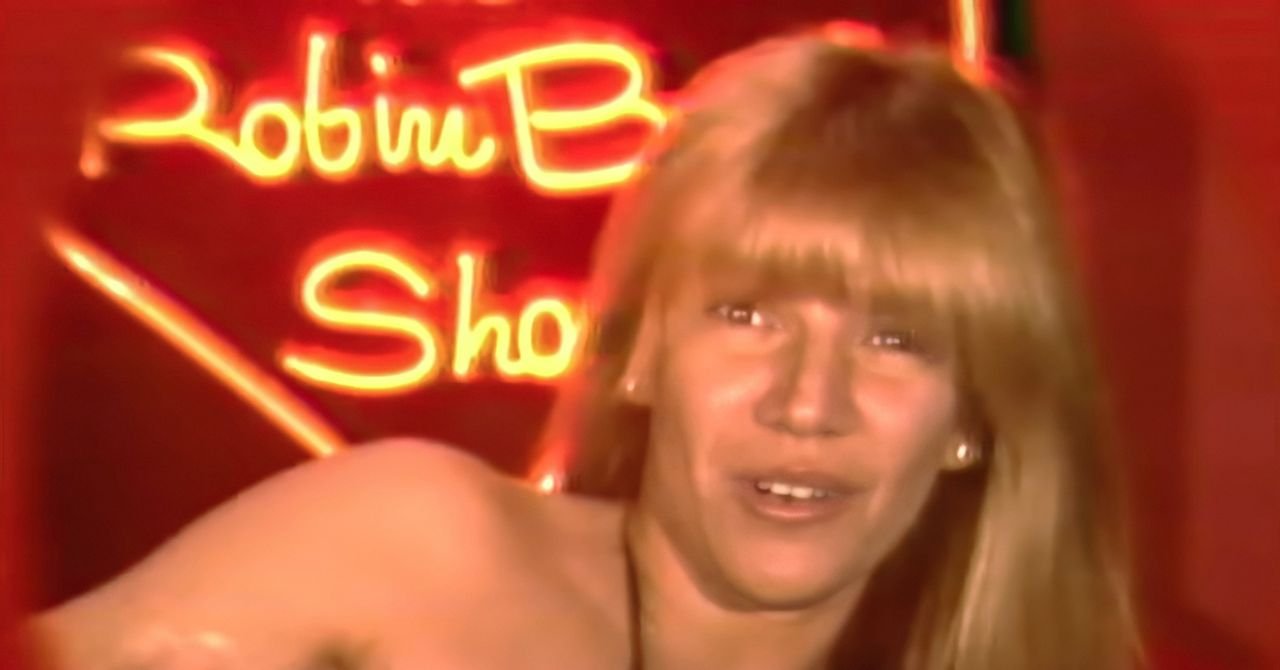

For anyone navigating the late-night airwaves of New York City in the 1980s and 90s, Channel 35 held a unique allure. There, after 10 pm, viewers would encounter a vision: Robin Byrd, a busty blonde in a black mesh bikini, gyrating with adult film stars or engaging in simulated acts with strippers. Her rockabilly theme song, “Baby, Let Me Bang Your Box,” and her memorable catchphrases like “Lie back, get comfortable” were etched into the city’s collective consciousness. Now, at 71, Robin Byrd, a former adult film star, is the subject of a new HBO documentary,
Bang My Box: The Robin Byrd Story, which reintroduces her as much more than a local celebrity – a sex-positive icon whose impact resonated far beyond public access television.
The Unfiltered Era of Public Access
From 1977 to 1998, The Robin Byrd Show was a cultural phenomenon, a charmingly low-budget spectacle featuring a garish heart-shaped set and vintage phone sex ads. Byrd would interview porn stars or exotic dancers, who would then perform stripteases, often accompanied by lingering close-up shots. The show would conclude with Byrd dancing to her theme song, frequently juggling comically oversized breasts. Her unique payment model for guests – tapes of the show rather than cash – was famously dubbed “tit for tat and dick for dat.” This raw, unpretentious approach made her a beloved figure, a pioneer of unfiltered entertainment.
More Than Just Entertainment: A Voice for the Marginalized
While often seen through a lens of adult entertainment, the HBO documentary, directed by self-described “Byrd-watchers” Jyllian Gunther and Stephanie Schwam, highlights Byrd’s profound social impact. She emerged as a fierce advocate for freedom of speech and the LGBTQ+ community, promoting safe sex during the devastating HIV/AIDS epidemic. Her landmark lawsuit against Time Warner Cable, when they attempted to censor her show, cemented her status as a champion against media control. Byrd’s influence was so pervasive that she became a meme long before the internet made such phenomena commonplace.
A Reluctant Icon’s Journey
Despite numerous prior offers, Byrd initially hesitated to greenlight a documentary. It was the genuine connection with Gunther and Schwam, who had grown up sneaking glances at her show, that convinced her. “They got it,” she explains, noting the timing during a Mercury retrograde – a period for renewal and rethinking. Byrd, who famously stated she was “raised by the TV” and then “became the TV,” embraces comparisons to figures like Mister Rogers, Ed Sullivan, and Johnny Carson, acknowledging her role as a comforting, if unconventional, presence in many homes.
Behind the Heart-Shaped Set: Unforgettable Moments
Over 600 episodes, Byrd hosted countless guests, but some moments stand out. She recalls an early episode featuring a trans person, whose identity was unknown to others in the studio, leading to an unexpected on-camera confrontation between the guest and a gay male actor. Byrd found herself mediating, observing the discrimination within the gay community mirroring that in the straight world. These moments underscored her show’s inadvertent role in exposing societal biases and fostering dialogue.
The Business of Byrd: From Phone Lines to National Recognition
Beyond the show, Byrd shrewdly managed her finances by owning the phone sex lines advertised on her program. While these lines still operate, providing “entertainment for people that are lonely,” their income has dwindled significantly with the shift from cable to streaming. Her cultural footprint extended to national recognition when Cheri Oteri famously parodied her on Saturday Night Live. Byrd loved the homage, feeling she had “arrived and went national,” even gifting Oteri her lip gloss, which Oteri suggested belonged in the Smithsonian.
The Internet’s Shadow: A Critique of Modern Pornography
The documentary also delves into the stark contrast between the analog era of adult entertainment and today’s digital landscape. While the original article’s discussion on this point is truncated, the title itself, “Robin Byrd, the Sex Godmother of Millennials, Says the Internet Ruined Porn,” strongly suggests her perspective. For Byrd, the internet’s ubiquity and instant access have fundamentally altered the industry, perhaps eroding the unique charm, personal connection, and even the sense of discovery that defined the public access era. The transition to digital, in her view, has led to a loss of something essential that made the analog experience distinct.
Robin Byrd’s story is a testament to authenticity, resilience, and the power of an individual to challenge norms. From her low-budget studio to the halls of HBO, she remains a captivating figure whose legacy as a sex-positive, free-speech advocate continues to resonate, reminding us of a time when television was truly public, and personalities were gloriously uncensored.
For more details, visit our website.
Source: Link