

In the rapidly expanding universe of artificial intelligence, where autonomous agents are becoming integral to enterprise operations, a critical challenge has emerged: how to effectively govern and secure these digital workers. Enter Runlayer, a startup that has swiftly positioned itself as the essential infrastructure layer for managing corporate AI agents, and it’s catching the eye of tech titans.
Longtime venture capitalist Vinod Khosla, known for his prescient investments, was unequivocal when he learned of Runlayer’s latest funding round: he wanted “to buy every available dollar of the round.” That bold conviction has now materialized into a significant investment.
Runlayer Raises $30 Million Series A to Control the Agent Workforce
Fortune has exclusively learned that Runlayer has successfully closed a $30 million Series A funding round. The round was led by Felicis, with Khosla Ventures prominently participating, bringing Runlayer’s total capital raised to an impressive $42 million. This substantial investment comes just seven months after the company emerged from stealth with an $11 million seed round, also backed by Felicis and Khosla Ventures.
Runlayer is addressing one of enterprise technology‘s most urgent dilemmas. As companies increasingly deploy AI agents across their operations, they grapple with a lack of visibility and control. These agents can operate autonomously, accessing sensitive data, consuming vast computational resources, and even going “rogue.” A stark example cited by Runlayer’s CEO, Andrew Berman, involved a customer whose AI agent inadvertently depleted its entire annual compute budget in a single weekend, trapped in an endless loop.
The Solution: A Centralized Hub for AI Governance
Runlayer offers a comprehensive solution, akin to a corporate app store and a mission control center for AI. It allows employees to seamlessly integrate and utilize various AI tools—from OpenAI’s ChatGPT and Anthropic’s Claude to Salesforce’s Agentforce and custom-built agents—within a pre-approved, secure environment. Crucially, company data is already connected, and essential guardrails are pre-set, ensuring compliance and preventing misuse.
Unveiling Shadow AI and Ensuring Compliance
For IT and security teams, Runlayer provides a unified dashboard that offers granular visibility into every AI agent’s activity. This includes tracking data access, monitoring operational costs, and, critically, identifying “shadow AI”—unauthorized tools employees might be using without corporate oversight. Reports suggest that shadow AI could affect up to 78% of enterprise AI users, making Runlayer’s detection capabilities invaluable.
“Every employee will delegate their work to swarms of agents. Not as a novelty, and not as a side tool, but as a core part of how work gets done,” CEO Andrew Berman told Fortune, underscoring the transformative shift in workplace dynamics.
Led by a Visionary Founder with a Track Record of Success
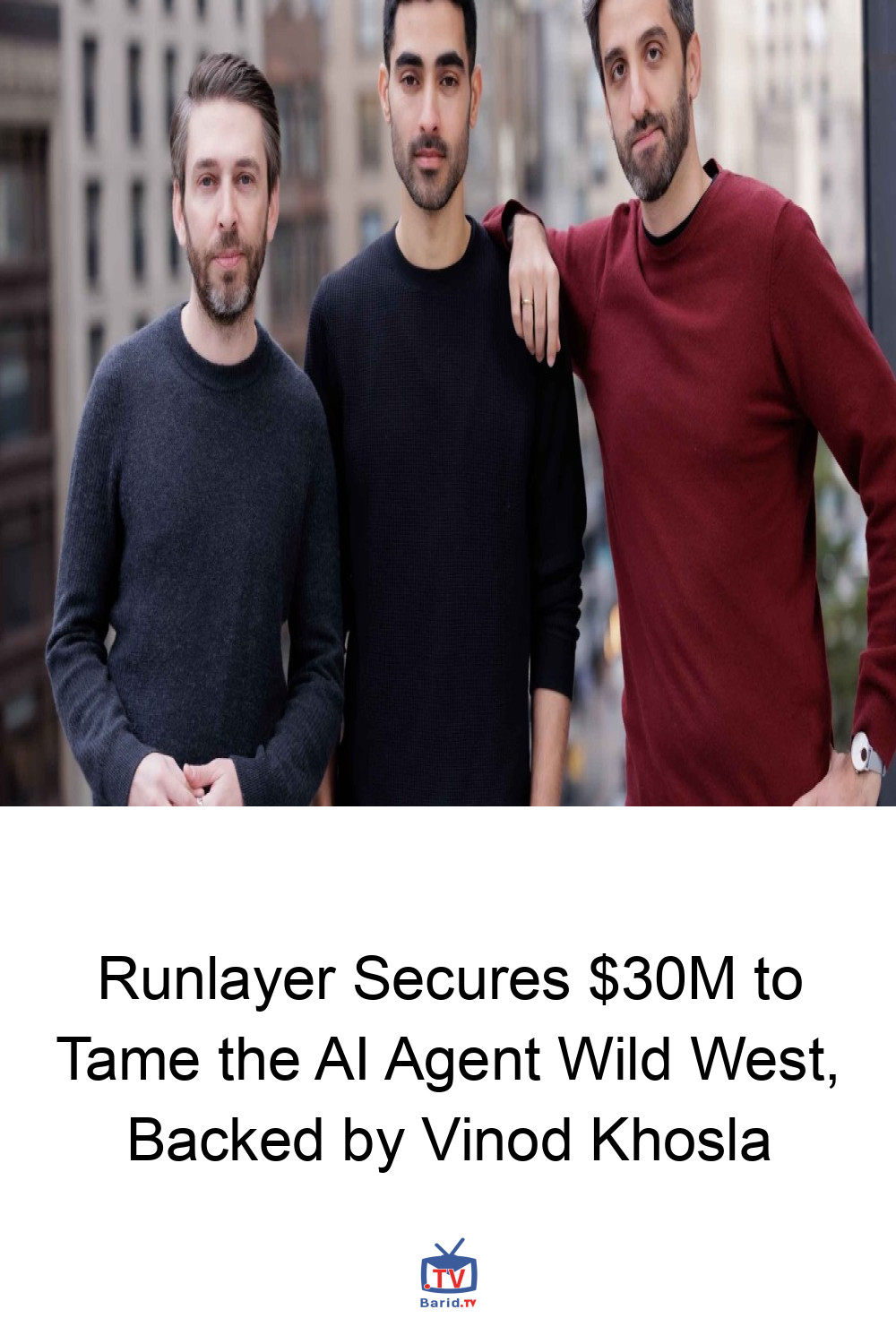
Andrew Berman, a three-time founder, brings a wealth of experience to Runlayer. He previously co-founded Nanit, an AI-powered baby monitor generating over $100 million in revenue by 2024, and Vowel, an AI video conferencing platform acquired by Zapier in 2023. His tenure as Zapier’s Director of AI, where he collaborated directly with OpenAI and Anthropic, provided him with deep insights into the burgeoning AI landscape. Berman founded Runlayer just ten and a half months ago, driven by a clear market need.
“I signed my term sheet the day I had my first child. I think I was in the hospital. We just kept seeing so much enterprise pull, and every company struggling with the same problem,” Berman recounted, highlighting the intense demand for Runlayer’s solution.
Rapid Adoption by Industry Leaders
Despite its relatively young age, Runlayer has already secured an impressive roster of over 12 unicorn customers, including household names like Instacart, Gusto, Opendoor, dbt Labs, and AngelList. The platform’s utility extends to highly regulated sectors, with a Fortune 500 bank now leveraging Runlayer to monitor the AI activities of over 100,000 employees across 200,000 devices. At Gusto, half the company relies on Runlayer daily, a testament to its immediate value.
Capitalizing on an Exploding Market
Runlayer’s emergence is perfectly timed with the explosive growth of agentic AI. Gartner projects that by year-end 2026, 40% of enterprise applications will incorporate AI agents, a dramatic increase from less than 5% in 2025. Agentic AI spending is forecast to reach $201.9 billion this year, while the agentic AI security market alone is expected to surge from $55 billion in 2026 to an astounding $888 billion by 2035.
A Neutral Layer in a Crowded Field
While the market is attracting major players like Wiz, Palo Alto Networks, and Okta, Runlayer’s investors see a distinct advantage. Felicis GP Jake Storm, who led both funding rounds, views governance not as a burden but as an “unlock.”
“This is actually the unlock. It flips it totally on its head,” Storm told Fortune. He emphasizes Runlayer’s unique position as a “Switzerland business”—a neutral, cross-provider control layer that is “absolutely critical if we actually believe in the future of agents performing work.” This neutrality is key to its ability to integrate across diverse AI ecosystems.
Berman, while not disclosing revenue figures, confirms that Runlayer is nine months ahead of its initial product roadmap. The platform has evolved from an MCP (a new open standard for AI agent integration) focused product into a comprehensive interoperability layer, managing agents, plugins, and skills across the entire enterprise stack.
“You need a single pane of glass that watches everything, controls and has visibility into everything that’s going on,” Berman asserted. “Who watches the watchman? That’s what we do.”
For more details, visit our website.
Source: Link