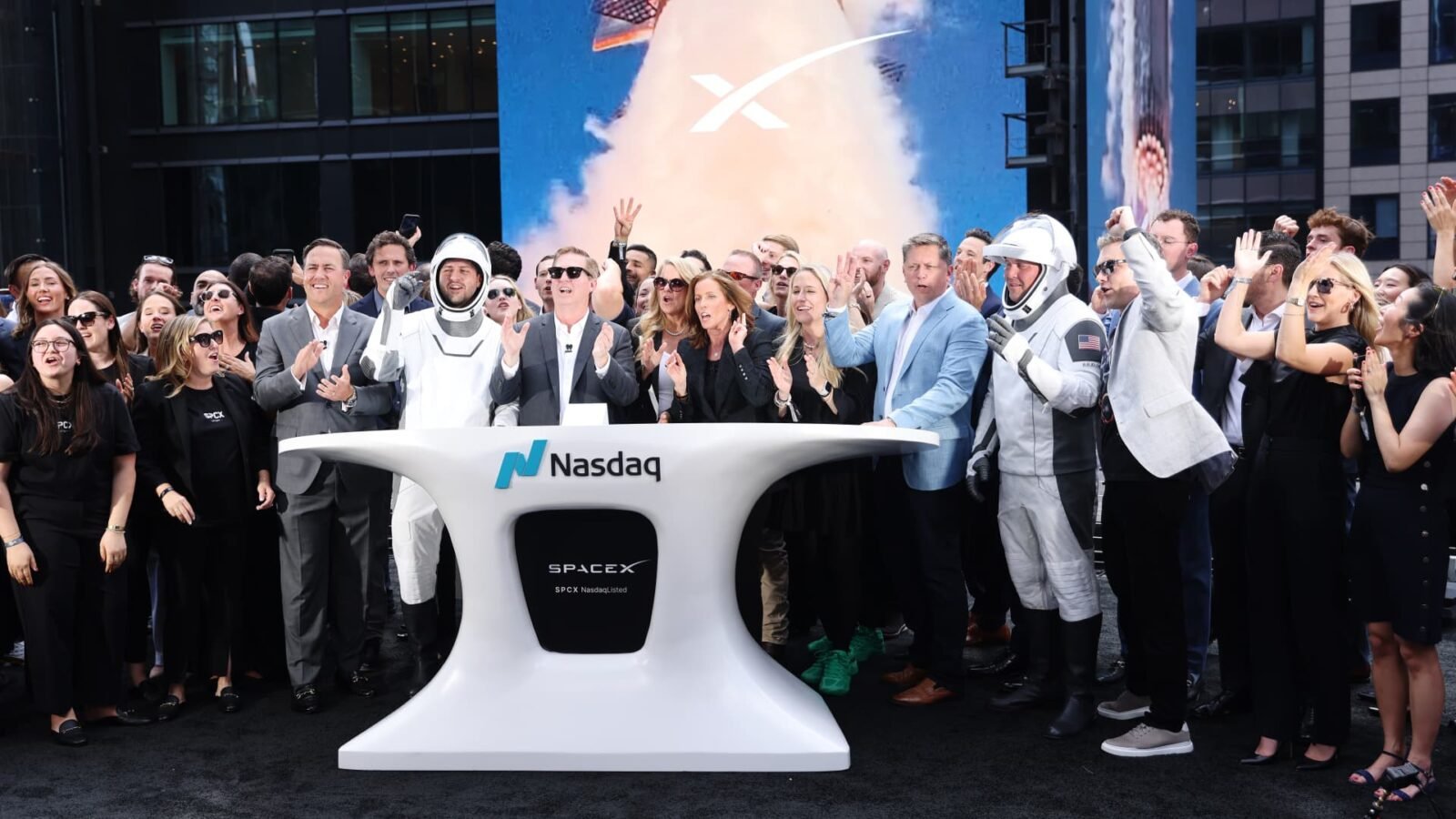

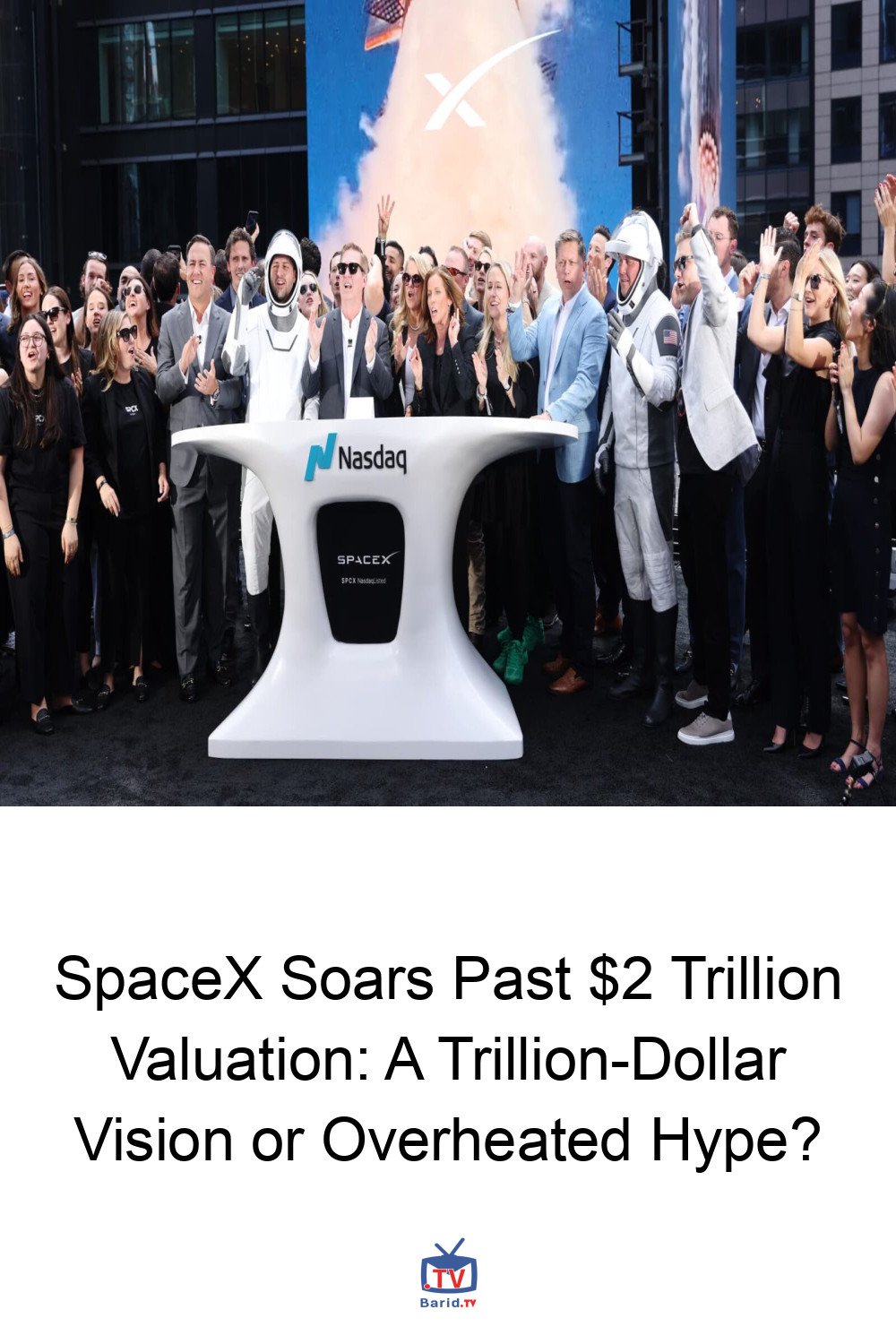
SpaceX’s Historic Market Debut
In a move that sent ripples across global financial markets, shares of Elon Musk’s SpaceX rocketed 20% on Monday, marking an electrifying first full day of trading after its record-shattering debut on Friday. The aerospace giant’s initial public offering (IPO) was the largest in history, raising an astounding $75 billion and catapulting its market capitalization beyond the $2 trillion mark.
A Blazing Start on Nasdaq
Following its pricing at $135 per share, SpaceX stock closed at approximately $161 on its debut day, with trading volume exceeding 500 million shares – a figure rivaling Facebook’s monumental 2012 launch. Monday saw an additional surge of about $31, closing at $192.50, as 244 million shares changed hands, signaling intense investor interest and confidence.
Elon Musk’s Audacious Trillion-Dollar Forecast
Fueling the excitement, CEO Elon Musk took to X (formerly Twitter) on Sunday to project an ambitious future for SpaceX. He stated the company “might be able to reach approximately” $1 trillion in revenue by 2030, further adding, “And I would be surprised if revenue is not greater than $1T in 2031.” This vision stands in stark contrast to the $18.7 billion in revenue reported by SpaceX in 2025.
Beyond Rockets: Starlink, xAI, and Orbital Data Centers
SpaceX’s expansive portfolio includes the ubiquitous Starlink satellite internet service and a formidable fleet of reusable rockets. In a strategic move earlier this year, Musk merged SpaceX with his artificial intelligence startup, xAI, signaling a broader technological ambition. However, the company also reported a nearly $5 billion loss in 2025, prompting a fervent debate among financial experts regarding the justification of its colossal valuation.
The Great Valuation Debate: Bull vs. Bear
The unprecedented IPO and subsequent stock performance have ignited a fierce discussion among analysts, with opinions sharply divided on SpaceX’s long-term prospects and current valuation.
Skeptics Point to Capital Intensity and “Poetry”
CFRA initiated coverage with a “sell” rating and a 12-month price target of $115, a nearly 29% drop from Friday’s close. Their rationale cited SpaceX’s “extremely ambitious growth strategy, elevated valuation expectations, and significant capital intensity.” Indeed, capital expenditures for the three months ending March surged to $10.1 billion, with the majority directed towards artificial intelligence. Morningstar analyst Nicolas Owens echoed concerns, valuing the stock at $63 per share and deeming it “overvalued.”
Paulina Roszkowska, a finance lecturer at Bayes Business School, articulated the skepticism succinctly on CNBC’s “Europe Early Edition.” She argued that while SpaceX has made “a lot of promises,” these must eventually translate into tangible cash flow. “If you are asking for 70, 80 billion contribution, I think that you owe investors a little bit more than poetry,” Roszkowska stated, highlighting the IPO prospectus’s perceived lack of detail on governance and execution risks.
Bullish Outlook: A Long-Term Equity Story
Conversely, some analysts remain staunchly bullish. NewStreet Research initiated coverage with a $165 price target, with partner and senior analyst James Ratzer suggesting that SpaceX represents a “much longer-dated equity story than most.” He posited that a 20 to 25-year time frame is necessary to justify the current valuation, asserting that many foundational elements for success are already in place.
Ratzer emphasized SpaceX’s “at least a 10-year lead” in rocket launch capabilities, particularly with the development of Starship, its latest-generation launch vehicle. He highlighted the critical role of launch success for ventures like Starlink, direct-to-cell communication, and the ambitious plans for “orbital data centers” for AI. Ratzer predicted Musk’s company would retain 90 to 95% of all space launch capacity over the next four to five years, underscoring its unparalleled competitive advantage.
The Road Ahead for the Space Giant
As SpaceX navigates its new life as a publicly traded entity, the market will closely watch how it balances audacious promises with concrete financial performance. The journey to a trillion-dollar revenue, fueled by innovation in space travel, satellite internet, and artificial intelligence, promises to be one of the most compelling narratives in modern finance and technology.
For more details, visit our website.
Source: Link