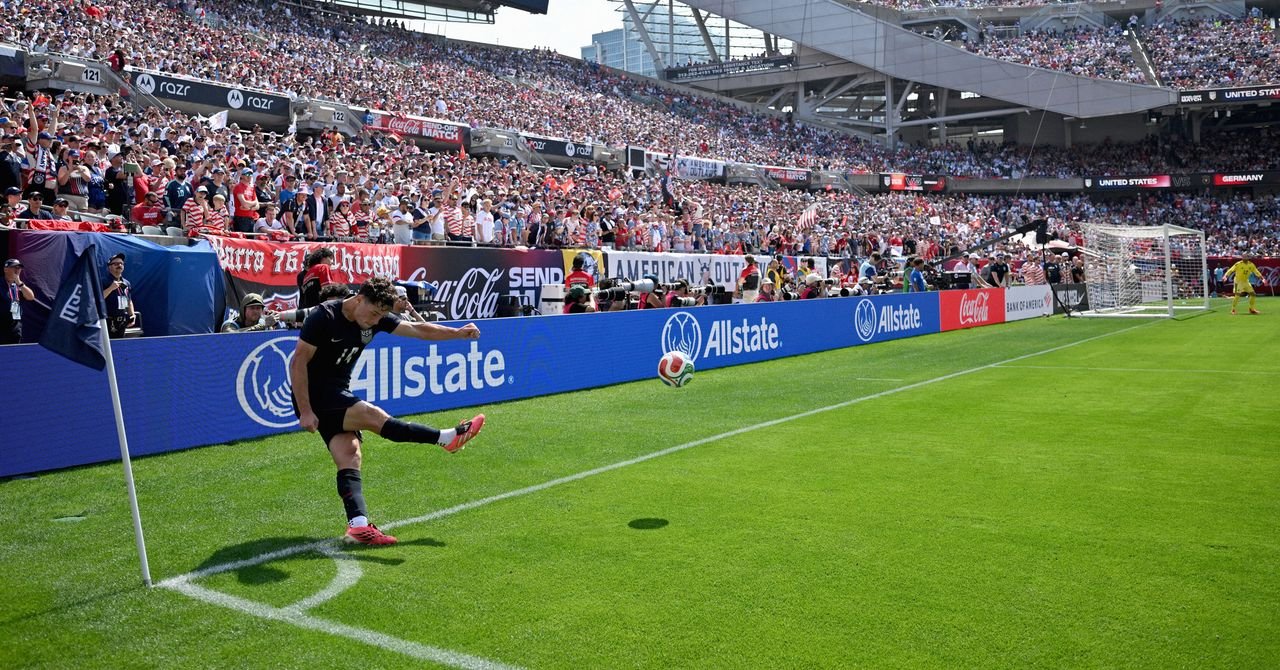

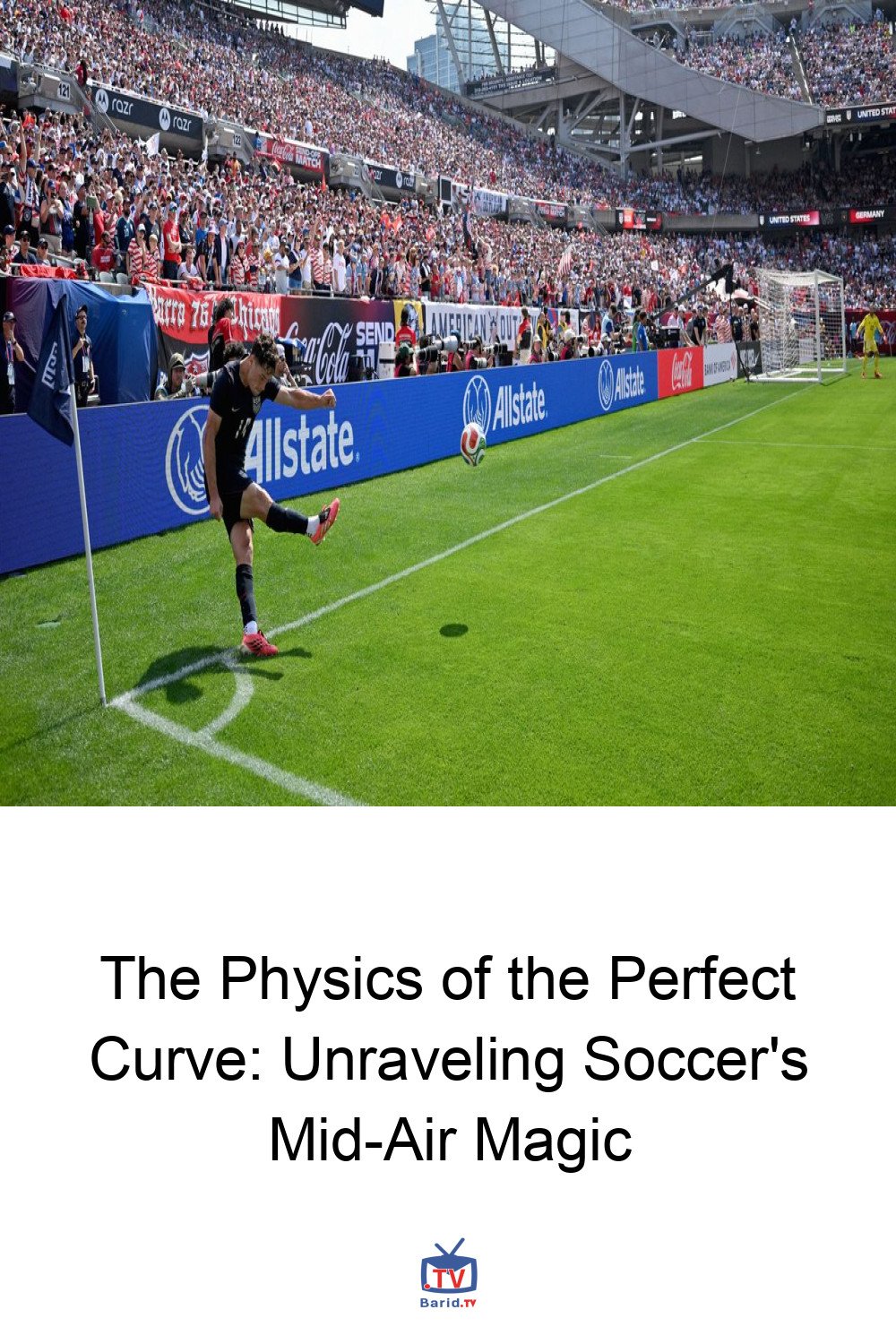
When the world’s greatest footballers step onto the pitch for World Cup 2026, prepare for moments of pure brilliance: a ball that seemingly defies logic, curving majestically around a defender or swerving past a bewildered goalkeeper. This isn’t mere chance or illusion; it’s a masterful blend of athletic prowess and fundamental physics. But how do these athletes achieve such ‘wizardry,’ altering a ball’s trajectory long after it leaves their foot? The answer lies not in magic, but in the intricate dance of fluid dynamics—the study of how objects behave within a fluid, and yes, air is very much a fluid.
Beyond the Boot: The Science of Ball Trajectory
To truly appreciate the complexity of a bending shot, let’s strip away the elements of our world, then reintroduce them one by one, much like a physicist dissecting a problem.
Kicking It in the Void: Newton’s First Law
Imagine a game of soccer played in the vacuum of space, far from gravity and atmosphere. A player in a spacesuit delivers a powerful kick. For a fleeting hundredth of a second, the foot exerts a significant force, compressing and then launching the ball at speeds up to 80 miles per hour. Crucially, once contact is lost, no other forces act upon the ball. According to Newton’s First Law of Motion, this means the ball would continue indefinitely in a straight line at a constant speed. While fascinating, it’s hardly practical for a game.
Earthbound, Airless: Gravity’s Embrace
Now, let’s bring our game back to Earth, but still without an atmosphere. Here, a new, persistent force enters the equation: gravity. The planet’s gravitational pull exerts a continuous downward force (Fg = m × g, where ‘m’ is the ball’s mass and ‘g’ is Earth’s gravitational field). Unlike the initial kick, gravity acts on the ball throughout its flight, constantly altering its vertical motion. This continuous change in velocity is known as acceleration.
Newton’s Second Law (Fnet = m × a, or a = Fnet/m) reveals something remarkable when combined with gravity: the acceleration due to gravity (9.8 m/s²) is constant for all objects, regardless of their mass. This is why a bowling ball and a marble dropped simultaneously will hit the ground at the same instant.
In this airless, gravity-bound scenario, a kicked ball would follow a predictable, upside-down parabolic path. Its vertical velocity would slow, halt, and then reverse, accelerating downwards from the moment it leaves the foot. Its horizontal motion, however, would remain constant, as there’s no horizontal force to impede it. This familiar arc is known as a ballistic trajectory, common to any unpowered projectile where gravity is the sole significant force.
The Game Changer: Air Resistance
Thankfully, Earth has an atmosphere, but it dramatically complicates the ball’s journey. Air introduces a continuous horizontal force known as air resistance, or drag, which always opposes the ball’s direction of motion. Picture air molecules as countless tiny ping-pong balls. As a soccer ball slices through the air, it collides with billions of these molecules, each collision exerting a minuscule backward push. Collectively, these create the total air-resistance force.
The impact of drag is significant. A larger object experiences more collisions, as does a faster-moving one. While a gentle sideline throw might barely notice air resistance, a powerful shot on goal cannot ignore it. In fact, doubling the ball’s speed quadruples the air resistance, dramatically shortening its flight path and reducing its velocity. Without air resistance, a goalie could indeed kick a ball the entire length of the field and beyond the stands.
The Secret Sauce: How Spin Bends the Ball – The Magnus Effect
Here’s where the true magic of the bending shot comes into play. Air resistance alone slows the ball, but it doesn’t explain the curve. For that, we need to consider spin. When a player strikes the ball off-center, they impart rotation. This rotation, combined with the ball’s forward motion through the air, creates what is known as the Magnus Effect.
Imagine a spinning ball moving through the air. On one side of the ball, the spin is in the same direction as the airflow, causing the air to speed up. On the opposite side, the spin is against the airflow, causing the air to slow down. According to Bernoulli’s Principle, faster-moving air exerts less pressure, while slower-moving air exerts more pressure.
This pressure differential creates a net force perpendicular to the direction of the ball’s motion and its axis of spin. If the ball has topspin, it dips; if it has backspin, it rises (though less common in soccer). Crucially, if it has sidespin, the ball will curve left or right, ‘bending’ around obstacles or away from the goalkeeper’s reach. The more spin, the greater the pressure difference, and the more pronounced the curve.
The Art and Science of the Beautiful Game
So, the next time you witness a soccer ball gracefully arc into the net, remember it’s not just the player’s skill, but a fascinating interplay of forces: the initial powerful kick, the relentless pull of gravity, the ever-present drag of air resistance, and most importantly, the subtle yet powerful Magnus effect generated by spin. It’s a testament to the beautiful game’s blend of human artistry and the elegant laws of physics.
For more details, visit our website.
Source: Link