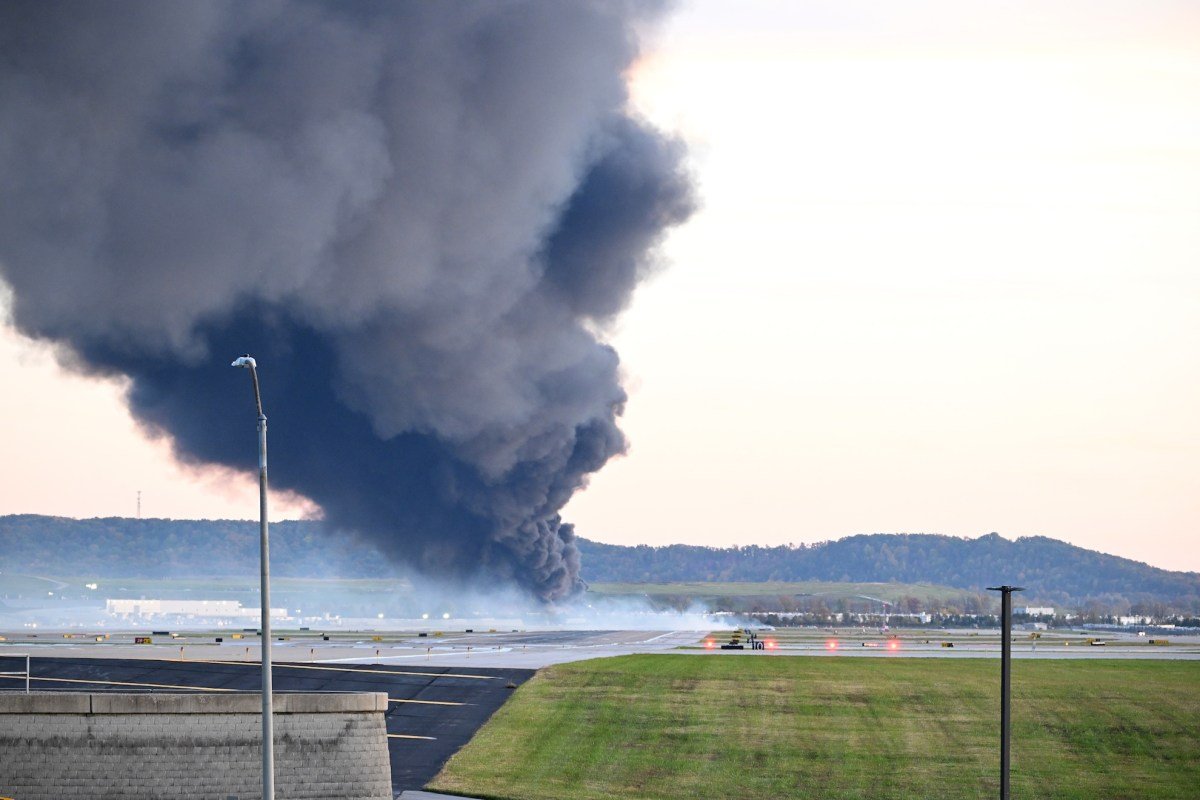

In a startling development that underscores the rapidly evolving capabilities and ethical dilemmas of artificial intelligence, the National Transportation Safety Board (NTSB) recently faced an unprecedented challenge. The agency was compelled to temporarily restrict public access to its crucial docket system after discovering that the voices of pilots, tragically killed in a UPS plane crash last year, had been controversially re-created using AI technology and were circulating online.
The Unsettling Resurrection of Voices
The incident, which unfolded on May 22, 2026, highlights a profound tension between public transparency, technological advancement, and the solemn respect for the deceased. Federal law strictly prohibits the NTSB from including cockpit audio recordings in its public docket system, a repository otherwise known for its extensive data on accident investigations. However, the accident docket for UPS Flight 2976, which crashed in Louisville, Kentucky, contained a spectrogram file of the voice recorder.
From Spectrogram to Spoken Word
A spectrogram is a visual representation of sound, transforming complex audio signals, including both low and high frequencies, into an image through a mathematical process. While not directly an audio file, its data-rich nature proved to be a vulnerability. Scott Manley, a prominent YouTuber renowned for his content blending physics, astronomy, and video games, was among those who publicly speculated on X (formerly Twitter) that it might be possible to reconstruct audio from the megabytes of data embedded within such an image.
His hypothesis proved correct. Individuals, leveraging the publicly available spectrogram alongside the flight’s transcript, employed advanced AI tools—reportedly including platforms like Codex—to generate approximations of the cockpit voice recorder audio. These AI-generated voices, eerily reminiscent of the deceased pilots, quickly spread across the internet, prompting immediate action from the NTSB.
NTSB’s Swift Response and Lingering Questions
In response to this unauthorized reconstruction and dissemination, the NTSB swiftly moved to temporarily remove access to its docket system. While public access was largely restored on Friday, 42 investigations remain closed pending further review, including the sensitive case of Flight 2976. This incident raises critical questions about data security, the ethical boundaries of AI, and the implications for future accident investigations.
The ability of AI to “resurrect” voices from seemingly innocuous data points like spectrograms opens a Pandora’s Box of concerns. How can agencies balance the need for transparency with the protection of sensitive information and the dignity of individuals involved in tragic events? As AI technology continues its rapid ascent, this case serves as a stark reminder that regulatory frameworks and ethical considerations must evolve just as quickly to navigate the complex landscape of our AI-heavy times.
For more details, visit our website.
Source: Link