
Linux’s Nine-Year Secret: Critical Kernel Flaw Unveiled, Granting Root Access
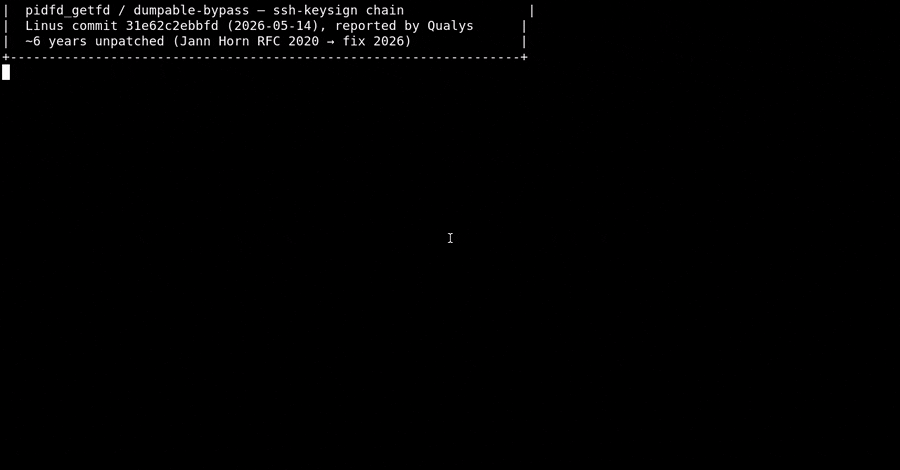
In a startling revelation, cybersecurity researchers have brought to light a significant vulnerability within the Linux kernel that lay dormant and undetected for an astonishing nine years. This flaw, officially tracked as CVE-2026-46333 and codenamed ‘ssh-keysign-pwn’, represents a severe lapse in privilege management, potentially allowing unprivileged local users to gain root access and compromise sensitive data on widely used distributions like Debian, Fedora, and Ubuntu.
The Anatomy of a Long-Hidden Threat
Discovered by security firm Qualys, the vulnerability’s roots trace back to November 2016, residing within the kernel’s __ptrace_may_access() function. This critical function, intended to manage process access, inadvertently created a pathway for malicious actors. Saeed Abbasi, senior manager of Qualys’s Threat Research Unit, emphasized the severity: “The primitive is reliable and turns any local shell into a path to root or to sensitive credential material.”
Successful exploitation of CVE-2026-46333 grants a local attacker the ability to:
- Disclose highly sensitive files such as
/etc/shadow(containing hashed passwords). - Expose host private keys located under
/etc/ssh/*_key, critical for secure shell communications. - Execute arbitrary commands with root privileges through various exploit vectors targeting system utilities like
chage,ssh-keysign,pkexec, andaccounts-daemon.
Urgent Action Required: Patching and Mitigation
The disclosure of this vulnerability comes on the heels of a public kernel commit and the recent release of a proof-of-concept (PoC) exploit, underscoring the immediate threat. This flaw joins a growing list of recently uncovered Linux kernel vulnerabilities, including “Copy Fail,” “Dirty Frag,” and “Fragnesia,” highlighting a critical period for Linux system security.
System administrators and users are strongly advised to apply the latest kernel updates released by their respective Linux distributions without delay. For situations where immediate patching is not feasible, a temporary workaround involves elevating the "kernel.yama.ptrace_scope" setting to 2. This adjustment can help restrict the scope of ptrace operations, thereby mitigating the vulnerability.
Qualys further cautions that “On hosts that have allowed untrusted local users during the exposure window, treat SSH host keys and locally cached credentials as potentially disclosed.” They recommend immediate rotation of SSH host keys and a thorough review of any administrative material that may have resided in the memory of set-uid processes.
Another Threat on the Horizon: PinTheft
Adding to the recent wave of Linux security concerns, the disclosure of CVE-2026-46333 follows closely on the heels of “PinTheft,” another local privilege escalation flaw. PinTheft specifically targets Arch Linux systems, enabling local attackers to achieve root privileges.
This exploit, detailed by Zellic and the V12 security team, leverages an RDS (Reliable Datagram Sockets) zerocopy double-free vulnerability. It requires the RDS module to be loaded,
io_uring to be enabled, a readable SUID-root binary, and x86_64 support for its payload. The bug’s mechanism involves the rds_message_zcopy_from_user() function, where a double-free condition can be manipulated into a page-cache overwrite via io_uring fixed buffers, effectively stealing references from pinned user pages.
These recent findings serve as a stark reminder of the ongoing need for vigilance and prompt action in maintaining the security posture of Linux systems worldwide.
For more details, visit our website.
Source: Link